


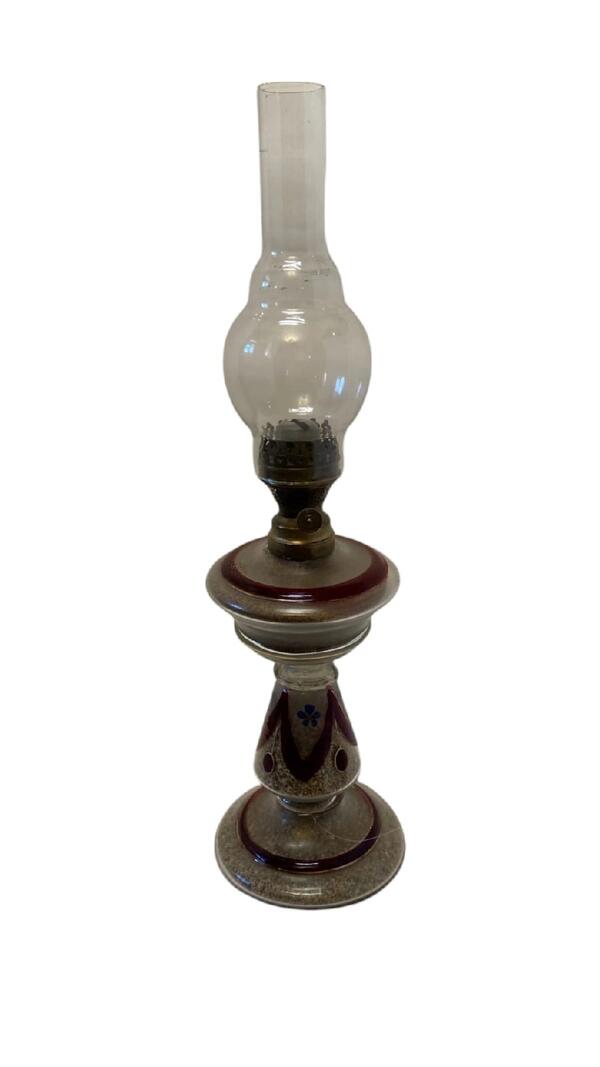
The kerosene lamp from the museum’s collection was produced in one of the oldest centers of metallurgy in Germany, in the city of Ruhla in Thuringia, at the Thiel Brothers Factory.
Gebrüder Thiel was founded by Christian and Georg Thiel around 1862. The brothers had worked for their father Sigmund at his small pipe fittings factory that produced threaded inserts, couplings, spoke nipples, and plumbing fittings. They continued their father’s work and even expanded the range of manufactured hardware. They targeted the mass market, and therefore the company mainly produced consumer goods: spare parts for cheap pocket watches, weights for wall clocks, furniture fittings and, of course, oil, gas and kerosene lamps. Since 1869, the company was even making heel protectors and toe caps for children’s shoes, an important product since shoes were still expensive and handmade. Over time, things went uphill, and the company had expanded to 80 employees.
In 1873, new production was opened on the site of the old felt factory. In 1875, the company established its own power source by building a water mill. The mill worked until 1924. In the 1870s, the company focused on the production of children’s music boxes. They were sold galore both in Germany and abroad. At that time, the company had about 200 employees. However, the company gained the main popularity thanks to the watches of its own production.
Gebrüder Thiel was the first German company to produce comfortable and cheap pocket watches. The watches were inexpensive (the retail price was about three marks) and proved to be a very successful business both in Germany and abroad. Thanks to modern machines and fundamentally new technologies, the company easily coped with growing demand. Before the Thiel Brothers, watches were made by hand, so they were an expensive device that most of the population was unable to afford. To improve production, another company had to be founded. It produced metalworking machine tools, and the company became a leader in Germany in the field of machine tool building. These innovations led the Thiel Brothers to break world records in terms of watch production.
Gebrüder Thiel was founded by Christian and Georg Thiel around 1862. The brothers had worked for their father Sigmund at his small pipe fittings factory that produced threaded inserts, couplings, spoke nipples, and plumbing fittings. They continued their father’s work and even expanded the range of manufactured hardware. They targeted the mass market, and therefore the company mainly produced consumer goods: spare parts for cheap pocket watches, weights for wall clocks, furniture fittings and, of course, oil, gas and kerosene lamps. Since 1869, the company was even making heel protectors and toe caps for children’s shoes, an important product since shoes were still expensive and handmade. Over time, things went uphill, and the company had expanded to 80 employees.
In 1873, new production was opened on the site of the old felt factory. In 1875, the company established its own power source by building a water mill. The mill worked until 1924. In the 1870s, the company focused on the production of children’s music boxes. They were sold galore both in Germany and abroad. At that time, the company had about 200 employees. However, the company gained the main popularity thanks to the watches of its own production.
Gebrüder Thiel was the first German company to produce comfortable and cheap pocket watches. The watches were inexpensive (the retail price was about three marks) and proved to be a very successful business both in Germany and abroad. Thanks to modern machines and fundamentally new technologies, the company easily coped with growing demand. Before the Thiel Brothers, watches were made by hand, so they were an expensive device that most of the population was unable to afford. To improve production, another company had to be founded. It produced metalworking machine tools, and the company became a leader in Germany in the field of machine tool building. These innovations led the Thiel Brothers to break world records in terms of watch production.


