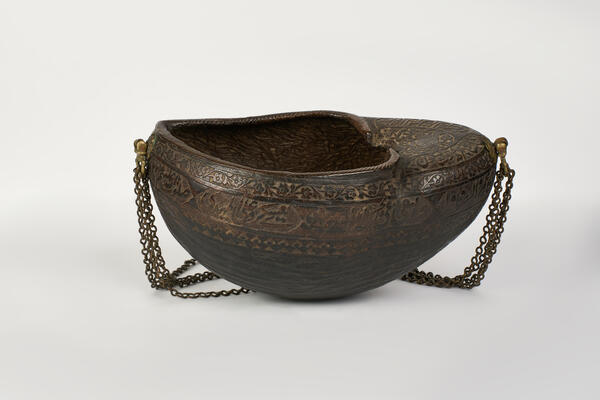
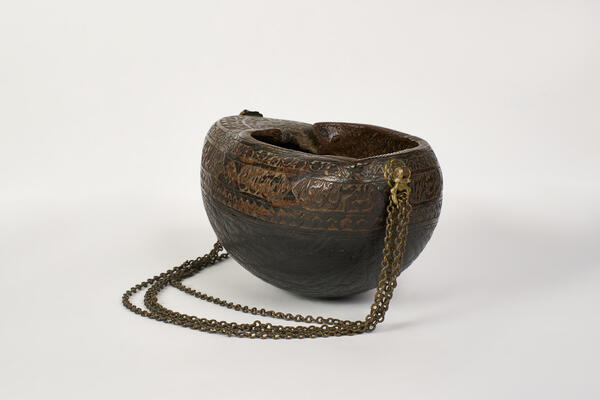
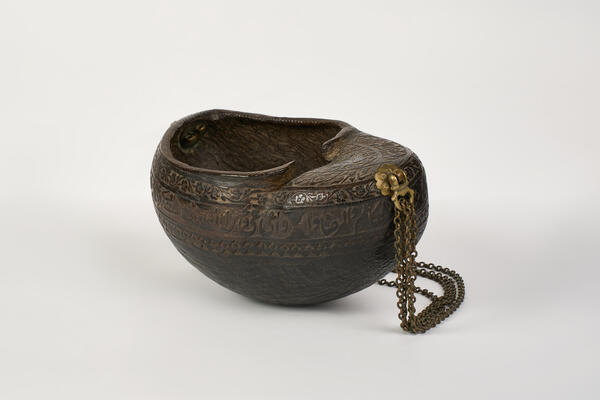
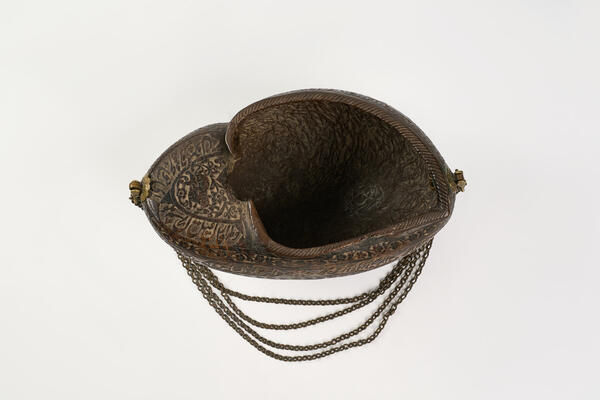
A kashkul is a vessel of a specific shape. It was used by wandering dervishes (members of Muslim Sufi brotherhoods) for drinking and collecting food and alms. The vessel is made from half of the world’s largest nut, known as the sea coconut (double coconut). The Farsi word “kashkul” (also “keshkul”) denotes “a large bowl for collecting alms, hollowed out of a coconut or made of wood.”
Though today the sea coconut grows on the coast of the Indian Ocean (Myanmar, Malaysia, Indonesia, Sri Lanka), originally it could only be found in one place — five closely located small islands in the Seychelles in the western Indian Ocean. Although the Seychelles are closer to Africa than to South Asia, the main currents of the Indian Ocean flow from west to east, and therefore nuts that fell into the water were carried by currents to the coast of South and Southeast Asia, where they were traditionally considered very valuable finds due to their bipartite shape and mysterious origin.
In the past, due to mysterious appearances of these strange nuts brought by the sea, they became objects of various superstitions. It was believed that the shell of this coconut had healing properties and protected against any poison. On the island of Java, for example, people thought that drinking water or other liquids infused in vessels made from half a coconut would neutralize any poisonous effects.
Kashkul vessels gained popularity in Persia. There were many tales about their mythical and magical qualities, as well as healing powers. These legends became an integral part of Iranian folklore, despite their Indian origin. Over time, kashkul bowls became associated with dervishes. They served as a symbol of dedication to the path of spiritual poverty and the renunciation of worldly possessions. If a disciple failed to fulfill his obligations, his teacher could revoke the right to carry his kashkul as punishment.
When the Safavids came to power in Iran, dervishes of the Khaksar movement, who were supported by Indian Sufis and with whom they had united, came to defend the new rulers. From that time on, common folk associated the Khaksars with Sufi symbols.