Font
Color
Graphics
Изображение точки

To see AR mode in action:

1. Install ARTEFACT app for iOS or Android;

2. Find the exhibition «Gelendzhik: Past and Present»

3. Push the «Augmented reality» button and point your phone's camera at the exhibit;

Скрыть точки интересаПоказать точки интереса
Показать в высоком качестве
#1
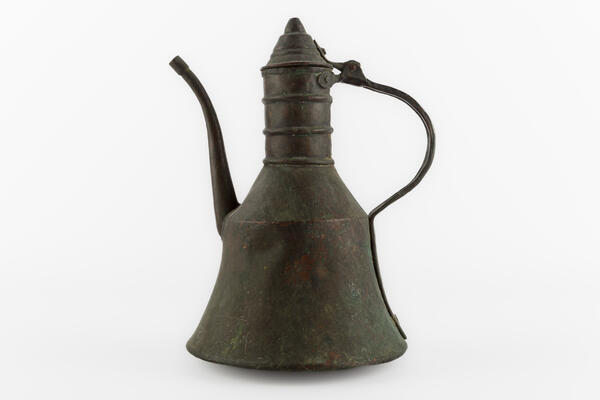
Turkish jug
#2
The museum displays a kumgan — a jug for water, used for washing the face and hands and for personal hygiene in accordance with the Islamic tradition. It is made of copper.

Copper dishes became common on the territory of Adygea at the turn of the 20th century, after the end of the Caucasian War. Traditionally, the Circassians used ceramics, but copper utensils proved much lighter, handier and more reliable at home and therefore soon became popular with the local people. Most copperware was made on the territory of modern Dagestan, where this craft was quite widespread. Copper products included weapon frames and various household utensils — cauldrons, dishes, basins, water vessels, pails, and mugs.

Copper tableware was in great demand, but the manufacturing process was quite expensive and laborious, so the abundance of such utensils in the house eventually became a sign of prosperity and wealth. To make dishes from copper, coppersmiths most often used the technique of stamping an item and its parts from a copper sheet, while cast dishes were rare. Initially, the elements (handles, lids) were attached to the main product with rivets. Later, the artisans used the techniques of soldering copper with brass, silver, and tin. To avoid the harmful effects of copper and to ensure a more hygienic use of water containers, artisans applied a wax-based mastic to the inner surface of the vessel. Later, they started using a tinning technique: from the inside, the surface of the dishes was covered with a thin layer of tin. Tinning protected the metal from external influences and adverse processes, in particular from corrosion. Often, the outer surface of the vessels was also tinned, and a pattern was engraved or chased.

With the increasing popularity of copper utensils, the services of itinerant coppersmiths were in great demand. The artisans traveled along the roads of the North and South Caucasus with all the necessary equipment: a hammer, a small anvil, tools for chasing, engraving, and repairing dishes.

This copper kumgan has a narrow neck and a soldered spout, a handle and a hinged lid attached to the vessel with copper rivets. It entered the museum’s collection in May 1949. The capacity of this jug is about two liters.
#3
Наименование: Turkish jug
Дата создания: the second half of the 19th century
Техника: copper, forging, tinning
Место создания: Turkey
Размеры: 26×17 cm
#4
Circassian jug
#5
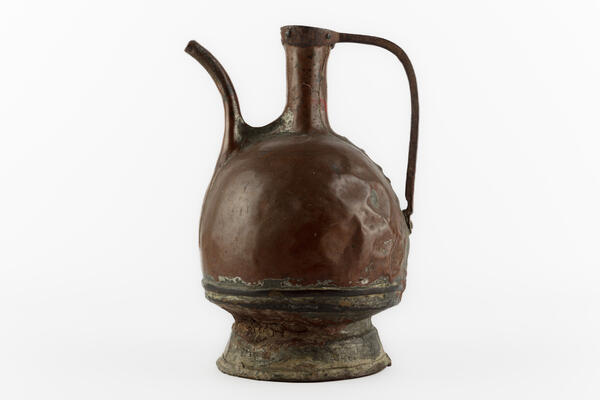
A Circassian jug, or kumgan, is a narrow-necked vessel with a spout and a handle. It was designed to carry and store water, and could also be used for ritual and everyday ablutions. The vessel was transferred to the Gelendzhik Museum from the Adyghe Regional Museum in 1971.

To make kumgans, brass, copper, zinc, silver or iron were usually used. Brass and copper were more common, since these materials have greater ductility. To manufacture jugs, craftsmen used hammers and anvils with various shapes of the working surface. In order to process the vessel from the inside, hammers and movable anvils of a special shape were used. Such an anvil was fixed on a bench, and the artisan put a jug blank on it and hit with the hammer from the outside to obtain the desired shape. Kumgans were often coated with chasing and decorated with various water symbols: circles and tubercles symbolized drops, stripes — flowing streams, and arcs, as the researchers suggest, stood for rain clouds. Special rods were used for chasing. The feet, handles and other massive parts of a kumgan were cast in special molds and then soldered or riveted to the vessel. In the Caucasus, copper was the main material used. To prolong the life of the jug, it was tinned, that is, covered with a thin layer of tin inside and outside. Tinning protected the metal from external influences and adverse processes, in particular from corrosion, and made the product more wear resistant. This procedure was periodically repeated, and the profession of a tinker was in great demand.

How did kumgans get to the Northwest Caucasus? It is believed that kumgans came to the Caucasus along with the spread of Islam in the 16th century. In Islam, ablution is a very important process of not only physical, but also ritual cleansing. Without ablution, Muslims cannot perform religious rites and touch the Koran. Despite the fact that the Circassians continued to adhere to the customs of their ancestors and the new religion spread very slowly, the lighter and more practical copper utensils quickly became popular with the locals and replaced ceramics.
#6
Наименование: Circassian jug
Дата создания: the second half of the 19th century
Техника: copper, forging, tinning
Место создания: Adygea
Размеры: 29×14,5 cm; rim diameter — 5 cm, spout diameter — 1.5 cm
#7
read morehide
00:00
00:00
1x
0
Point your smartphone camera to open in the app
Share
VkontakteOdnoklassnikiTelegram
Share on my website
Copy linkCopied
Copy
Open in app
To see AR mode in action:
  1. Install ARTEFACT app for 
  2. iOS or Android;
  3. Find and download the «Paintings in Details» exhibition
  4. Push the «Augmented reality» button and point your phone's camera at the painting;
  5. Watch what happens on your phone screen whilst you flip through the pictures.
 
We use Cookies
Cookies on the Artefact Website. We use cookies to ensure that we give you the best experience on our website. If you continue without changing your settings, we'll assume that you are happy to receive all cookies on the Artefact website. However, if you would like to, you can change your cookie settings at any time.
Learn more about cookie useHide
Content is available only in Russian

X

Нашли опечатку?...

%title%%type%