The European way of life in the modern period was closely connected with a plethora of household tin utensils. Tin was used to make mugs, plates, jugs, spoons, sugar bowls, kettles, cream jugs, cups, and bowls.
The Austrian businessman Otto Yakovlevich Wiblinger showed a special interest in collecting examples of decorative and applied art. By 1914, Wiblinger’s house in Astrakhan had a rich collection of antique weapons and artifacts from Asia and the East; German and Bohemian art glass of the 17th–20th centuries; tin products from Germany and the Czech Republic of the 18th–19th centuries; Italian majolica of the 18th century, and artisanal Austrian pottery of the 19th century.
It should be noted that when designing the interior of his home, Otto Wiblinger drew inspiration from the style of antique European cabinets. As a self-proclaimed collector, he possessed a keen appreciation for the artistic value of the rare objects he acquired. For some pieces in his collection, Wiblinger commissioned bespoke cabinets, stylized pedestals, and frames, all executed with exquisite taste and true craftsmanship.
On the eve of World War I, in the summer of 1914, Otto Wiblinger and his family left Russia forever, leaving their collection behind in their Astrakhan estate. In 1918, this impressive and varied collection marked the beginning of the formation of the fund of foreign decorative and applied arts.
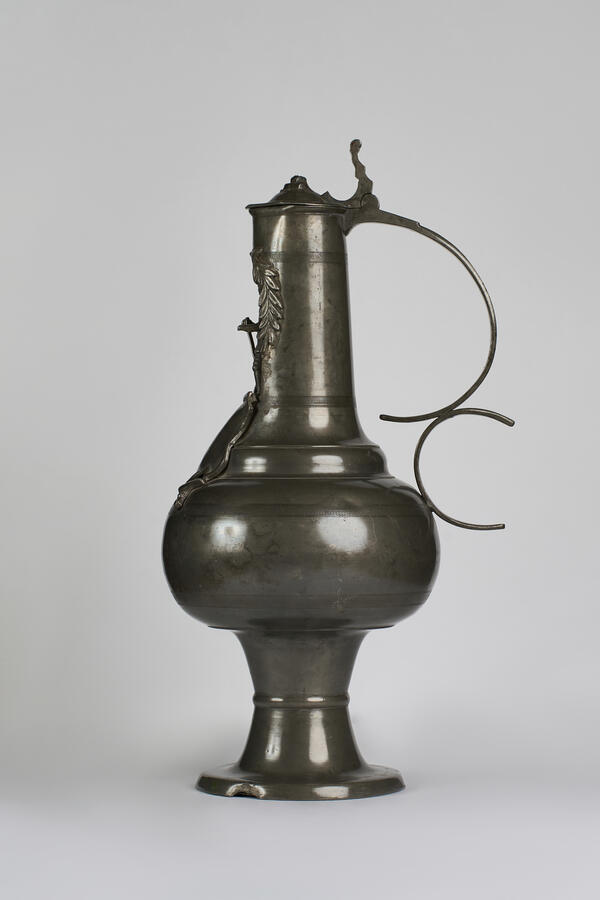
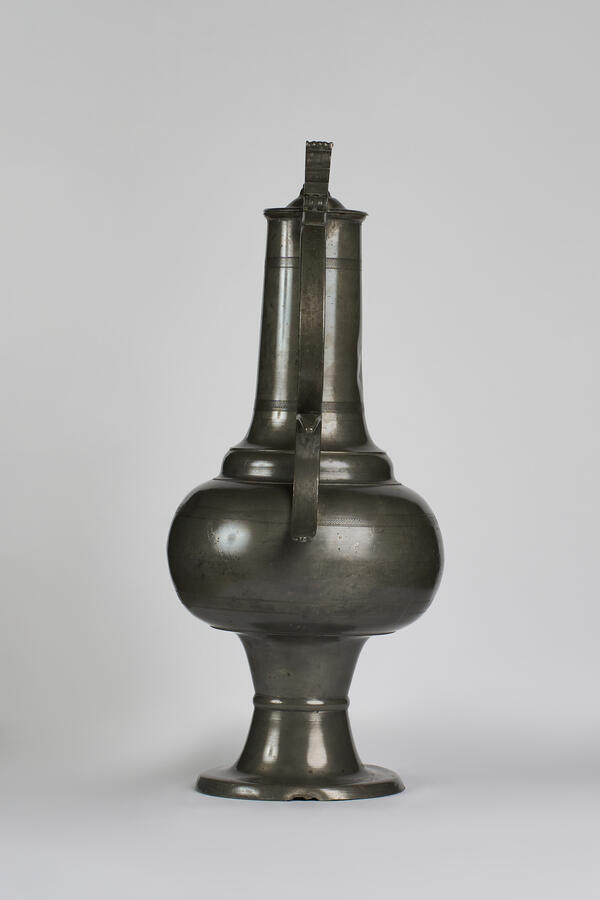
The displayed wine jar made of tin is part of the Collection of Foreign Art of the Astrakhan Art Gallery, named after Pavel Mikhailovich Dogadin.
Since ancient times, tin has been a popular material. It has been widely used in alloys with other metals, such as copper. Tin is considered to be non-toxic and does not pose a health risk to humans, which has made it a suitable material for the production of dishes and jewelry. Lead was sometimes used to make the melting process easier. Tin was most popular in the period from the 16th to the 19th century. Its malleability allowed for the creation of intricate designs and decorations on dishes, including reliefs, notches, and three-dimensional images. Names of customers and guild marks were often inscribed on products in order to authenticate them.