

#1
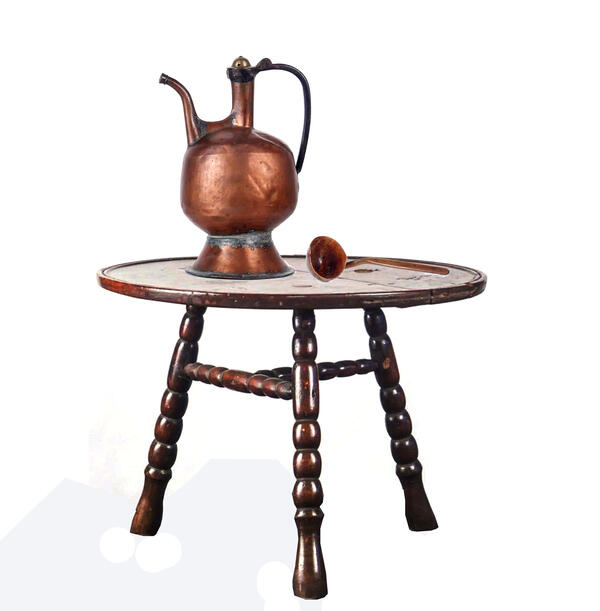
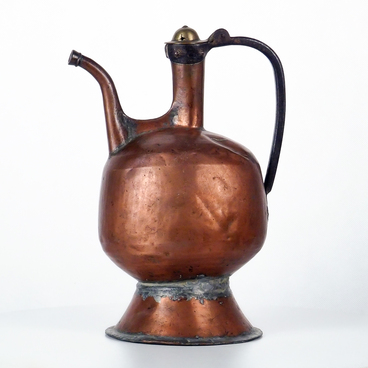
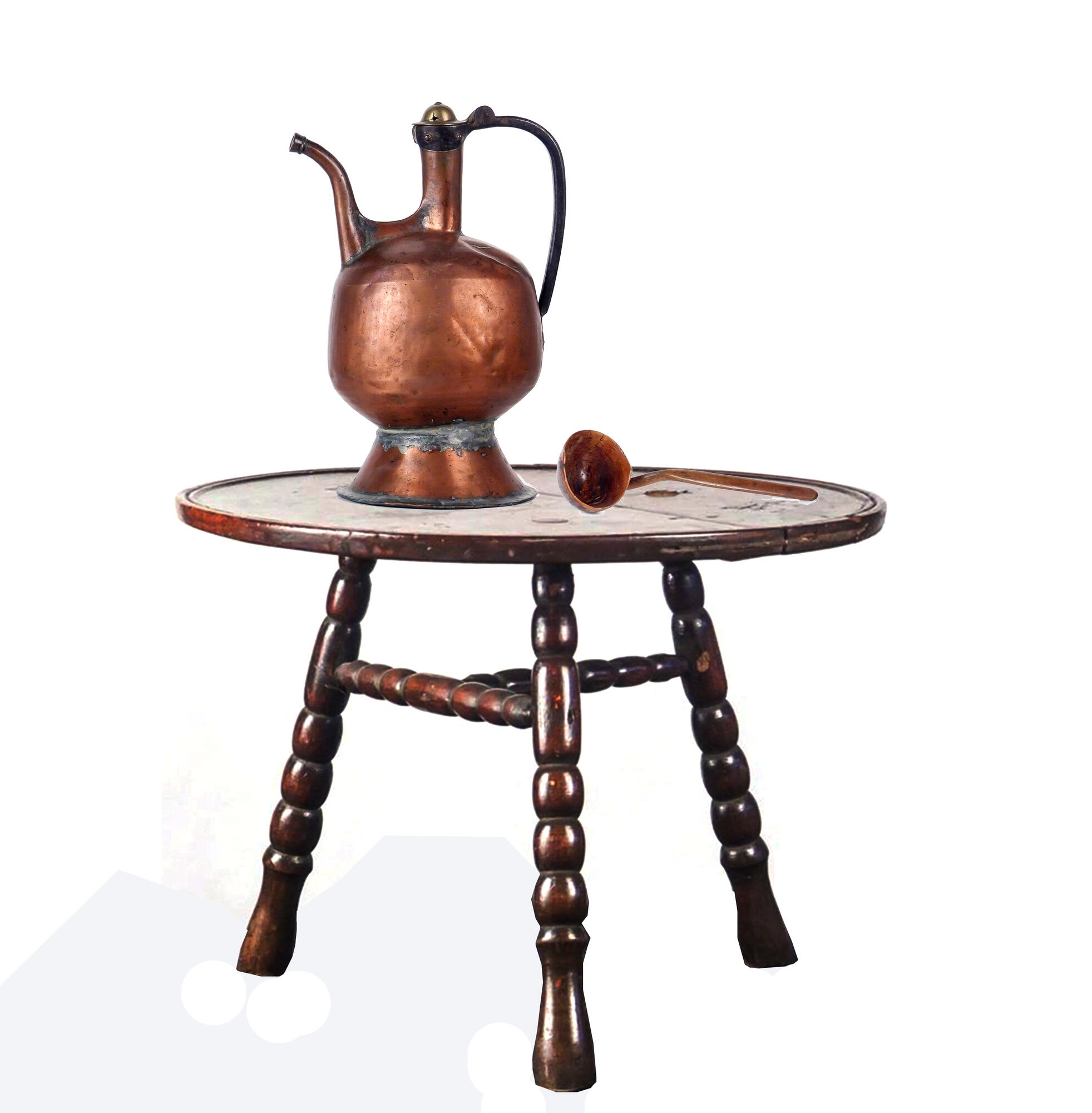
Kumgan, Spoon for Kalmyk tea, Three-legged table
#31
#33
#3
After the end of the Caucasian war, closer to the turn of the 19th — 20th centuries, copperware began to be spread on the territory of Adygheya. Traditionally, Circassians had used ceramics but copperware proved lighter and handier at home and therefore soon became popular with the local people.
Most of the copperware was forged on the territory of modern Daghestan; the services of wandering masters were also in high demand. Tinkers walked the roads of the Northern and Southern Caucasus equipped with all the necessary implements: they took with them, little hammers and anvils, chasing and engraving tools, and whatever was needed to repair dishware.
While being forged copperware was tinned both inside and outside. It protected the metal from ambient impacts and adverse processes such as corrosion. To make it more hygienic for use, the inner surface was coated with wax-based mastic.
Copperware was often decorated with engraving or chasing, therefore it was hard work making it, and such goods were quite expensive. Only well-to-do Adyghes could afford to buy whole sets.
Most of the copperware was forged on the territory of modern Daghestan; the services of wandering masters were also in high demand. Tinkers walked the roads of the Northern and Southern Caucasus equipped with all the necessary implements: they took with them, little hammers and anvils, chasing and engraving tools, and whatever was needed to repair dishware.
While being forged copperware was tinned both inside and outside. It protected the metal from ambient impacts and adverse processes such as corrosion. To make it more hygienic for use, the inner surface was coated with wax-based mastic.
Copperware was often decorated with engraving or chasing, therefore it was hard work making it, and such goods were quite expensive. Only well-to-do Adyghes could afford to buy whole sets.
#8
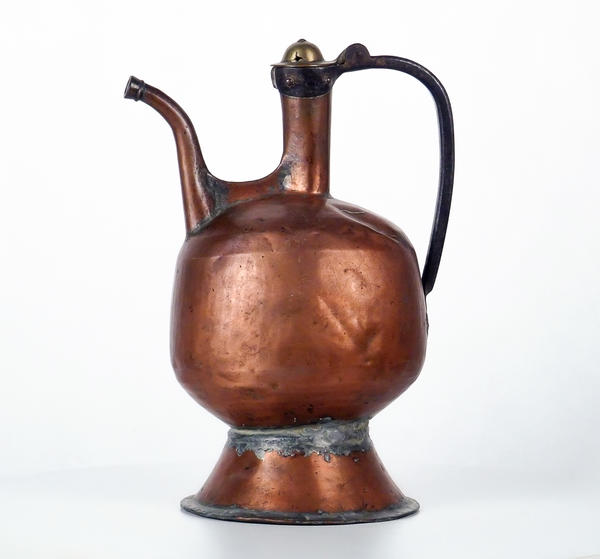
One of the most common copper vessels was a high pitcher with a spout called kumgan. It was used for household and ritual ablutions.
With all the variety of shapes, kumgans were traditionally forged convex with a thin neck. This shape was associated with a female figure. According to Circassian beliefs, water was a feminine substance.
#9
Kumgans were decorated with various water symbols. As suggested by scholars, circles and little bulges symbolised water drops, stripes — sprays and streams, and arches — rain clouds.
Spread of kumgans and other ritual vessels and dishes in Circassia was a result of Islam having been introduced in the Adyghe culture. Not a single Mohammedan prayer, salah, was allowed without a special ablution as only those who have performed a special purification ritual could present themselves to the Allah.
Sunni Mohammedanism in Circassia was promoted by Crimean Tatar khans and Turkish missionaries. The Adyghes resisted the new religion being imposed on them, as well as resisting the Ottoman domination in their land; therefore Islamic institutions had failed to firmly establish themselves by the 19th-20th centuries. Even identifying themselves as members of the Muslim world, Circassians continued to live in accordance with their own ancient ideas and values. Out of all religious prescriptions, they adhered only to some important rituals, such as a funeral ceremony.
Spread of kumgans and other ritual vessels and dishes in Circassia was a result of Islam having been introduced in the Adyghe culture. Not a single Mohammedan prayer, salah, was allowed without a special ablution as only those who have performed a special purification ritual could present themselves to the Allah.
Sunni Mohammedanism in Circassia was promoted by Crimean Tatar khans and Turkish missionaries. The Adyghes resisted the new religion being imposed on them, as well as resisting the Ottoman domination in their land; therefore Islamic institutions had failed to firmly establish themselves by the 19th-20th centuries. Even identifying themselves as members of the Muslim world, Circassians continued to live in accordance with their own ancient ideas and values. Out of all religious prescriptions, they adhered only to some important rituals, such as a funeral ceremony.
#34
Spoon for Kalmyk tea
#29

#13
The Adyghes preferred wooden, metal and ceramic dishware but most often they would use wooden ware, notably, made from boxwood which is very good for woodworking even with the simplest tools. It is the wood from which the spoon presented in the Museum was made.
For centuries, Kalmyk tea was Adyghes’ most popular drink. It was used to sate not only thirst but hunger as well. A couple of cups of such tea and a piece of fresh home-made bread were enough for a good snack. The rich drink consisted of tea, milk and salt.
As one can guess from the name, the Adyghes borrowed the recipe from their neighbours, Kalmyks. Salty, with a lot of milk and therefore buttery and thick, Kalmyk tea became popular in Central Asia during the Golden Horde times. Up to this day, scholars cannot reliably determine where and when exactly this culinary tradition appeared, but many believe that it was in the Tibet where milk, yak butter and salt were added to green tea.
The basis of the classic Kalmyk drink was brick tea, i.e. pressed green tea. This kind of storage added an especially rich flavour to the tealeaves and made it possible to conveniently transport it when travelling for a long time. The Adyghe drink was brewed using horse dock as a basis to which origanum (dady’u in the Adyghe language) was added for a delicious flavour.
Kalmyk tea ‘Adyghe style’ was brewed in the following way. They took a few, usually 3-4, sprigs of horse dock, rinsed them and put on the bottom of a pan, poured cold water in the pan, brought it to boil and left on a slow fire for a hour until the brew acquired a dark colour. Then the pan was covered with a lid and the brew was left to infuse; 15 minutes later the sprigs were taken out with a straining spoon and the drink was poured to another vessel. Then milk was added, usually one third of the brew volume, and put on fire to boil again. Then salt, black pepper and up to 100 grams of butter were added.
Kalmyk tea was poured into cups with a big wooden spoon, which looked more like a ladle, stirring thoroughly. The custom was to serve the drink hot together with pastry, for example, with guubat, a traditional Adyghe cheese pie from wheat flour.
For centuries, Kalmyk tea was Adyghes’ most popular drink. It was used to sate not only thirst but hunger as well. A couple of cups of such tea and a piece of fresh home-made bread were enough for a good snack. The rich drink consisted of tea, milk and salt.
As one can guess from the name, the Adyghes borrowed the recipe from their neighbours, Kalmyks. Salty, with a lot of milk and therefore buttery and thick, Kalmyk tea became popular in Central Asia during the Golden Horde times. Up to this day, scholars cannot reliably determine where and when exactly this culinary tradition appeared, but many believe that it was in the Tibet where milk, yak butter and salt were added to green tea.
The basis of the classic Kalmyk drink was brick tea, i.e. pressed green tea. This kind of storage added an especially rich flavour to the tealeaves and made it possible to conveniently transport it when travelling for a long time. The Adyghe drink was brewed using horse dock as a basis to which origanum (dady’u in the Adyghe language) was added for a delicious flavour.
Kalmyk tea ‘Adyghe style’ was brewed in the following way. They took a few, usually 3-4, sprigs of horse dock, rinsed them and put on the bottom of a pan, poured cold water in the pan, brought it to boil and left on a slow fire for a hour until the brew acquired a dark colour. Then the pan was covered with a lid and the brew was left to infuse; 15 minutes later the sprigs were taken out with a straining spoon and the drink was poured to another vessel. Then milk was added, usually one third of the brew volume, and put on fire to boil again. Then salt, black pepper and up to 100 grams of butter were added.
Kalmyk tea was poured into cups with a big wooden spoon, which looked more like a ladle, stirring thoroughly. The custom was to serve the drink hot together with pastry, for example, with guubat, a traditional Adyghe cheese pie from wheat flour.
#35
Three-legged table
#30
#20
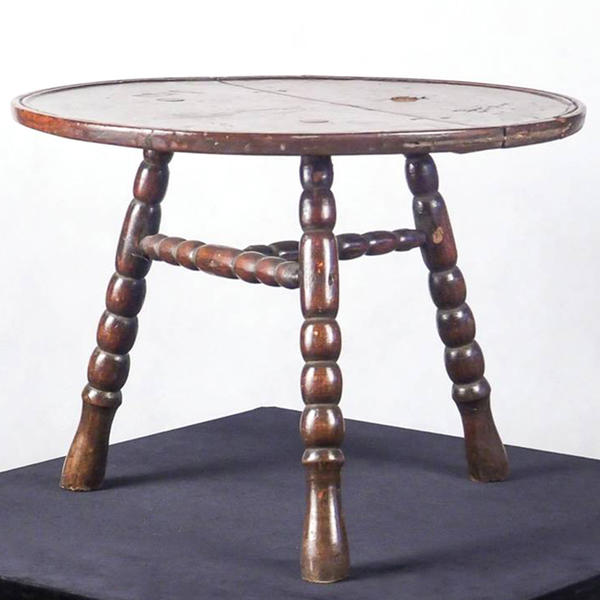
The traditional Adyghe ‘aney [Iанэ] is a round, small-diameter serving table on three shaped legs with crossbars. Owing to a well thought-through design it was stable and did not overturn when accidentally stumbled on, was very convenient to sit at. There would commonly be three-legged little stools at each such table.
#21
Historians believe that “aney table was one of the Adyghe people”s most ancient inventions. It is often mentioned in the Nart epos, the North Caucasus people”s epos that dates back to the 8th-7th centuries B.C.
#22
The round shape of the table top comes from the Adyghe pagan beliefs. Ancient Adyghes worshipped the sun — the great luminary — and tried to give the circular shape to most important objects. According to Circassian traditions and their world outlook, a table of such a shape meant that all those sitting around it were equal.
#23
Traditionally “aney were made from wood, often carved from the plane, one of the longest-living plants on earth. Explorers have discovered a few living planes whose age is 2000 years.
#24
The custom was not to cover “aney with a table cloth. Upon completion of a meal it was simply washed with hot water. It served as both a table and a tray. It was very light and therefore was convenient to move from one place to another, bring in and take away without disturbing the guests.
#25
French traveller Aubrey de la Mottraye wrote about a Iанэ meal:
“the table was totally uncovered, i.e. without a table cloth, but well washed and very clean. It served as a plate for all guests as everyone carved meat on it which they then took by the handful from the serving dish”.
#26
During the meal, the tables were brought in already laid and different dishes were served on different table in the established order. During the feast, over a dozen such tables could be brought in by the hosts — traditions of generosity and hospitality have for centuries been a hallmark of the Adyghe people, and guests have always been received with candid care and great attention.
#27
Giorgio Interiano, an Italian historian and ethnographer, the author of the first European accounts of the life and customs of the Circassian people, noted:
“Circassians highly value generosity and willingly give away everything they have, with the exception, though, of their horses and weapons”.
#28
According to the notes of another foreigner who visited the Adyghe land, Mayor of Amsterdam Nicolaes Witsen:
“both men and women of Circassia are cordial, kind-tempered and virtuous”.
read morehide
00:00
00:00
1x
Kumgan, Spoon for Kalmyk tea, Three-legged table
Exhibition
3
 Point your smartphone camera to open in the app
Open in app
Share