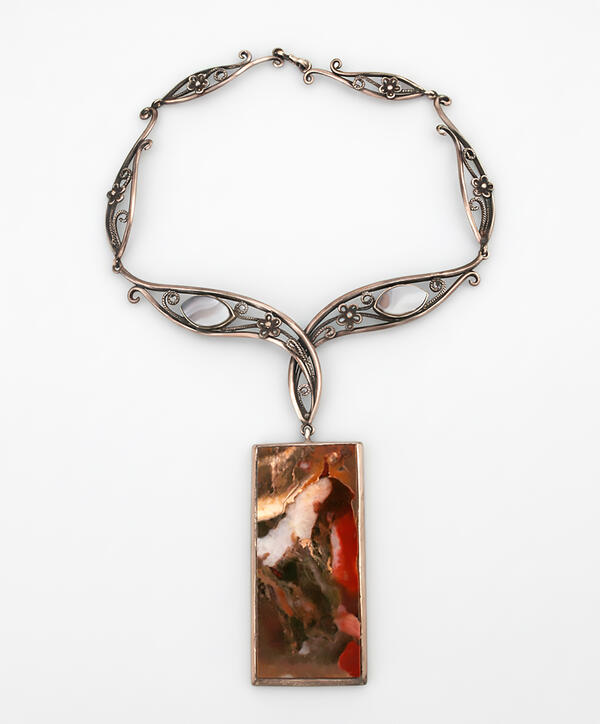
Ural jewelers have a distinctive approach to working with stone. For them, a gemstone is far more than raw material — it is a source of inspiration that shapes the form, the design of the setting, and the overall look of the piece. A brilliant example of this philosophy is Vladimir Mikhailovich Vasilkov’s series of pendants titled “Seasons”, where the stone itself forms the artistic core of each work, giving it a distinctive character and mood.
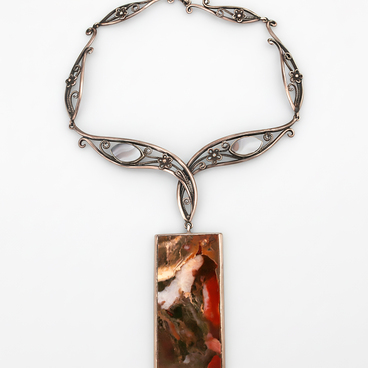
The “Winter” pendant comprises a chain and a pendant. The chain features six gracefully curved links adorned with rhythmic swirls and delicate five-petaled flowers crafted from intricately twisted wire. Suspended at the bottom is a larger five-petaled flower and a rectangular pendant. The pendant is made from a patterned piece of white-gray jasper, flecked with ochre spots, in a smooth setting.
The word “jasper” originates from the Greek word “iaspis,” meaning “spotted stone”. In Rus, it was also called “a mottled stone”. It comes in a variety of colors. Jasper has been valued since prehistoric times, when early humans used it alongside flint and jade to craft tools, arrowheads, and spear points.
Today, jasper remains one of the most beloved ornamental stones. It is widely used in jewelry, as well as for decorative objects such as boxes, ashtrays, writing instruments, and cladding. Its appeal lies in its rich and diverse coloring — from solid hues to complex, multi-tonal patterns. Particularly striking is patterned jasper with dark (brown or black) veining that often resembles natural landscapes like forests, mountains, or swirling snowstorms.
The Urals are home to the world’s longest jasper belt, stretching over 1,000 kilometers from the Polar Urals to the southern ranges. This region yields jasper in an extraordinary array of colors and patterns. Peter the Great first championed the use of Ural jasper in decoration and interior design. Its use then flourished under Catherine the Great, when jasper became a signature of palace style. By her decree, jasper fireplaces were installed in the Kremlin, and the famed Agate Rooms at Tsarskoe Selo were adorned with panels of deep red Ural jasper.
In Vasilkov’s “Winter” pendant, the jasper combines white, gray, and black tones, forming a natural composition reminiscent of a snowy landscape. Drifts of snow-covered terrain emerge from the stone’s organic patterns, while the chain’s snowflake-like motifs complete the poetic image of winter’s quiet beauty.