Font
Color
Graphics
Изображение точки

To see AR mode in action:

1. Install ARTEFACT app for iOS or Android;

2. Find the exhibition «A Composer Ahead of His Time»

3. Push the «Augmented reality» button and point your phone's camera at the exhibit;

Скрыть точки интересаПоказать точки интереса
Показать в высоком качестве

Kukryniksy, Program of concert

0
Open in app
#1
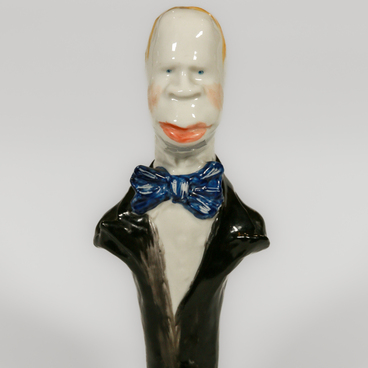
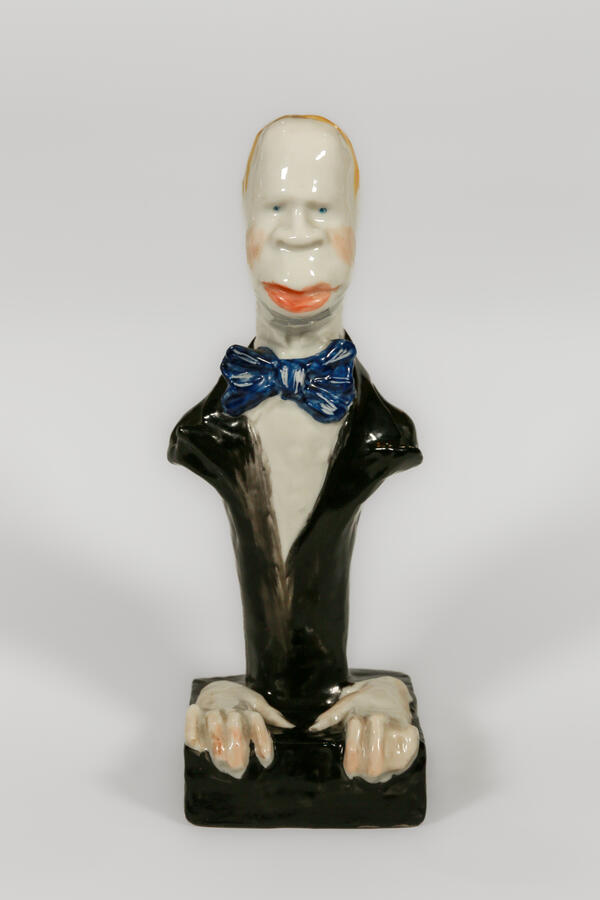
Kukryniksy. Portrait of Sergei Prokofiev
#3
The sculptural portrait of Sergei Prokofiev was designed by a creative team of Soviet caricaturists “Kukryniksy”. It included the artists Mikhail Kupriyanov, Porfiri Krylov, and Nikolai Sokolov. Their imposing pseudonym was derived from the first letters of their first and last names.

The artists created caricatures of poets and writers, actors and directors, painters and sculptors. They also often portrayed musicians, including Sergei Prokofiev, Dmitri Kabalevsky, Aram Khachaturian, Ivan Kozlovsky, Sviatoslav Richter, Emil Gilels, David Oistrakh, Van Cliburn, and Rudolf Kehrer. The Kukryniksy received wide recognition for their poignant political caricatures. They also illustrated a number of books by such authors as Nikolay Gogol, Mikhail Saltykov-Shchedrin, Anton Chekhov, Maxim Gorky, Miguel de Cervantes, and Ilf and Petrov.

The poet and editor-in-chief of the “Komsomolia” magazine Alexander Zharov described the beginning of the creative career of the Kukryniksy:
#4
Three rather poorly dressed young men stepped into my editor’s office on Neglinnaya Street and said:
‘We’re artists. What we mean is that we’re VKhUTEMAS students. Can we do some drawing for your magazine? ’
‘We put out a purely literary magazine, without illustrations, ’ I told them, ‘So we haven’t anything to offer you. Besides, there are a few too many of you, don’t you think? ’
‘Yes, but we work together… you know, like a single person.’
‘But you sign your three names to a single work? ’
‘No, one name — Kukryniksy.’
‘And what do you do? ’
‘We draw cartoons.’
‘Alright, make me a cartoon of these three men, ’ I said pointing to the poets sitting beside me.
The boys got to work without a word. First one of them made a sketch. Then the second took the sketch silently and added some lines to it. He passed it on to the third who also added a line here and there. The sketch made the rounds of the three several times right in front of us.
Alexander Zharov
#5
The artists were agemates: Kupriyanov and Sokolov were born in 1903, and Krylov was born in 1902. All of them came from different regions: Kupriyanov was born in the town of Tetyushi in Tatarstan; Krylov — in the village of Shchelkunovo, the Tula Region; and Sokolov — in the village of Tsaritsyno. The young men met and became friends during their years at VKhUTEMAS, a Moscow art school. Kupriyanov and Sokolov studied at the department of graphic arts, while Krylov studied painting. The three of them were united by their appreciation for satirical caricatures. They published their first work in 1925.
#2
Name: Kukryniksy. Portrait of Sergei Prokofiev
Date of creation: the 1930s
Technique: molding, firing, glazing
Dimensions: 22×9×7,8 cm
#6
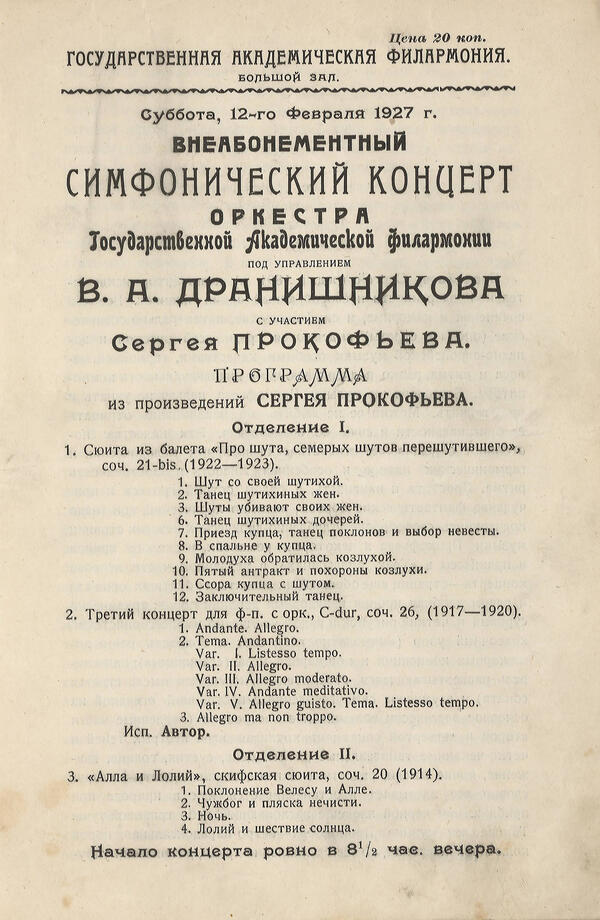
Program of Sergei Prokofiev’s concert
#9
In 1927, after nine years of living abroad, Sergei Prokofiev made his first return visit to the Soviet Union. In two months, he gave over twenty concerts in Moscow, Leningrad, Kharkov, Kiev, and Odessa.

At the Great Hall of the Moscow Conservatory, Prokofiev was met with thunderous applause. He reminisced, “As I appear the orchestra plays a flourish, then stands up and applauds. This turns into a large-scale and exceedingly long ovation on the part of both audience and orchestra. I stand for a long time, bow to all sides and really do not know what to do, sit down, but since the applause continues, again stand up, again bow and again do not know what to do… Finally, I get fed up and resolutely sit down… I was not at my most relaxed as I played but did quite well. There was only one incident: at one point in the third variation, I got in a bit of a muddle. I don’t remember exactly what happened, but in any event, it was nothing serious, and we quickly got back on an even keel again. In the end, the hall shouted its head off. I don’t think I ever got such a reception anywhere. I am called out over and over again. As an encore, I play first the ‘Gavotte’ from the ‘Classical Symphony’, then the ‘Toccata’. Both these party pieces go down well. At last, I retire to the Green Room while the orchestra plays the ‘Three Oranges Suite’. Following the tradition, the ‘March’ is repeated as an encore, and after that, I go out several times.”

The concert at the Leningrad Philharmonic was an equally resounding success. Prokofiev gave his own account of the event, “When I appeared Dranishnikov started playing the ‘Slava’ and set a colossal ovation in train, just about the same as the one at my first Moscow concert. It’s not worth describing it again, except for one amusing incident: after they had played the ‘Slava’ twice and had started it a third time, some very loud instruments came in one bar too late, and so the whole of this third rendition turned into a canon. Once started it was impossible to stop, and since they did not end together Dranishnikov had to play it a fourth time instead of three times.”

The program of Prokofiev’s concert included a suite from his ballet “Chout” (1922–1923), Piano Concerto No. 3 (1917–1920), and the “Scythian Suite” (1914). The concert was conducted by Vladimir Dranishnikov, with Prokofiev himself playing the solo part.
#7
Name: Program of Sergei Prokofiev’s concert
Date of creation: February 12, 1927
Technique: printing
 Place of creation: Leningrad
Dimensions: 22×15,3 cm
#8
read morehide
00:00
00:00
1x

Kukryniksy, Program of concert

0
Point your smartphone camera to open in the app
Share
VkontakteOdnoklassnikiTelegram
Share on my website
Copy linkCopied
Copy
Open in app
To see AR mode in action:
  1. Install ARTEFACT app for 
  2. iOS or Android;
  3. Find and download the «Paintings in Details» exhibition
  4. Push the «Augmented reality» button and point your phone's camera at the painting;
  5. Watch what happens on your phone screen whilst you flip through the pictures.
 
We use Cookies
Cookies on the Artefact Website. We use cookies to ensure that we give you the best experience on our website. If you continue without changing your settings, we'll assume that you are happy to receive all cookies on the Artefact website. However, if you would like to, you can change your cookie settings at any time.
Learn more about useHide
Content is available only in Russian

X

Нашли опечатку?...

%title%%type%