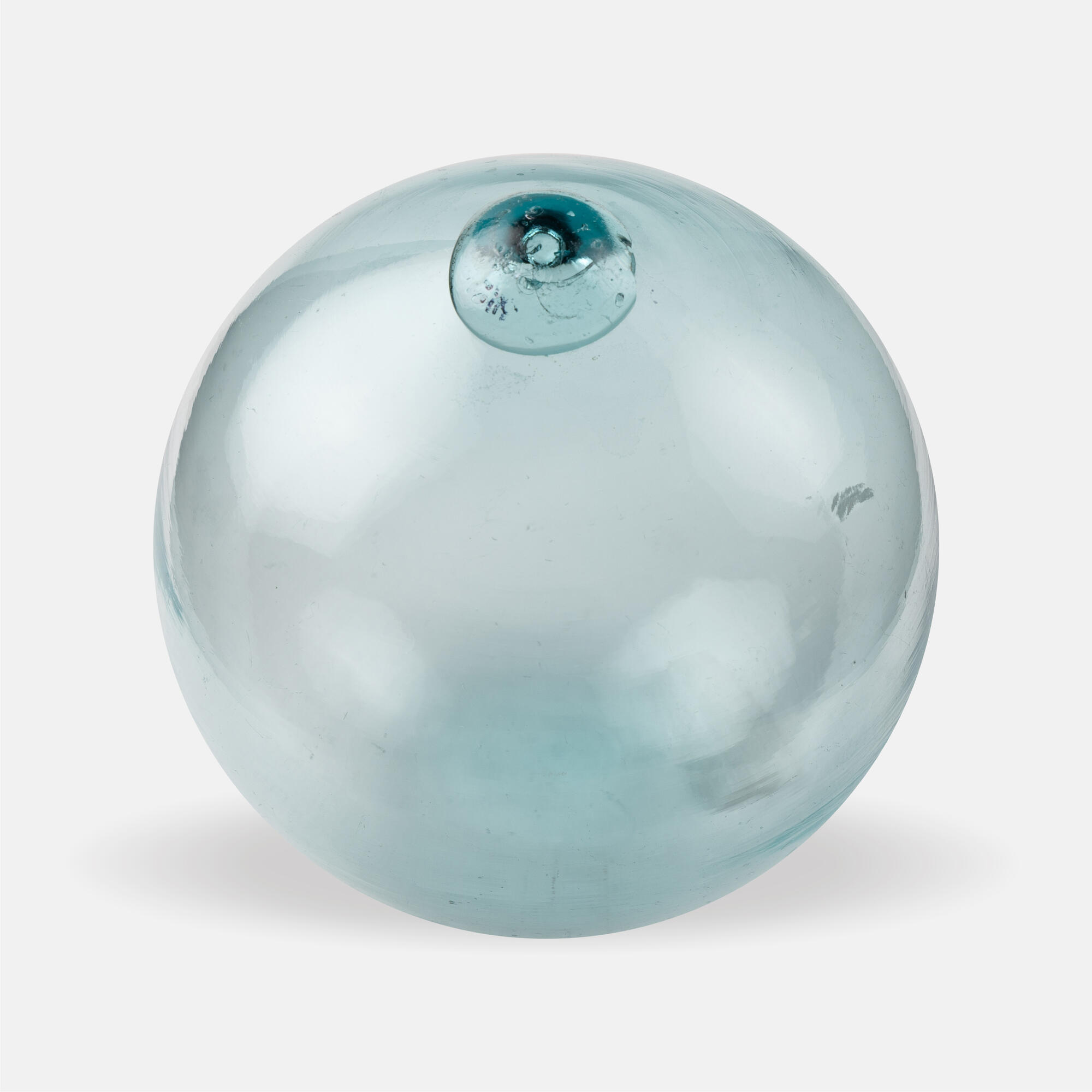


This fragile and transparent glass ball is a float used to keep the fishing nets and trawls afloat. The net is spread using weights at the bottom and floats at the top. Glass floats have different load capacity as they are made of different materials, including foam, glass, metal, and plastic. The shape of glass floats can also vary, but the ball is the most common one.
If a weight accidentally escaped from the net, it would sink to the bottom. A glass float, being light, would rise to the surface and float until it reached the shore. The glass float is believed to have been invented by Christopher Faye from Bergen, Norway. Hadeland Glaaverk became the first company to produce glass floats in 1840–1841. According to other sources, the Schimmelmanns Glassverk company used to produce a type of floats made of bottle glass in the early 1800s. These floats were described as being quite thin and lacked any marking. Curiously, this was only discovered after excavations at the factory site. Following Norway, many European countries began to produce glass floats for fishing nets. The floats varied in size and ranged from 3–5 to 50–60 centimeters. The main objective of glass float production was to completely replace wooden floats, which was soon achieved.
In the early 20th century, the production of glass floats increased, and the floats often bore customer’s or manufacturer’s marks. The largest number of glass floats was produced by Japan where they continued to be manufactured until 1980. Germany produced and supplied fishing floats up to 1940. The United States established its own production in the 1930s–1940s. Before that, floats had been purchased from Germany. In 1933, the Northwestern Glass Company of Seattle tried to adapt its main product — beer bottles — for keeping fishing nets afloat. However, since it was difficult to seal them properly, they were poorly suited for this purpose. The company developed an automatic manufacturing and sealing system for glass floats of different sizes. After World War II, manufacturers started experimenting with the shapes of floats. Some experimental prototypes, produced in small series, have become popular among collectors and sell well at auctions.
In 1943, the United States produced 690,000 glass
floats for “Krabotrest”, a crab fishing company in Vladivostok. These products
were supplied to the USSR under the Lend-Lease Act with labels in Russian.