Articles made by craftsmen from the Dagestan village of Kubachi were popular already in the VI century well outside of the area. за пределами этой территории. Especially valuable were silver items: daggers and sabers which Russian officers loved to boast in the period of Russian — Caucasian wars, silverware and women’s jewelry. Legend has it that the famous two-horned helmet of Alexander Makedonsky and the shield of Alexander Nevsky were also created here.
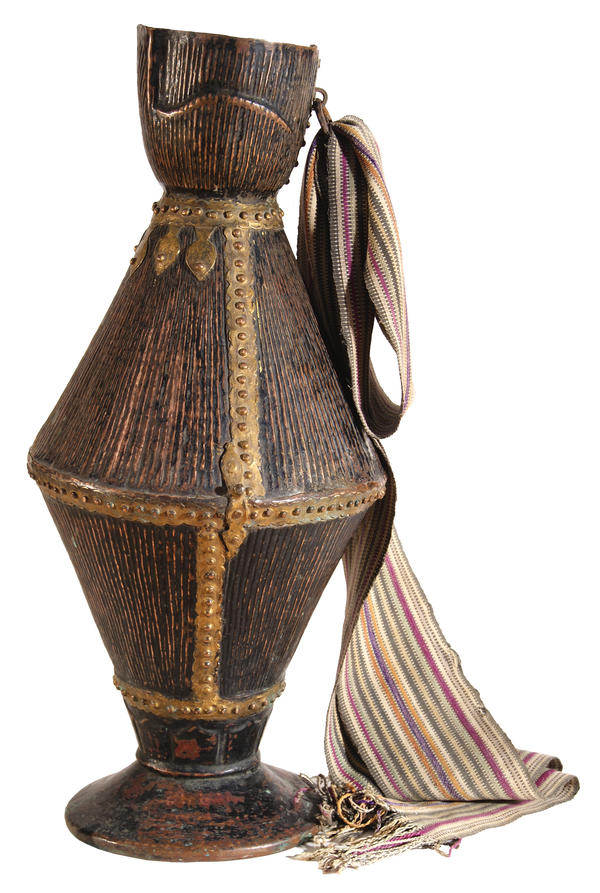
Water pitchers were popular embossed copper items, they were reliable and light. One of them is muchal pitcher. It has a pear-like shape and consists of two truncated cones with a wide body and narrowed neck. A smaller pitcher was called ‘kutka’. It was made from yellow copper and used for washing or offering water to a passing traveler (a characteristic bent handle points to that effect). Muchal and kutka were always carried together.
One of Dagestan’s rituals was related to these pitchers. If a young man wanted to meet a girl, he would wait for her near a spring and ask for a drink of water. If the girl was agile in untying the knot and offering the pitcher, she was considered to be a good future wife and housekeeper.
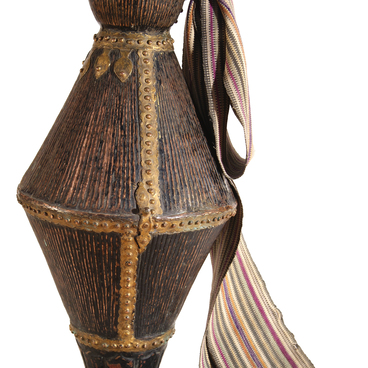
These utensils were cast from brass — an alloy of copper and zinc that was extremely popular due to its long service life. The neck of muchal slightly resembles a human face, so researchers talk about anthropomorphic shape of the article. Pitchers were decorated with geometric ornaments using embossment or engraving. The former technique presupposed a more volumetric and complicated relief than the second one. Some decorations included on-lays in the shape of petals. They were also made from brass, and located under the pitcher neck resembled a necklace of a fine lady.
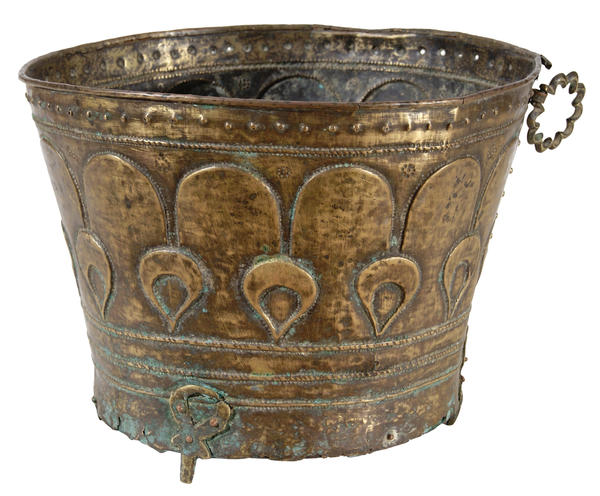
According to a Dagestani legend, muchals saved Kubachi citizens from Persian invasion in the XVIII century. People put pitchers and cauldrons on the roofs of buildings and set fire to burned lime next to them that produced thick white smoke. Seeing something huge shine in the sun and smolder, the invaders led by Nadir-Shah turned around. They thought that the villagers were equipped with canons.
Water pitchers were popular embossed copper items, they were reliable and light. One of them is muchal pitcher. It has a pear-like shape and consists of two truncated cones with a wide body and narrowed neck. A smaller pitcher was called ‘kutka’. It was made from yellow copper and used for washing or offering water to a passing traveler (a characteristic bent handle points to that effect). Muchal and kutka were always carried together.
One of Dagestan’s rituals was related to these pitchers. If a young man wanted to meet a girl, he would wait for her near a spring and ask for a drink of water. If the girl was agile in untying the knot and offering the pitcher, she was considered to be a good future wife and housekeeper.
These utensils were cast from brass — an alloy of copper and zinc that was extremely popular due to its long service life. The neck of muchal slightly resembles a human face, so researchers talk about anthropomorphic shape of the article. Pitchers were decorated with geometric ornaments using embossment or engraving. The former technique presupposed a more volumetric and complicated relief than the second one. Some decorations included on-lays in the shape of petals. They were also made from brass, and located under the pitcher neck resembled a necklace of a fine lady.
According to a Dagestani legend, muchals saved Kubachi citizens from Persian invasion in the XVIII century. People put pitchers and cauldrons on the roofs of buildings and set fire to burned lime next to them that produced thick white smoke. Seeing something huge shine in the sun and smolder, the invaders led by Nadir-Shah turned around. They thought that the villagers were equipped with canons.