


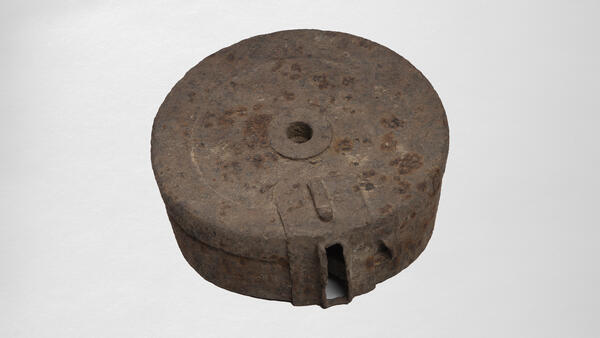
The permanent exhibition of the Zimovniki Museum of Local History presents fragments and models of weapons that were used during the Great Patriotic War. Among the exhibits, there is a model of a Shpagin’s machine pistol and its drum magazine cover.
The drum magazine contained 71 rounds of 7.62 mm caliber. The rounds were placed circumferentially, with the bullets towards the center. Because of the loud noise when the shots were made it was often called “drumroll”.
The machine gunner needed about ten seconds to use one drum magazine. The Shpagin’s machine pistol was rapid-firing — it fired up to a thousand rounds per minute. Because of this, the fire was very dense and the enemy had no opportunity to attack in response. The shot range was 200-300 meters.
In 1940, the Soviet designer Georgy Shpagin was faced with the task of developing a new machine pistol adapted to mass production, which could be assembled at factories that were not intended for the production of weapons. Therefore, the designer proposed to produce all metal parts of a machine pistol by cold stamping and fasten them with spot welding. This simplified the process of assembling and allowed the production of more weapons.
Often the Shpagin’s machine pistol was made from homemade parts, without any prior technical drawings. For example, craft-produced arms were widely used by the Belarusian partisans.
In 1942, the machine pistol was redesigned and the main shortcomings were corrected. The case became lighter: the 1941 model, together with the equipped magazine, weighed 5.3 kilograms. In addition to the machine gun, each fighter had spare magazines, so it was difficult to wear such heavy objects.
In addition, due to the cold stamping method, every detail of the weapon turned out to be unique. Therefore, the drums of the first Shpagin’s machine pistols often did not fit together, and the magazines were unfastened when the fighter fell.
For the new model of 1942, a snail-type magazine of 35 rounds was developed. Thanks to this, the Shpagin’s machine pistol became lighter, and additional magazines took up less space in the soldiers' map cases.
The drum magazine contained 71 rounds of 7.62 mm caliber. The rounds were placed circumferentially, with the bullets towards the center. Because of the loud noise when the shots were made it was often called “drumroll”.
The machine gunner needed about ten seconds to use one drum magazine. The Shpagin’s machine pistol was rapid-firing — it fired up to a thousand rounds per minute. Because of this, the fire was very dense and the enemy had no opportunity to attack in response. The shot range was 200-300 meters.
In 1940, the Soviet designer Georgy Shpagin was faced with the task of developing a new machine pistol adapted to mass production, which could be assembled at factories that were not intended for the production of weapons. Therefore, the designer proposed to produce all metal parts of a machine pistol by cold stamping and fasten them with spot welding. This simplified the process of assembling and allowed the production of more weapons.
Often the Shpagin’s machine pistol was made from homemade parts, without any prior technical drawings. For example, craft-produced arms were widely used by the Belarusian partisans.
In 1942, the machine pistol was redesigned and the main shortcomings were corrected. The case became lighter: the 1941 model, together with the equipped magazine, weighed 5.3 kilograms. In addition to the machine gun, each fighter had spare magazines, so it was difficult to wear such heavy objects.
In addition, due to the cold stamping method, every detail of the weapon turned out to be unique. Therefore, the drums of the first Shpagin’s machine pistols often did not fit together, and the magazines were unfastened when the fighter fell.
For the new model of 1942, a snail-type magazine of 35 rounds was developed. Thanks to this, the Shpagin’s machine pistol became lighter, and additional magazines took up less space in the soldiers' map cases.


