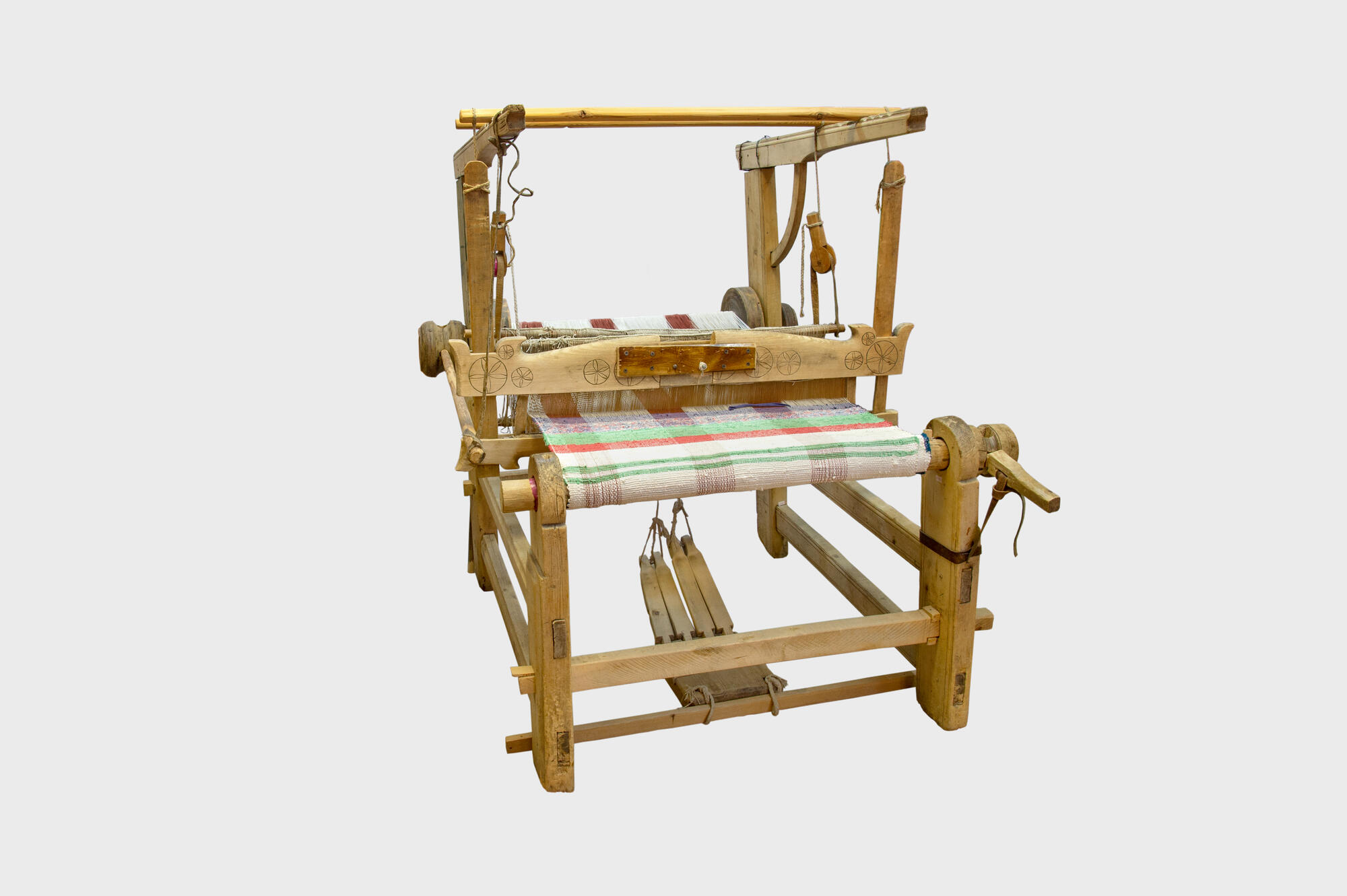


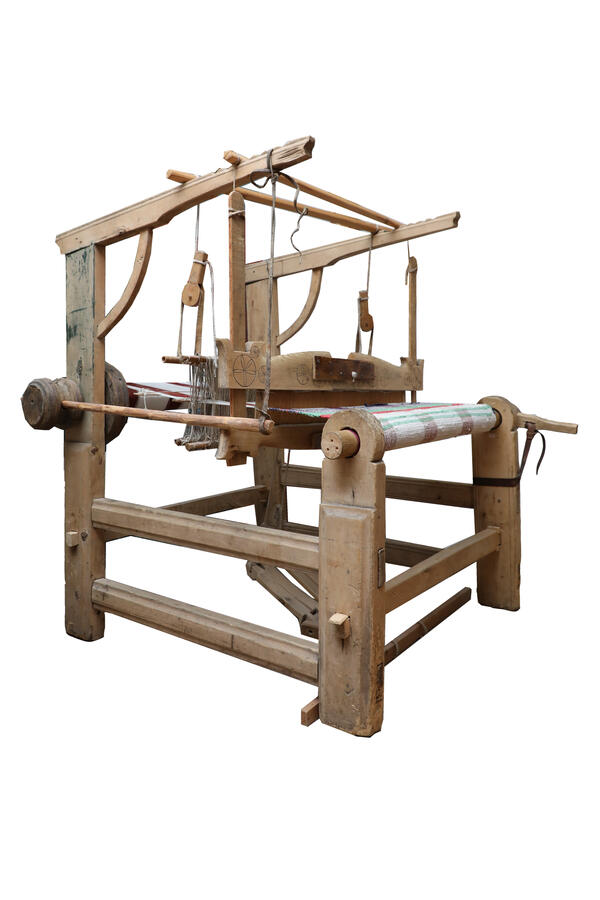
The collection of the Verkhnyaya Pyshma Historical Museum contains a loom called ‘krosna’ that was made in 1920. It was designed to make fabrics by hand.
Historians claim that people mastered weaving several millennia ago, in the Neolithic era. The most ancient homemade looms were found in Asia, they were made in the 6th — 5th millennium BC.
At first, animal wool, plant fibers, and natural silk were used as raw materials for yarn. The fabrics were dyed with juices, and craftsmen mixed weaved multi-colored threads to get a pattern. Gradually, weaving turned into a form of real art.
Weaving was traditionally a women’s business. In Russia, every peasant family had a loom. Women made linen and used it to sew clothes, sheets, towels, tablecloths and other household items. In addition to the smooth plain canvas, the village craftswomen also created patterned fabrics.
The weaving technique gradually became more sophisticated. Simple threads were replaced by yarn, which was obtained from flax, hemp, sheep and goat wool. It was painted in different colors.
The first loom was vertical. It was a simple frame with a warp — a set of yarns stretched on a loom. The craftswoman had a large loom shuttle, which also had a thread in it, and used it to intertwine the threads. It was difficult to work on such a loom: the threads had to be operated by hand, they often broke, and the fabric turned out to be thick and dense.
In the 11th century, the horizontal loom was invented, a copy of which is housed in the museum. This device had the warp threads stretched horizontally. In addition, the machine consisted of a large wooden frame with three rollers, two foot pedals, vertical “comb” frames, and a shuttle with a thread. By now, the horizontal loom has undergone only minor changes and has been preserved in some village houses and museums.
Nowadays, mechanical weaving machines are used in mass production that work on electricity. Hand weaving remained only in the villages — as a traditional folk craft.
Historians claim that people mastered weaving several millennia ago, in the Neolithic era. The most ancient homemade looms were found in Asia, they were made in the 6th — 5th millennium BC.
At first, animal wool, plant fibers, and natural silk were used as raw materials for yarn. The fabrics were dyed with juices, and craftsmen mixed weaved multi-colored threads to get a pattern. Gradually, weaving turned into a form of real art.
Weaving was traditionally a women’s business. In Russia, every peasant family had a loom. Women made linen and used it to sew clothes, sheets, towels, tablecloths and other household items. In addition to the smooth plain canvas, the village craftswomen also created patterned fabrics.
The weaving technique gradually became more sophisticated. Simple threads were replaced by yarn, which was obtained from flax, hemp, sheep and goat wool. It was painted in different colors.
The first loom was vertical. It was a simple frame with a warp — a set of yarns stretched on a loom. The craftswoman had a large loom shuttle, which also had a thread in it, and used it to intertwine the threads. It was difficult to work on such a loom: the threads had to be operated by hand, they often broke, and the fabric turned out to be thick and dense.
In the 11th century, the horizontal loom was invented, a copy of which is housed in the museum. This device had the warp threads stretched horizontally. In addition, the machine consisted of a large wooden frame with three rollers, two foot pedals, vertical “comb” frames, and a shuttle with a thread. By now, the horizontal loom has undergone only minor changes and has been preserved in some village houses and museums.
Nowadays, mechanical weaving machines are used in mass production that work on electricity. Hand weaving remained only in the villages — as a traditional folk craft.