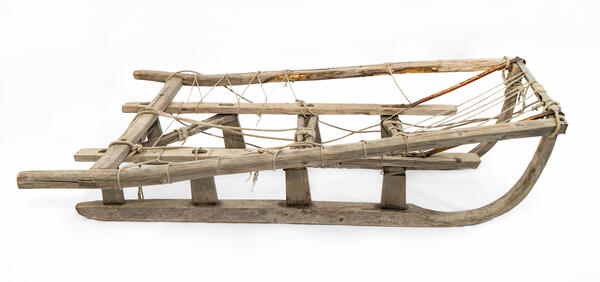
In the old days, sledges were assembled without nails with the help of braces and a hemp rope. The most important quality of the sled was its low weight. The main structural element of the sled is a load-bearing frame mounted on runners. To make them, birch was usually used; the wood was harvested in spring, when it gave juice. The birch was steamed in boiling water and bent.
Before winter, the runners were treated with sable or mink fat for better sliding. Well-to-do peasants lined the runners with metal tape. To bind the runners and reinforce the back of the sledge, a deck was made on which the arc was strengthened, and in front there was a hood made of two bars. In addition, the bars themselves were fastened together with crossbars.
Low and wide peasant sledges (called “rozvalni”) were used to transport both household and commercial goods in winter, which is why they did not have a seat. Such sledges often had rails diverging apart from the front.
Every peasant farm had rozvalni. Cargo sleds were necessary in everyday life, people used them to go to the bazaar. Professional sledge craftsmen were engaged in the manufacture of such items. They worked to order, and also sold products at fairs. At the same time, the peasants themselves could make cargo sleds for their farms.
The sleigh presented in the museum’s collection consists of two runners with heads bent upwards by 27 centimeters in height. Four pairs of stanchions are inserted into the nests of the runners — vertical short bars connected by transverse overlaps. Top rails are laid on the stanchions — two side bars. Two poles run from the heads of the runners. The space between the poles is braided with ropes. The ends of the runners’ heads are fastened with a metal corner. A rope is tied to the sleigh.
The item belonged to
Leonid Alexandrovich Sukhodoyev, a resident of the village of Shelekhovo in the
Komsomolsk district of the Khabarovsk Territory, which was founded in 1861. He
was engaged in carpentry, as well as cooperage — the manufacture of barrels for
salting fish and caviar. Leonid Sukhodoyev came from a family of descendants of
Russian immigrants, the founders of the village of Shelekhovo.