

This type of crucifix is not suitable for wearing and has a different purpose. It differs from the pectoral cross in shape and size. The name of this type of crosses comes from the word “kiot” meaning an “icon case.” An icon case is a small box or chest where icons are displayed.
Such crosses were placed in antiquity on all kinds of gates: both in private courtyards and on the city gates. They were also often inserted into a tree, for example, on graves, in places of worship, or on the roads.
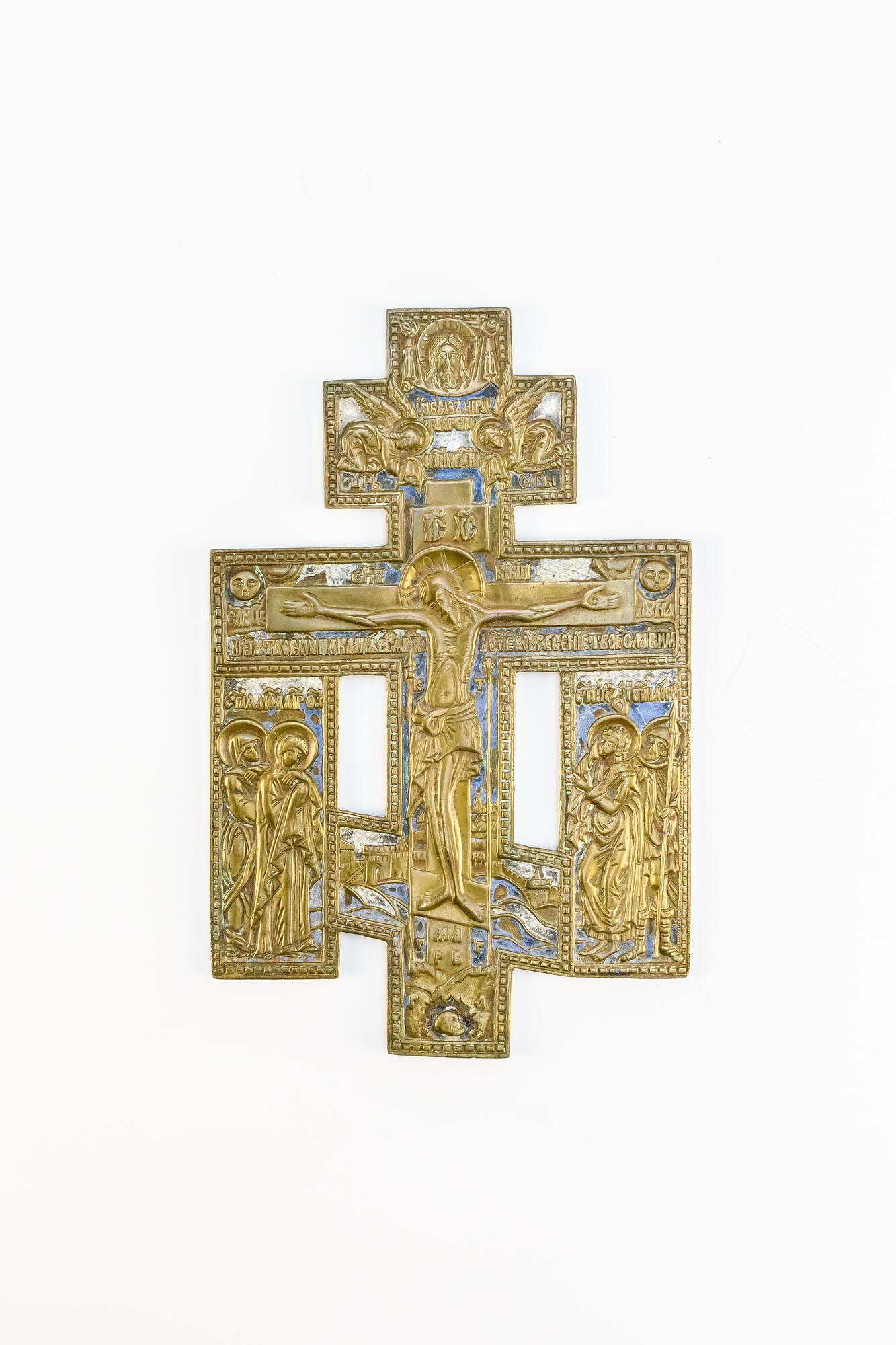
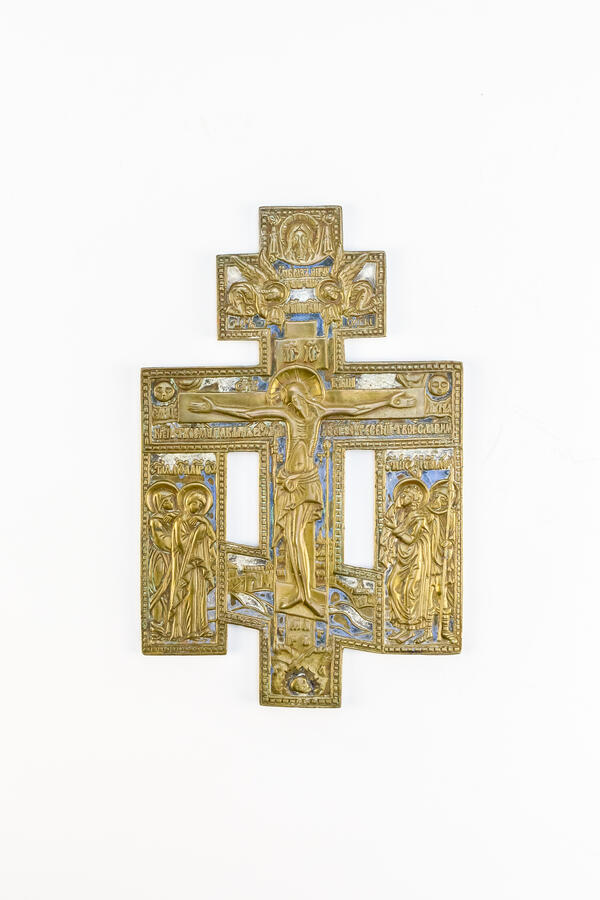
As a rule, such crosses were eight-pointed: they had three crossbeams, of which two were horizontal and the third lower one was diagonal. Artists often framed the holy symbol with additional images: Cherubim, saints, and other images of this kind. The outline of these crosses reminded a temple; it was meant to demonstrate all the grace of the Church.
In the old days, icon case crosses were made of bronze or copper, and covered with colored enamels for embellishment and preservation purposes. In addition to enamels, such items were also decorated with patina. Patina is a protective layer of metal oxides that forms on copper or its alloys over several decades. But it can also be applied artificially, with the help of some active chemicals.
The cross from the museum collection was created in the 19th century. It is made of copper, and polychrome (multi-colored) enamel is also used. The artist depicted the crucifixion of Jesus Christ. According to the Orthodox tradition, the figure of the Lord on the Cross is slightly curved, His arms are slightly sagging. In addition, He is featured with a bowed head and closed eyes — the Savior’s death is perceived as deep sleep.
Usually there were different variants of the scenes depicted on the crosses, but sometimes the same scene could be repeated over a long period, often spanning several centuries. Therefore, it is rather difficult to attribute the cross to a particular time period. However, it is possible to trace the common patterns in the drawing: the same scenes were drawn in an accurate manner with the meticulous depiction of the minutest details, while the older items featured less elaborate drawings.
There is a large number of these crosses that have been preserved to the present day. The largest coppersmiths used to cast about a hundred thousand items a year, and there were also small workshops contributing to the production. Crosses were cheap; they could be purchased not only in churches, but also at fairs.
Such crosses were placed in antiquity on all kinds of gates: both in private courtyards and on the city gates. They were also often inserted into a tree, for example, on graves, in places of worship, or on the roads.
As a rule, such crosses were eight-pointed: they had three crossbeams, of which two were horizontal and the third lower one was diagonal. Artists often framed the holy symbol with additional images: Cherubim, saints, and other images of this kind. The outline of these crosses reminded a temple; it was meant to demonstrate all the grace of the Church.
In the old days, icon case crosses were made of bronze or copper, and covered with colored enamels for embellishment and preservation purposes. In addition to enamels, such items were also decorated with patina. Patina is a protective layer of metal oxides that forms on copper or its alloys over several decades. But it can also be applied artificially, with the help of some active chemicals.
The cross from the museum collection was created in the 19th century. It is made of copper, and polychrome (multi-colored) enamel is also used. The artist depicted the crucifixion of Jesus Christ. According to the Orthodox tradition, the figure of the Lord on the Cross is slightly curved, His arms are slightly sagging. In addition, He is featured with a bowed head and closed eyes — the Savior’s death is perceived as deep sleep.
Usually there were different variants of the scenes depicted on the crosses, but sometimes the same scene could be repeated over a long period, often spanning several centuries. Therefore, it is rather difficult to attribute the cross to a particular time period. However, it is possible to trace the common patterns in the drawing: the same scenes were drawn in an accurate manner with the meticulous depiction of the minutest details, while the older items featured less elaborate drawings.
There is a large number of these crosses that have been preserved to the present day. The largest coppersmiths used to cast about a hundred thousand items a year, and there were also small workshops contributing to the production. Crosses were cheap; they could be purchased not only in churches, but also at fairs.