

An encolpion is a small medallion with an inner container for carrying relics, which protect from all kinds of misfortune. Basically, it contained fragments of residual relics: fabric, plants, hair or threads. Encolpions came to Rus from Byzantium and were already widespread in the pre-Mongolian period. The word “encolpion” is of Greek origin and means “on the chest.”
The encolpion cross “Saint Boris and Gleb” was found in the 1880s in the village of Krasnye Buitsy and was part of the collection belonging to Counts Olsufiev. The cross is currently kept in the collection of the Association “Tula Historical, Local Lore and Art Museum”. The State Museum-Reserve “Kulikovo Field” houses a replica of this encolpion cross made by Oleg Zaidov in 2013.
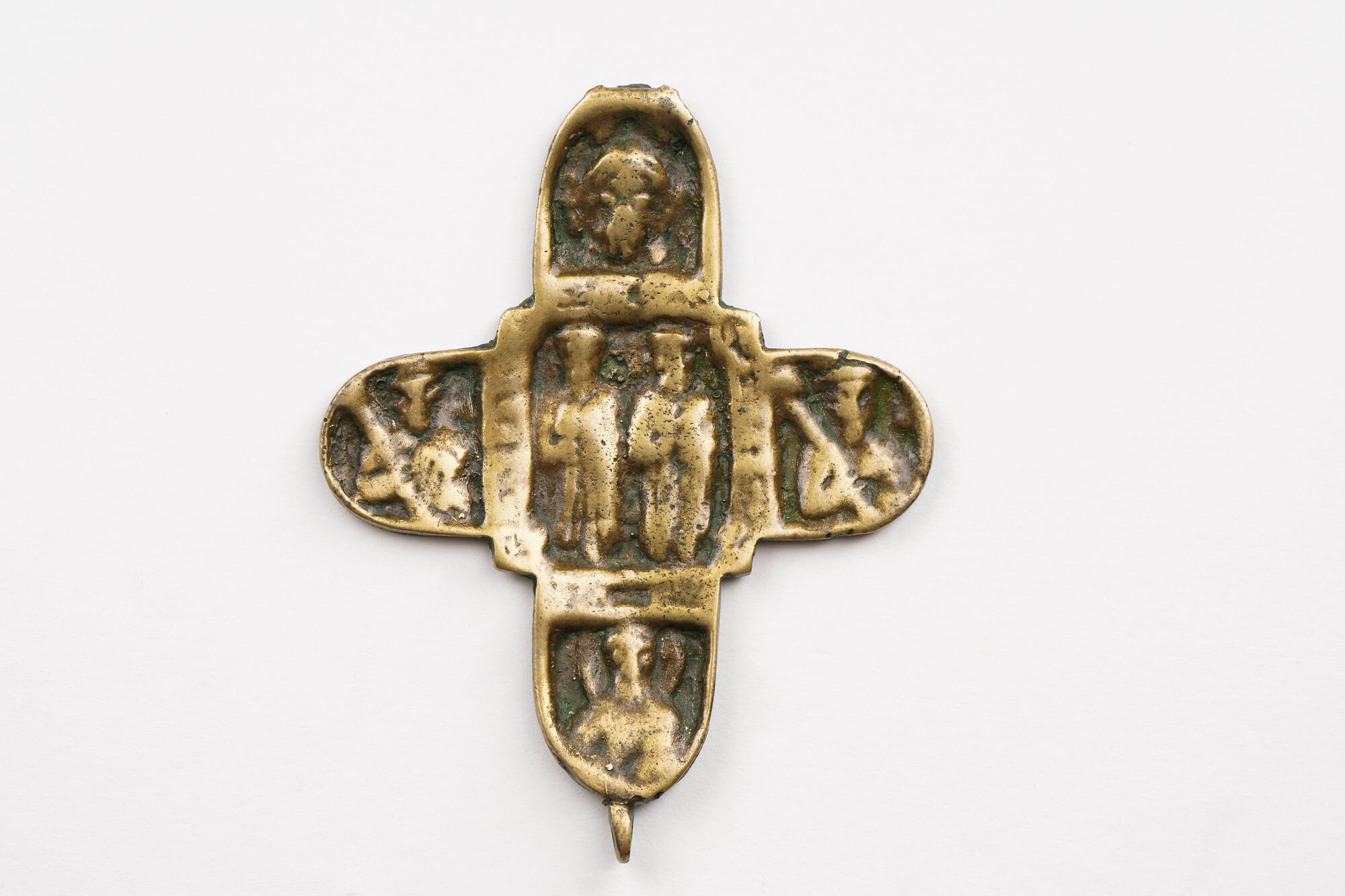
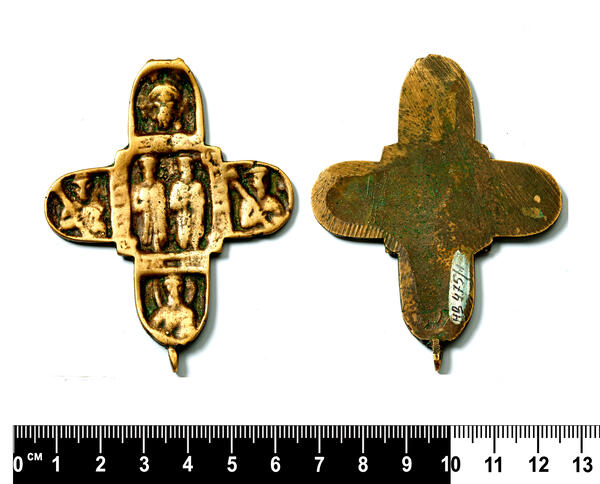
In the middle of the encolpion cross are the full-length figures of the holy princes Boris and Gleb with crosses in their right hands and swords in their left. The holy noble princes and martyrs Boris and Gleb (their Christian names were Romanus and David) were the first Russian saints, canonized by both the Russian and Constantinople Churches. At the left and right ends are archangels, at the top is the Mandylion, at the bottom is the image of St. Nicholas the Wonderworker. There are fragments of worn inscriptions in the border around the middle of the cross. The cross has equal arms with rounded ends, the middle part is rectangular, with a low rim. At the end of the top terminal, there is a fragment of the base of two suspension loops, at the bottom end there is a single loop.
The cross is similar in shape to the front part of the encolpion with the Crucifixion from the collection of Stepan Dmitrievich Nechaev, a collector of relics from the Battle of Kulikovo, historian, and public figure. Similar products with the holy princes Boris and Gleb in a rectangular middle crossing are attributed to the Novgorod and Kyiv handicraft products of the late 13th and early 14th centuries. The model of this reliquary becomes known in the 14th century. Exactly the same copy with the front side featuring St. Fyodor Stratilat was kept in the collection of the Khanenko brothers. The distribution area of such encolpions was very wide: they have been found in Pskov, Moscow region, Vyatka area, Tver, and Nizhny Novgorod.
The encolpion cross “Saint Boris and Gleb” was found in the 1880s in the village of Krasnye Buitsy and was part of the collection belonging to Counts Olsufiev. The cross is currently kept in the collection of the Association “Tula Historical, Local Lore and Art Museum”. The State Museum-Reserve “Kulikovo Field” houses a replica of this encolpion cross made by Oleg Zaidov in 2013.
In the middle of the encolpion cross are the full-length figures of the holy princes Boris and Gleb with crosses in their right hands and swords in their left. The holy noble princes and martyrs Boris and Gleb (their Christian names were Romanus and David) were the first Russian saints, canonized by both the Russian and Constantinople Churches. At the left and right ends are archangels, at the top is the Mandylion, at the bottom is the image of St. Nicholas the Wonderworker. There are fragments of worn inscriptions in the border around the middle of the cross. The cross has equal arms with rounded ends, the middle part is rectangular, with a low rim. At the end of the top terminal, there is a fragment of the base of two suspension loops, at the bottom end there is a single loop.
The cross is similar in shape to the front part of the encolpion with the Crucifixion from the collection of Stepan Dmitrievich Nechaev, a collector of relics from the Battle of Kulikovo, historian, and public figure. Similar products with the holy princes Boris and Gleb in a rectangular middle crossing are attributed to the Novgorod and Kyiv handicraft products of the late 13th and early 14th centuries. The model of this reliquary becomes known in the 14th century. Exactly the same copy with the front side featuring St. Fyodor Stratilat was kept in the collection of the Khanenko brothers. The distribution area of such encolpions was very wide: they have been found in Pskov, Moscow region, Vyatka area, Tver, and Nizhny Novgorod.


