


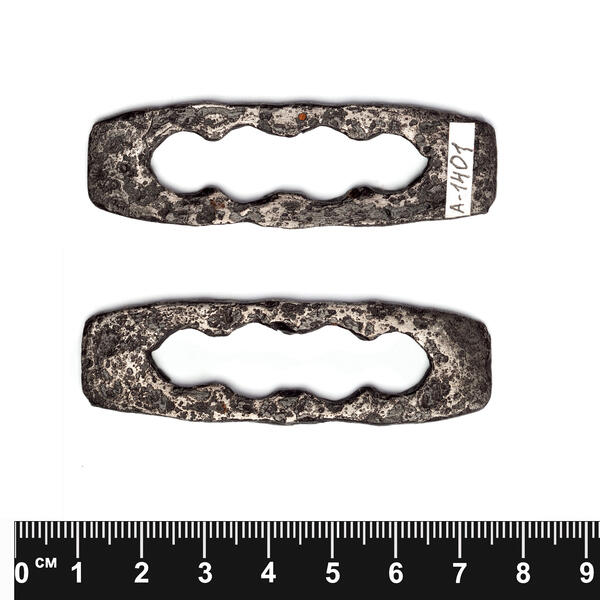
A fire striker, or flint, was a tool used in firemaking from the 12th to the 17th centuries. The item on display is an oblong-shaped sub-rectangular frame with a wide curved opening. The slightly pointed ends taper up to 1.5 cm.
The fire striker was uncovered in 2009 in excavations conducted by the military-historical unit of the Upper-Don archaeological expedition of the State Historical Museum and the State Museum-Reserve “Kulikovo Field” on the watershed between the Rybiy Verkh ravine and the Smolka River, to the north of the Khvorostyanka village, Kurkinsky District, Tula Oblast, on site No. 22, grid 9.
This item belongs to a fairly common type of double-edged fire strikers. Such tools were widely used in Old Rus, Volga Bulgaria, and in the Middle and Lower Volga Region. Double-edged fire strikers can be oval and pointed, oval and short or rectangular. Oval pointed flints are most numerous ones. The book “The Culture of Bilär” mentions rectangular double-edged fire strikers and dates them to the 13th–16th centuries. Such fire strikers found in Novgorod and nomadic burials of the later period date to the second half of the 13th and the 14th centuries. The fire striker from the battlefield of Kulikovo is unique since it has a decorative opening instead of a simple one.
In Old Rus, fire-starting utilized a fire striker, flint and tinder. The Russian word “kresalo” derives from the verb “kresat” which meant to create a spark. The other names were an “ognivo” and a “plashka”. The fire striker was used to strike the flint and generate sparks.
Fire strikers are amongst the most common archaeological finds. They were an integral part of medieval cities across Europe and Asia. They were a mass product of the ironworking trade and were used until the 19th century, when the more convenient matches replaced them.
The shape of the Old Russian tool considerably varied over the centuries. It was not uncommon to commission fire strikers that had a specifically designed shape and were decorated with carvings and cut patterns.
The fire striker was uncovered in 2009 in excavations conducted by the military-historical unit of the Upper-Don archaeological expedition of the State Historical Museum and the State Museum-Reserve “Kulikovo Field” on the watershed between the Rybiy Verkh ravine and the Smolka River, to the north of the Khvorostyanka village, Kurkinsky District, Tula Oblast, on site No. 22, grid 9.
This item belongs to a fairly common type of double-edged fire strikers. Such tools were widely used in Old Rus, Volga Bulgaria, and in the Middle and Lower Volga Region. Double-edged fire strikers can be oval and pointed, oval and short or rectangular. Oval pointed flints are most numerous ones. The book “The Culture of Bilär” mentions rectangular double-edged fire strikers and dates them to the 13th–16th centuries. Such fire strikers found in Novgorod and nomadic burials of the later period date to the second half of the 13th and the 14th centuries. The fire striker from the battlefield of Kulikovo is unique since it has a decorative opening instead of a simple one.
In Old Rus, fire-starting utilized a fire striker, flint and tinder. The Russian word “kresalo” derives from the verb “kresat” which meant to create a spark. The other names were an “ognivo” and a “plashka”. The fire striker was used to strike the flint and generate sparks.
Fire strikers are amongst the most common archaeological finds. They were an integral part of medieval cities across Europe and Asia. They were a mass product of the ironworking trade and were used until the 19th century, when the more convenient matches replaced them.
The shape of the Old Russian tool considerably varied over the centuries. It was not uncommon to commission fire strikers that had a specifically designed shape and were decorated with carvings and cut patterns.


