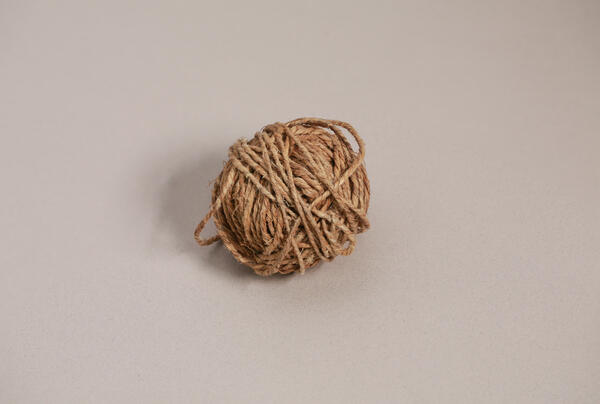
Nettle is one of the first plants from which a person learned to extract yarn. Fishing nets were woven from nettle fibers, clothes were made and utensils were sewn from soft materials. The peoples of the Ob region processed nettle until the end of the 19th century. However, already in the 20th century, this continued to be done only in remote places and only by elderly people.
In the late 1990s, the staff of the Museum of the Ob River went on an expedition to the national village of Lempino. Together with the locals, they managed to recreate the traditional nettle processing.
Nettles began to be harvested in early October during the morning frosts until the sun did not warm the soil. This made it possible to break off the stalk, and not pull it off the ground.
The stalks were first dried in bundles in a cold room. Then, each stalk was split into fibers with the help of special needles. The Yugan Khanty made needles from wood or elk bone, the Salym Khanty used reindeer or elk bone. For the fiber to bend and spin freely during processing, it was soaked.
Then the fibers were cleaned. They were pushed in a special nettle breaker, broken with a wooden beater on a stone, and mashed with hands. There was also a second method: the fibers were combed with a special comb—this was what the Salym Khanty used.
The comb is a special composite device. The wooden handle was made separately, and then, thin metal teeth were inserted into it. This made it possible to quickly separate the fibers and get nettle hay.
A spinning wheel and a spindle were used to spin the yarn. The Khanty spindle differed from the Russian one — it had a spindle whorl — disk or a low cylinder-shaped weight with a hole in the center. With its help, the yarn was fastened and the hand spindle was weighted. Spindle whorls were made of stone, clay, bone, and sometimes, from pieces of the broken pots. Due to their small size and strength, the spindle whorls were well preserved, and they are often found during archaeological excavations. The women were spinning on their knees.
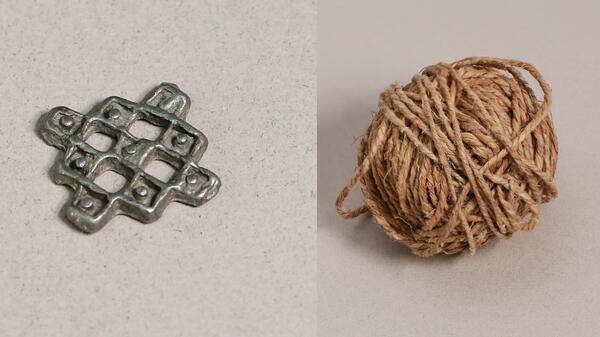
Nettle yarn was divided into several varieties depending on the purpose: canvases were woven from thin yarn, and thick yarn was used for nets.
In the late 1990s, the staff of the Museum of the Ob River went on an expedition to the national village of Lempino. Together with the locals, they managed to recreate the traditional nettle processing.
Nettles began to be harvested in early October during the morning frosts until the sun did not warm the soil. This made it possible to break off the stalk, and not pull it off the ground.
The stalks were first dried in bundles in a cold room. Then, each stalk was split into fibers with the help of special needles. The Yugan Khanty made needles from wood or elk bone, the Salym Khanty used reindeer or elk bone. For the fiber to bend and spin freely during processing, it was soaked.
Then the fibers were cleaned. They were pushed in a special nettle breaker, broken with a wooden beater on a stone, and mashed with hands. There was also a second method: the fibers were combed with a special comb—this was what the Salym Khanty used.
The comb is a special composite device. The wooden handle was made separately, and then, thin metal teeth were inserted into it. This made it possible to quickly separate the fibers and get nettle hay.
A spinning wheel and a spindle were used to spin the yarn. The Khanty spindle differed from the Russian one — it had a spindle whorl — disk or a low cylinder-shaped weight with a hole in the center. With its help, the yarn was fastened and the hand spindle was weighted. Spindle whorls were made of stone, clay, bone, and sometimes, from pieces of the broken pots. Due to their small size and strength, the spindle whorls were well preserved, and they are often found during archaeological excavations. The women were spinning on their knees.
Nettle yarn was divided into several varieties depending on the purpose: canvases were woven from thin yarn, and thick yarn was used for nets.