Font
Color
Graphics
Изображение точки

To see AR mode in action:

1. Install ARTEFACT app for iOS or Android;

2. Find the exhibition «The Life and Work of Pavel Bazhov»

3. Push the «Augmented reality» button and point your phone's camera at the exhibit;

Скрыть точки интересаПоказать точки интереса
Показать в высоком качестве

Figurine “Silver Hoof”

0
Open in app
#1
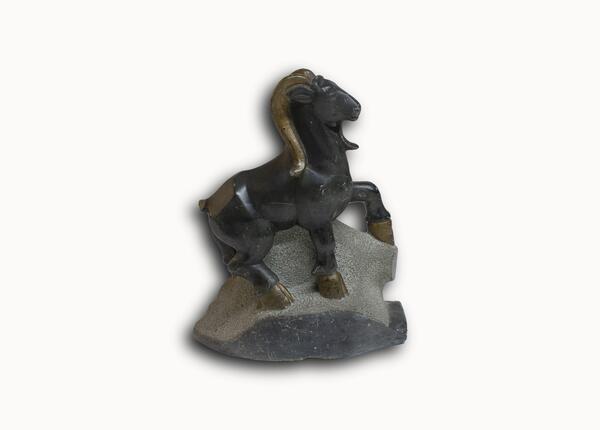
Figurine “Silver Hoof”
#6
Silver Hoof is the hero of Pavel Petrovich Bazhov’s tale of the same name. An old hunter, Kokovanya told his adopted granddaughter, the orphan Daryonka, a story about the magic goat. According to legend, when it stamped with his hoof, gems appeared. Kokovanya kept chasing after the fabulous goat, but it was the orphan girl who managed to get a glimpse of Silver Hoof: the miracle beast ran in front of her, scattering precious stones.

In the text of the tale, Silver Hoof is called a “goat”, but a professional hunter and forester, Kokovanya describes him as a roe deer: “… No taller than a table, thin legs, a pretty head… his horns are excellent. Ordinary goats have two horns, and this one has five tines. In summer [the fur] is brown … and in winter it is gray.”

In the Middle Urals, hunters called the roe deer, which was the most common hoofed animal in the local forests, a “goat” or “forest goat”.

The Silver Hoof figurine was made by students of the Mramorskoye Art School. Together with a figurine of Muryonka, the cat from the same tale, and other lapidary works, it was presented to Bazhov for his 70th birthday.

Unfortunately, not all artists, sculptors, and animators who worked on illustrating the famous Ural tales were well versed in the texts. Pavel Petrovich repeatedly commented on annoying omissions, blunders, inaccuracies and errors in the visual works of his contemporaries. For example, about Konstantin Vasilyevich Kuznetsov’s illustrations for the book “The Malachite Box”, released in 1942, he wrote as follows:
#7
The ‘Mistress of the [Copper] Mountain’… is supposed to be scary and not an attractive woman… and in the ‘Silver Hoof’ a domestic goat is drawn, instead of a species of goat-antelope.” Periodically, the writer repeated his thoughts, saying “I would not like, for example, to replace the graceful mountain goat with a domestic goat.
Pavel Petrovich Bazhov
#8
Most likely, the young creators of the sculpture ‘Silver Hoof’ focused on the word “goat” and created an animal with characteristic backward-curling horns, a beard and a stocky body.

Moreover, misinterpreting the tale, various artists depicted the magic goat as an antelope and a spotted deer, an elk and even a horse.
#2
Name: Figurine “Silver Hoof”
Date of creation: 1949
Place of creation: the USSR
Technique: soaprock, stone-cutting art, coloring
Dimensions: 19,6×15,5×9,8 cm
#9
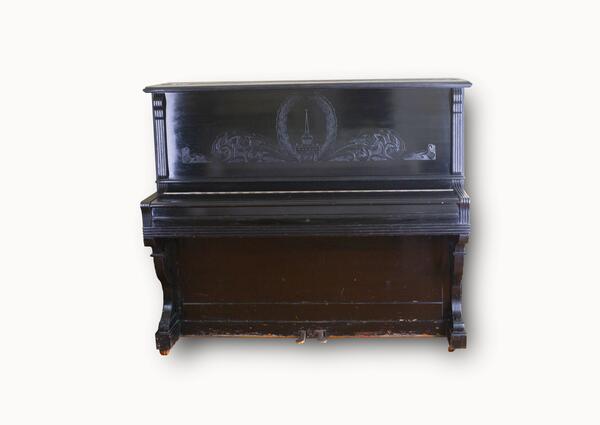
Piano
#10
Instruments under the brand name “Red October” were produced in Leningrad at the former piano factory of Jacob Becker, formerly supplier to the imperial court. In the late 19th century, Becker pianos were among the best sounding pianos in the world. They were played by Franz Liszt, Camille Saint-Saens, Pyotr Tchaikovsky, the Rubinstein brothers and many other prominent musicians.

After the Russian Revolution, the factory was nationalized by the Bolsheviks. At first, this led to a decline, but after the Great Patriotic War, the quality of Soviet products manufactured at the factory significantly increased. For instance, the concert grand piano “Russia” of the brand “Red October” was awarded the Grand Prix at the 1958 Brussels World’s Fair.

The piano appeared in the house of Pavel Petrovich Bazhov in the middle of the 20th century. The writer’s family was quite musical. Valentina Alexandrovna, Bazhov’s wife, sang beautifully and accompanied herself on the guitar. Their son Alexey had a good ear for music and, according to the memoirs of his contemporaries, “could extract sounds from any object that came to hand.” He independently and without any assistance mastered a number of stringed instruments: the guitar, mandolin, and accordion.

Pavel Petrovich himself could neither sing nor play musical instruments, which he clearly regretted and mentioned repeatedly in passing or directly.

In 1946, Bazhov’s youngest daughter Ariadna had her first child Nikita. The boy lived with his grandparents who passionately loved him. The writer bought the piano which now stands in the living room specifically for Nikita. Bazhov hoped that his grandson would grow up and learn to play an instrument. However, Nikita developed other interests, and music was not one of them. Thus, not a single member of the Bazhov family played the piano.

However, the instrument did not stand there simply gathering dust. After the publication of the collection “The Malachite Box”, the fame of the Ural author grew and the house gradually turned into a kind of salon — a popular place where various creative people would meet. Guests, including those who could play the piano, constantly gathered in the living room. Therefore, sometimes the family hosted fun musical evenings.
#3
Name: Piano
Date of creation: the first half of the 20th century
Place of creation: Leningrad, the USSR
Technique: wood, metal, plastic, factory-made
Dimensions: 130×150×36 cm
#11
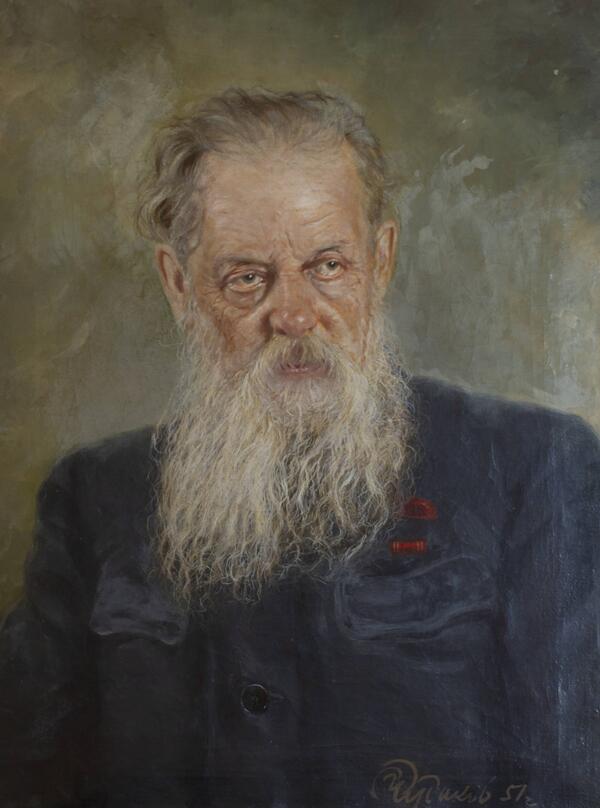
Portrait of Pavel Bazhov
#12
In the iconography of Pavel Petrovich Bazhov, the portrait by the Tula artist Seraphim Sergeyevich Chudakov occupies an honorable place. The artist, who was commissioned by Bazhov’s daughters, created several almost identical sketches on paper using pastels during the writer’s lifetime. Several years after Bazhov’s death, Chudakov also created an oil portrait, which is now presented in the dining room of the House-Museum.

The last years of Pavel Petrovich’s life, this spot housed another painting by Alexander Paramonov. Bazhov wrote about him in his letters, joking about his beard:
#13
Paramonov and I are old friends. About twenty years ago he painted my first portrait. If you remember, the one that hangs in the dining room. Back then I still had a real beard, although browned. The artist was interested in this coloring, and now it is a memento.
Pavel Petrovich Bazhov
#14
Initially, Paramonov drew a pencil portrait of Bazhov for the celebratory issue of the “Peasant Newspaper” from May 22, 1924, and then, two years later, he made a watercolor one.

Alexander Nikitich Paramonov (1874–1949) was an artist, poster designer and employee of the “Ural Regional Peasant Newspaper”, in which he worked in the 1920s together with Bazhov, who headed the department of peasant letters.

Evidently, Bazhov loved the portraits made by his old friend and colleague. Pavel Petrovich wrote to friends.
#15
He is a very old man, but a wonderful and fast draughtsman. I myself witnessed his speed. On the last day, he drew a portrait in one hour. He grumbled that this was not enough, that it was impossible, but, in my opinion, he created the most interesting portrait of all the others… Of course, I do not compare it with Bershadsky’s work, but it was an oil painting which took several months of work, and this a pencil one made in one hour.
Pavel Petrovich Bazhov
#16
The portraits by Tatiana Partina, Vasily Rozhdestvensky, the above-mentioned Julius Bershadsky, Anatoly Yar-Kravchenko, Nikolai Razdrogin are considered classic among Bazhov’s images. They all were made using various painting techniques in the 1930s and 1940s.

It is also known that Vasily Vasilyevich Kamensky, a prominent avant-garde poet, artist, and aviator, met Bazhov in Perm in 1943 at the apartment of the Ural local historian and chairman of the city executive committee Alexander Schwartz and began working on Bazhov’s portrait, which was never completed.
#4
Name: Portrait of Pavel Bazhov
Author: Serafim Chudakov
Date of creation: 1951
Place of creation: the USSR
Technique: canvas, oil
Dimensions: 68×52 cm
#5
read morehide
00:00
00:00
1x

Figurine “Silver Hoof”

0
Point your smartphone camera to open in the app
Share
VkontakteOdnoklassnikiTelegram
Share on my website
Copy linkCopied
Copy
Open in app
To see AR mode in action:
  1. Install ARTEFACT app for 
  2. iOS or Android;
  3. Find and download the «Paintings in Details» exhibition
  4. Push the «Augmented reality» button and point your phone's camera at the painting;
  5. Watch what happens on your phone screen whilst you flip through the pictures.
 
We use Cookies
Cookies on the Artefact Website. We use cookies to ensure that we give you the best experience on our website. If you continue without changing your settings, we'll assume that you are happy to receive all cookies on the Artefact website. However, if you would like to, you can change your cookie settings at any time.
Learn more about cookie useHide
Content is available only in Russian

X

Нашли опечатку?...

%title%%type%