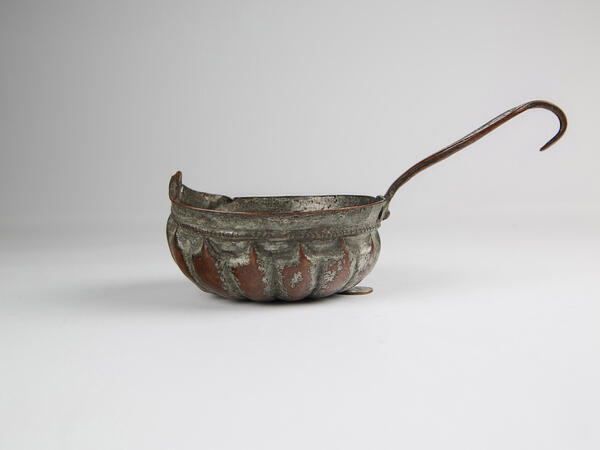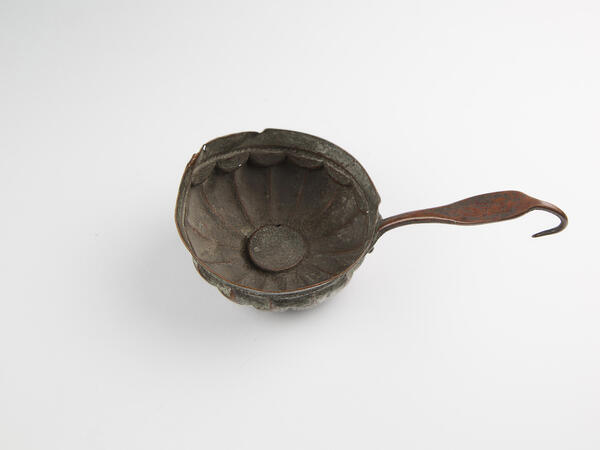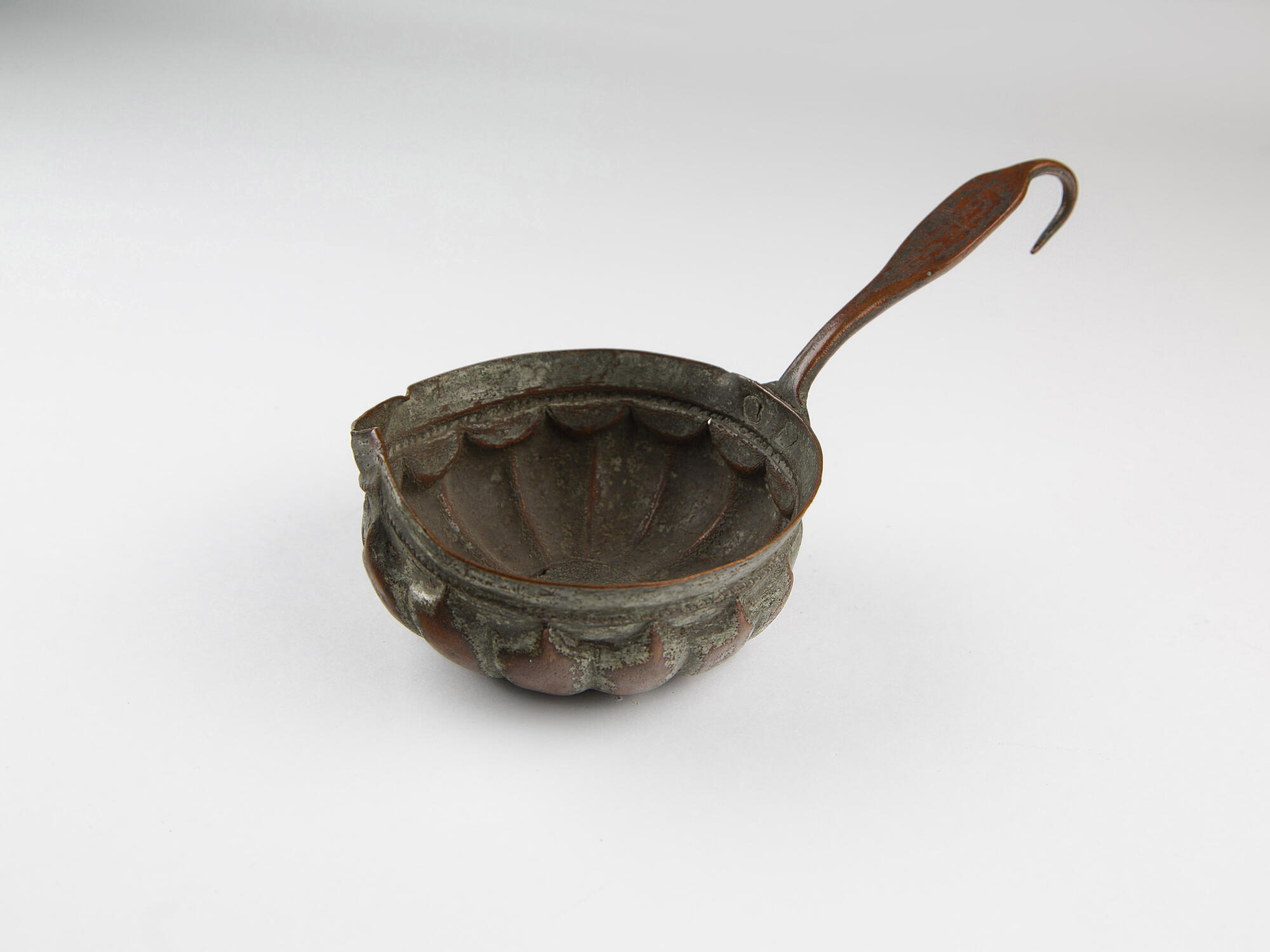


The Historical and Memorial Museum of the Demidovs presents a copper kovsh ladle — a household item that occupies a special place among old Russian drinking utensils.
The shape of kovsh ladles makes them steady and convenient to use. The first ladles were made of hollowed-out wood or pieces of trunk with a branch that served as a handle. The ladle undoubtedly originated in the north, where nature itself pushed people to make wooden tools. Wooden ladles were made as far back as the second millennium BC — they were small shallow oval bowls with handles carved into the shape of heads of water birds.
Metal ladles were first mentioned fairly recently — in the 16th century, and the word “kovsh” (ladle) did not appear until the middle of the 17th century. Most likely, the term “kovsh” emerged with the appearance of metal forging (“kovat”, meaning “to forge”), and wooden counterparts of such utensils bore some other name, which was later lost. It can be argued that boat-shaped ladles are a purely Russian form of tableware. If rounded one-handed bowls or cups with a flat or shaped handle can be found in Greece, the Caucasus and Western Europe, as well as among artifacts attributed to the Sassanian dynasty and traditional tableware of the peoples of Mongolia — boat-shaped ladles are exclusively to Russia. Throughout the centuries ladles were used in many household tasks, and therefore their size and appearance varied greatly.
Copper tableware made at the Demidov factories in the Urals are particularly interesting. The 1740s–1750s were the heyday of copper manufacture at the Demidov enterprises. It is their products that make up the majority of these items preserved in museum collections. Most patterns featured on the products from the Demidov factories are engravings with predominantly geometric and floral motifs. This ladle was made of brass — an alloy of zinc and copper with various additives. Zinc gave the ladle its golden hue — depending on its quantity, the product could turn yellow or even acquire a greenish hue. Such an alloy cost much cheaper than pure copper or gold.