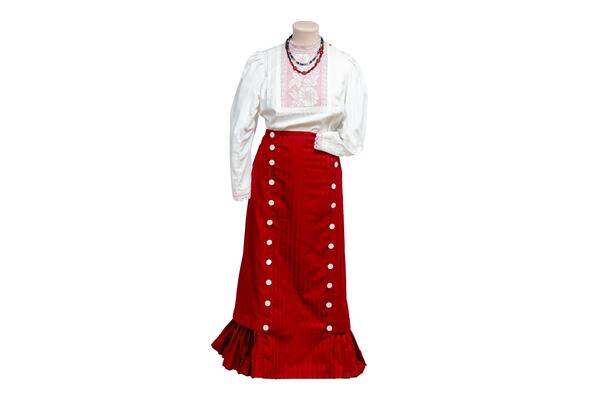
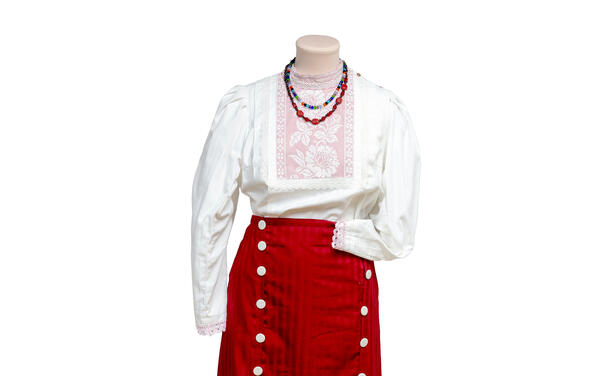
The blouse from the collection of Nizhnevartovsk Museum of Local History is a modern replica blouse of Russian Siberian women’s traditional costume. Tatiana Ilyina sewed it in 2018. The main material of the blouse is thick white cotton fabric. There are eight small hidden snaps on the left shoulder used to fasten it. Three of them are complemented with decorative pink buttons to match the collar and sleeves trimming. A lining made of thick fabric is sewn on the inner side of the chest. Many years ago it was called “podoplyoka”.
The blouse is decorated with an insert of pink fabric with white polka dots and three types of factory lace on the chest. Long sleeves are decorated with plaits on the shoulders. Along with the cuffs, you can see hand-knitted pink lace.
Women’s blouses made in the Middle Ob Region were sewn in different ways. The collar, as a rule, was upright. Sometimes it was replaced with a colorful band along the neck. Such a blouse was called “golosheika” (consonant with Russian “bare neck”). The rectangular insert, which was placed on the chest, was cross-stitched or decorated with lace, buttons, and beads. The plaits could be on the chest, on the back, or both sides. There were even straight models without any pleats.
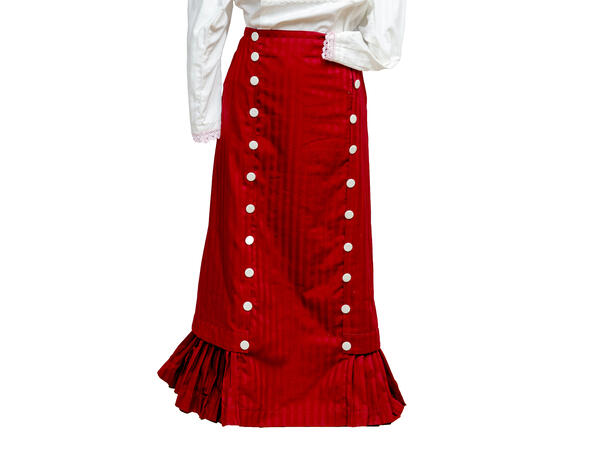
These blouses were worn with long skirts. Such costumes were called “parochka” (consonant with Russian “couple”) because they consisted of two pieces. Both skirts and blouses were often made of a fabric of the same color and texture. But sometimes the top was white with decorations matching the skirt.
“Parochka” used to be a festive costume for maidens and young women. It was sewed of purchased fabrics. Wool was chosen for winter clothes; chintz, cambric, and satin were chosen for summer clothes. Women from rich families wore festive costumes made of silk, velvet, or cashmere.
“Parochka” almost completely replaced traditional sarafans (peasant women’s dresses) by the end of the 19th century. Earlier sarafans were worn only by elderly women or during ritual ceremonies. Costumes consisted of skirts and blouses, which were popular not only in Siberia but almost in all Russian governorates. Peasant women, who lived in the villages, sewed costumes themselves, without any sewing patterns. They determined the size by eye. City women read fashion magazines and ordered costumes from professional tailoresses. The smartest and most festive models were brought from St. Petersburg and Moscow.
The blouse is decorated with an insert of pink fabric with white polka dots and three types of factory lace on the chest. Long sleeves are decorated with plaits on the shoulders. Along with the cuffs, you can see hand-knitted pink lace.
Women’s blouses made in the Middle Ob Region were sewn in different ways. The collar, as a rule, was upright. Sometimes it was replaced with a colorful band along the neck. Such a blouse was called “golosheika” (consonant with Russian “bare neck”). The rectangular insert, which was placed on the chest, was cross-stitched or decorated with lace, buttons, and beads. The plaits could be on the chest, on the back, or both sides. There were even straight models without any pleats.
These blouses were worn with long skirts. Such costumes were called “parochka” (consonant with Russian “couple”) because they consisted of two pieces. Both skirts and blouses were often made of a fabric of the same color and texture. But sometimes the top was white with decorations matching the skirt.
“Parochka” used to be a festive costume for maidens and young women. It was sewed of purchased fabrics. Wool was chosen for winter clothes; chintz, cambric, and satin were chosen for summer clothes. Women from rich families wore festive costumes made of silk, velvet, or cashmere.
“Parochka” almost completely replaced traditional sarafans (peasant women’s dresses) by the end of the 19th century. Earlier sarafans were worn only by elderly women or during ritual ceremonies. Costumes consisted of skirts and blouses, which were popular not only in Siberia but almost in all Russian governorates. Peasant women, who lived in the villages, sewed costumes themselves, without any sewing patterns. They determined the size by eye. City women read fashion magazines and ordered costumes from professional tailoresses. The smartest and most festive models were brought from St. Petersburg and Moscow.