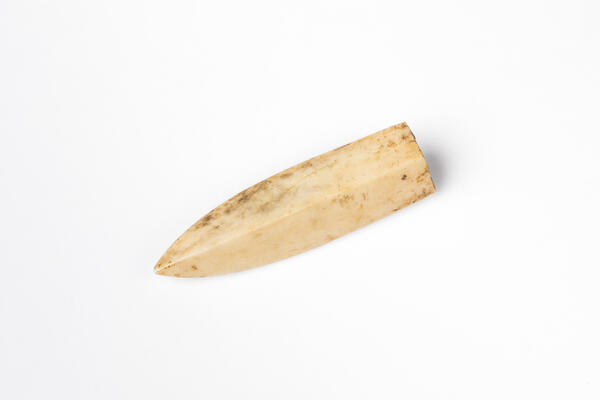
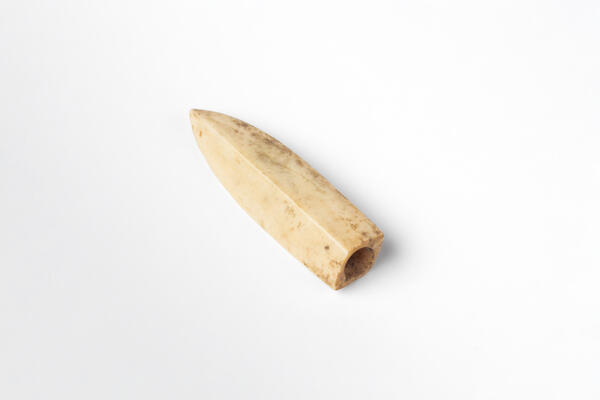
The socketed arrowhead of a triangular shape was made of bone approximately in the period from the 6th to the 5th century BCE. The researchers attributed it to the Tagar archaeological culture. The object was discovered in the village of Beya in the Republic of Khakassia in 2007. There, the Beya archaeological expedition carried out the rescue work of a large burial ground of the Podgornov stage of the Tagar culture, which developed in the 9th–3rd centuries BCE.
During the study of the site, a dense pack of bone stemmed arrowheads was found. Apparently, they were originally placed in a quiver, which has not been preserved. The bone arrowheads that archaeologists have encountered are diverse in size and shape of the blade: they are divided into three-bladed and rhombic types. According to the method of attachment to the shaft, there are two large classes: stemmed and socketed.
Bone arrowheads in the Tagar culture most often repeated the shape of the bronze ones. They were usually created in a triangular shape and very rarely in a four-bladed shape with a hidden or protruding socket. The arrowheads were cut with a knife from the thick bone of a large animal. The surface was often carefully polished. The socket was carved out with a drill and could be round, triangular or square.
Archaeologists, exploring Tagar settlements, found arrows with a triangular head shape, sometimes double-bladed and more often three-bladed. They also found arrows with a leaf-shaped head shape, usually double-bladed and much less often three-bladed. The first type probably dates back to the copper stemmed spears with a triangular head and barbs from Mesopotamia (Sumerian city of Ur) and to the flint triangular stemmed arrowheads.
The second type of Tagar
arrows, leaf-shaped, goes back to the arrows of the Srubno-Andronovsky circle,
a community of cultures named after the toponym, the village of Andronovo in
the former Yenisei province. This community belonged to the second half of the
2nd and the beginning of the 1st millennium BCE. The arrows of the Tagar were
probably influenced by the spears of the Bronze Age. The variety of bone
arrowheads was associated with a developed hunting economy and the
specialization of arrowhead shapes depending on the objects of the hunt.