#1
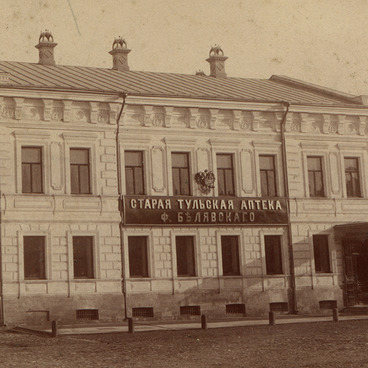
Косметика
#2
#3
#4
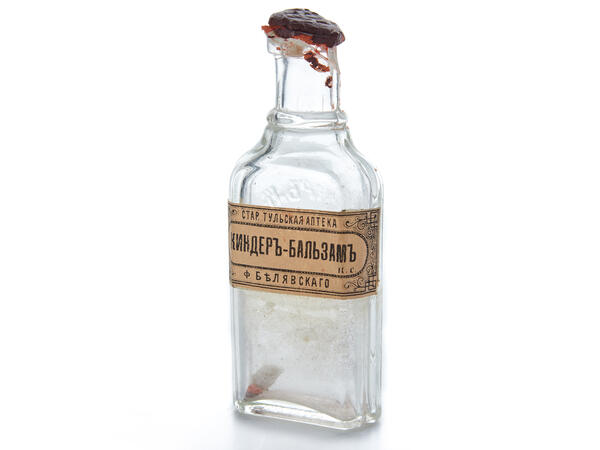
Kinder balm is a fragrant alcoholate, a folk remedy that was often used in Russia, especially in the provinces. It was obtained from alcohol and essential oils dissolved in it: nutmeg, lemon, mint. In old collections of recipes and lists of permitted medicinal substances, there are different ways of making kinder balm. The composition of the drug according to the 6th Russian Pharmacopoeia of 1910 was as follows: essential oils — nutmeg 10.0, lavender — 10.0, lemon — 3.0, clove — 3.0, fennel — 3.0, spearmint — 3.0, cinnamony — 3.0, lemon balm — 1.0, 90% wine alcohol — 1.800 and 70% wine alcohol — 5.000, 0. The volume was probably indicated in fractions. In folk medicine, kinder balm was used 30–60 drops at a time, more often women during pregnancy used it, after childbirth, with abdominal pain after lifting weights, as a remedy for uterine prolapse. Hence another name for it — ‘uplifting drops’. They were used both externally — rubbed in the abdominal area or applied as a compress — and internally. From the point of view of modern pharmacology, kinder balm, even if it worked, then it did only as a light antiflatulent thanks to essential oils.
In the late 19th — early 20th century, kinder balm gained popularity as an alcoholic drink among the lower social groups. Its frequent use led to the loss of vision and even death. In addition to kinder balm, there were also so-called Hoffmann drops — ‘liquor’, which were a mixture of two parts of 90% alcohol and one part of sulphuric ether. The abuse of these liquids got so popular among the people that the medical council considered it necessary to prohibit their free sale in pharmacies.
It was then that the tsarist government began the centralized production of alcohol: the introduction of a monopoly was supposed to help reduce alcoholism. In 1894, after the research of Dmitry Mendeleev, the technology for the production of such vodka was patented, which, among other characteristics, was diluted with water by weight exactly to 40° potency. Ever since the cheap state vodka appeared on the market, alcohol solutions were practically abandoned.
In the late 19th — early 20th century, kinder balm gained popularity as an alcoholic drink among the lower social groups. Its frequent use led to the loss of vision and even death. In addition to kinder balm, there were also so-called Hoffmann drops — ‘liquor’, which were a mixture of two parts of 90% alcohol and one part of sulphuric ether. The abuse of these liquids got so popular among the people that the medical council considered it necessary to prohibit their free sale in pharmacies.
It was then that the tsarist government began the centralized production of alcohol: the introduction of a monopoly was supposed to help reduce alcoholism. In 1894, after the research of Dmitry Mendeleev, the technology for the production of such vodka was patented, which, among other characteristics, was diluted with water by weight exactly to 40° potency. Ever since the cheap state vodka appeared on the market, alcohol solutions were practically abandoned.
#5
Full name: Pharmacy bottle with “Kinder balm” label
Date: early 20th century
Technique: molding, printing
Place: Russian Empire
Copyright: Tula Historical and Architectural Museum
Dimensions: 13×4,5×2 cm
Date: early 20th century
Technique: molding, printing
Place: Russian Empire
Copyright: Tula Historical and Architectural Museum
Dimensions: 13×4,5×2 cm
Дата создания: 2014 год
Техника: муляж
Место создания: Тула
Владелец коллекции: Тульский историко-архитектурный музей
Физические размеры: 25×18 см
#6
Peruin
#7
#8
At the turn of the 19th — 20th centuries, interest in Eastern cultures grew in society. Bouffants a la Nippon, that is, ‘Japanese style’, which resembled geisha hairdos, became fashionable. One needed thick and long hair for that. As pre-revolutionary advertising assured, cosmetic care products were supposed to help to achieve such effect. They were also used by men because of the fashion for all kinds of beards, whiskers, and thick mustaches.
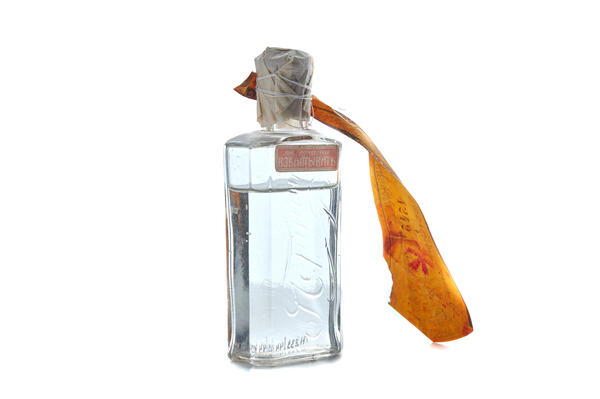
At the end of the 19th century, there was a boom in chemical discoveries, and almost every year a new cosmetic product appeared, which became another breakthrough in the market. One of such ‘fashionable’ hair care products was ‘Peruin’. It was produced by Mr. Peto, his name, as well as the recipe of the product, has not been preserved. Peto received gold medals at reputable international exhibitions, including The World Exhibition in Paris and Brussels. ‘Peruin’ became famous not so much for its effect, but aggressive advertising in newspapers and magazines:
At the end of the 19th century, there was a boom in chemical discoveries, and almost every year a new cosmetic product appeared, which became another breakthrough in the market. One of such ‘fashionable’ hair care products was ‘Peruin’. It was produced by Mr. Peto, his name, as well as the recipe of the product, has not been preserved. Peto received gold medals at reputable international exhibitions, including The World Exhibition in Paris and Brussels. ‘Peruin’ became famous not so much for its effect, but aggressive advertising in newspapers and magazines:
#39
An incomparable, the best and surest means for hair growth. Those who has hardly visible fine hair, soon develop a thick beard and an exuberant, elegant moustache. It has been proven by many experiments that ‘Peruin’ always helps, even when other means turn out to be ineffective.
#40
The product was produced in glass bottles with the inscription ‘Peruin’ or ‘Peruin-Peto’ and sold for 1 ruble 75 kopecks. It was so popular that dishonest sellers produced their own ‘peruins’ — counterfeits. To protect the product, Peto factories attached miniature gold chips and a certificate to the neck of the bottles.
These pendants were minted on the model of a real award gold medal of the Paris exhibition. Moreover, they were released repeatedly and, possibly, in different stamping workshops: the demand for a remedy for baldness was great, the chips often ran low, and they had to be minted every time. The forms were cut out anew, and despite the skill of the carvers, the stamps were noticeably different from each other. There are four varieties on the front side of the medal and three on the backside. But all these differences are insignificant and do not violate the overall design.
These pendants were minted on the model of a real award gold medal of the Paris exhibition. Moreover, they were released repeatedly and, possibly, in different stamping workshops: the demand for a remedy for baldness was great, the chips often ran low, and they had to be minted every time. The forms were cut out anew, and despite the skill of the carvers, the stamps were noticeably different from each other. There are four varieties on the front side of the medal and three on the backside. But all these differences are insignificant and do not violate the overall design.
#9
Full name: Pharmacy bottle with a “Peruin” embossed inscription
Date: the beginning of the 20th century
Technique: molding
Place: Russian Empire
Copyright: Tula Historical and Architectural Museum
Dimensions: 14×6×2 cm
Date: the beginning of the 20th century
Technique: molding
Place: Russian Empire
Copyright: Tula Historical and Architectural Museum
Dimensions: 14×6×2 cm
#10
Pomade jars
#11
#12
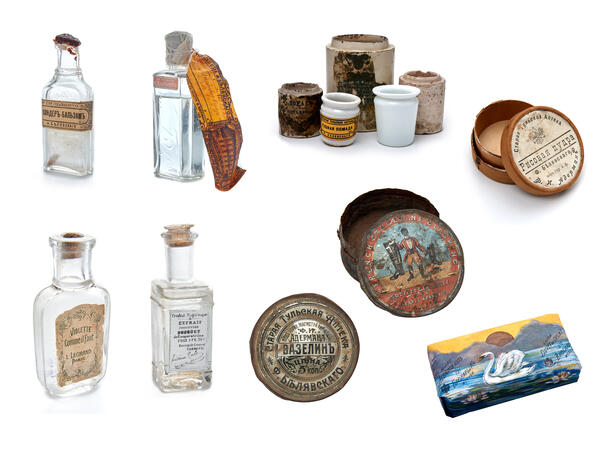
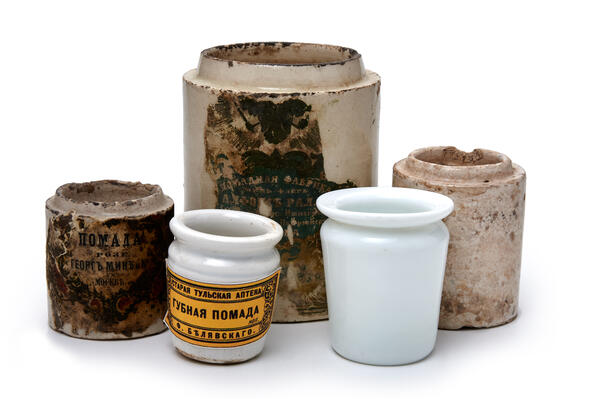
Among the exhibits of the ‘Old Tula Pharmacy, ’ there is a ceramic jar from the perfume company ‘Georg Min and Co.’ The word ‘pomade’ (‘pomada’ in Russian) has Roman roots (from the Latin ‘pomum’ — ‘apple’): in ancient Rome, this was the name of a healing ointment made of apple pulp and fat. This word came to the Russian language in the 17th century from French or German.
In the 19th — early 20th century, pomade was a hair care product that added shine and stability to the hair. It was popular with both women and men. The main ingredient was fat from pork, bovine or other fat, and aromatic substances were added to it.
By 1850, there were 11 pomade factories in Moscow; they manufactured products worth 400 thousand rubles a year. When hair sprays and hair gels came into existence, the Russian word ‘pomada’ began to be used to refer to lipsticks as well.
At the end of the 18th century, cream, pomade, and balm containers were made in Gzhel. At first, a certain peasant Stepan Fedotov was engaged in production, but already in the 1820s, earthenware jars were made at two village manufactories.
The pomade containers were somewhat different from other pharmacy containers. They had thick walls and a massive rounded bottom so that it was more convenient to take out the contents with a wooden spatula or fingers. Pomade jars were made of clay and covered with an opaque layer of glaze with the addition of tin on top: it protected the ceramic product from acids and alkalis and made the container impermeable. The container was always white inside, outside it was painted.
Archaeologists often find small ceramic containers in the late cultural deposits of Russian cities. This exhibit was found in the attic of the building where the exhibition ‘Old Tula Pharmacy’ is located. There are indications that pharmacy pomade jars were used not only for their intended purpose. In particular, Alexander Pushkin’s neighbor Praskovya Osipova recalled that, while staying in the village of Mikhailovskoye, the poet lived quite modestly and even used a cosmetic jar, probably of Gzhel production, instead of an inkwell.
In the 19th — early 20th century, pomade was a hair care product that added shine and stability to the hair. It was popular with both women and men. The main ingredient was fat from pork, bovine or other fat, and aromatic substances were added to it.
By 1850, there were 11 pomade factories in Moscow; they manufactured products worth 400 thousand rubles a year. When hair sprays and hair gels came into existence, the Russian word ‘pomada’ began to be used to refer to lipsticks as well.
At the end of the 18th century, cream, pomade, and balm containers were made in Gzhel. At first, a certain peasant Stepan Fedotov was engaged in production, but already in the 1820s, earthenware jars were made at two village manufactories.
The pomade containers were somewhat different from other pharmacy containers. They had thick walls and a massive rounded bottom so that it was more convenient to take out the contents with a wooden spatula or fingers. Pomade jars were made of clay and covered with an opaque layer of glaze with the addition of tin on top: it protected the ceramic product from acids and alkalis and made the container impermeable. The container was always white inside, outside it was painted.
Archaeologists often find small ceramic containers in the late cultural deposits of Russian cities. This exhibit was found in the attic of the building where the exhibition ‘Old Tula Pharmacy’ is located. There are indications that pharmacy pomade jars were used not only for their intended purpose. In particular, Alexander Pushkin’s neighbor Praskovya Osipova recalled that, while staying in the village of Mikhailovskoye, the poet lived quite modestly and even used a cosmetic jar, probably of Gzhel production, instead of an inkwell.
#13
Full name: Pomade jar from the company Georg Min and Co. in Moscow
Date: the beginning of the 20th century
Technique: combined
Place: Russia
Copyright: Tula Historical and Architectural Museum
Dimensions: 5×4,7×4,7 cm
Date: the beginning of the 20th century
Technique: combined
Place: Russia
Copyright: Tula Historical and Architectural Museum
Dimensions: 5×4,7×4,7 cm
#14
Rice powder
#15
#16
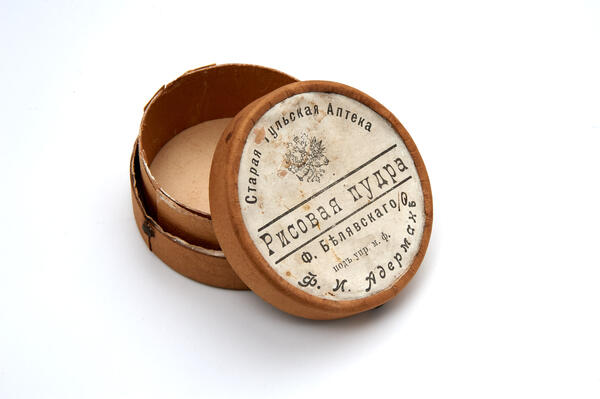
Among the exhibits of the ‘Old Tula Pharmacy’ is the round powder box. It is made of cardboard, and it is closed on the side with a metal clasp.
Since ancient times, women have used various means as cosmetics. To whiten the skin, some preferred clay, others — white lead, and others used ground crocodile droppings as a powder. It is believed that rice powder was invented in ancient China: there, rice grains were ground into flour. In European countries, the powder was also made of wheat, sometimes lead was added.
In the 17th century, not only the face was powdered, but also the hair. Under Louis XIII, wigs made of women’s hair became fashionable. Most of all, blond curls were valued. Under the King’s decree, only representatives of the ruling dynasty could wear blond wigs. Then the courtiers with dark hair began to sprinkle them with light- colored powder. Peter the First brought the fashion for wigs and powder to Russia. Following the aristocrats, merchant wives began to lighten their hair, and soon soldiers in the army were forced to wear such secular hairdos. After the overthrow of the French monarchy in 1792, powdered wigs went out of fashion.
British Queen Victoria declared cosmetics vulgar. Naturalness and a healthy complexion have become fashionable for a short time. Cosmetic powder again gained popularity at the beginning of the 20th century thanks to actresses Sarah Bernhardt and Eleanor Duse. This was also when a cosmetic revolution took place: now powder was made of talc on an industrial scale. It did not stick together into a crust, did not cause skin irritation, and was easily mixed with various dyes and fragrances. And soon lead and other harmful substances completely disappeared from the powder; they were replaced with safe zinc oxide.
The preparation of powder is a cheap and technologically simple process, so it was often produced directly at the pharmacy. Pharmacy powder of the highest grade was made of rice or potato starch and magnesia alba. The cheaper version contained kaolin and wheat starch. For the fragrance, essential oils or a drop of fashionable perfume were always added to the finished powder.
In 1923, the English company Laughton & Sons began to produce convenient compact powder boxes with a sponge. And in the 1950s, the Hollywood make-up artist Max Factor created an everyday version of his foundation powder that was accessible to all women — not only for movie actresses — which effectively hid skin imperfections. Because of the flat box, it was called Pan Cake. Helena Rubinstein was one of the first to produce inexpensive powder, and in the early 1940s, Elizabeth Arden launched mass production. The cosmetic product is still popular today: according to statistics, the inhabitants of the planet use up to 700 thousand tons of powder a year.
Since ancient times, women have used various means as cosmetics. To whiten the skin, some preferred clay, others — white lead, and others used ground crocodile droppings as a powder. It is believed that rice powder was invented in ancient China: there, rice grains were ground into flour. In European countries, the powder was also made of wheat, sometimes lead was added.
In the 17th century, not only the face was powdered, but also the hair. Under Louis XIII, wigs made of women’s hair became fashionable. Most of all, blond curls were valued. Under the King’s decree, only representatives of the ruling dynasty could wear blond wigs. Then the courtiers with dark hair began to sprinkle them with light- colored powder. Peter the First brought the fashion for wigs and powder to Russia. Following the aristocrats, merchant wives began to lighten their hair, and soon soldiers in the army were forced to wear such secular hairdos. After the overthrow of the French monarchy in 1792, powdered wigs went out of fashion.
British Queen Victoria declared cosmetics vulgar. Naturalness and a healthy complexion have become fashionable for a short time. Cosmetic powder again gained popularity at the beginning of the 20th century thanks to actresses Sarah Bernhardt and Eleanor Duse. This was also when a cosmetic revolution took place: now powder was made of talc on an industrial scale. It did not stick together into a crust, did not cause skin irritation, and was easily mixed with various dyes and fragrances. And soon lead and other harmful substances completely disappeared from the powder; they were replaced with safe zinc oxide.
The preparation of powder is a cheap and technologically simple process, so it was often produced directly at the pharmacy. Pharmacy powder of the highest grade was made of rice or potato starch and magnesia alba. The cheaper version contained kaolin and wheat starch. For the fragrance, essential oils or a drop of fashionable perfume were always added to the finished powder.
In 1923, the English company Laughton & Sons began to produce convenient compact powder boxes with a sponge. And in the 1950s, the Hollywood make-up artist Max Factor created an everyday version of his foundation powder that was accessible to all women — not only for movie actresses — which effectively hid skin imperfections. Because of the flat box, it was called Pan Cake. Helena Rubinstein was one of the first to produce inexpensive powder, and in the early 1940s, Elizabeth Arden launched mass production. The cosmetic product is still popular today: according to statistics, the inhabitants of the planet use up to 700 thousand tons of powder a year.
#17
Full name: Round pharmacy box “Rice powder. The old Tula pharmacy of F. Belyavsky”
Date: late 19th — early 20th centuries
Technique: gluing, printing
Place: Tula
Copyright: Tula Historical and Architectural Museum
Dimensions: 2,7×6×6 cm
Date: late 19th — early 20th centuries
Technique: gluing, printing
Place: Tula
Copyright: Tula Historical and Architectural Museum
Dimensions: 2,7×6×6 cm
#18
Violette Commeil Faut
#19
#20
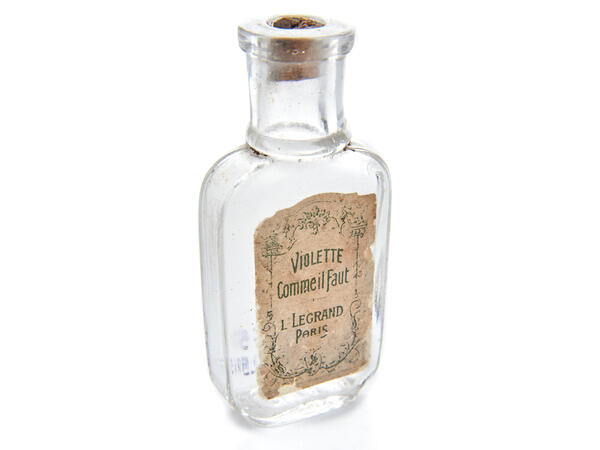
In the second half of the 19th century, hygiene products and cosmetics: soap, tooth powder, face powder, bleaching creams, hair growth products, perfumes, and aromatic waters — could be bought at a pharmacy. The ‘Old Tula pharmacy’ has a bottle of Violette Comme Il Faut perfume by the manufacturer L. Legrand, Paris. Judging by the name, it was a violet-scented perfume — sweet, powdery, boudoir, extremely popular at the end of the 19th century.
The violet symbolized innocence and purity, tenderness and modesty. No fashionable parlor was complete without pots of violets. In the stores, one could buy chocolates with violet filling and violet liqueur.
Following the fashion trends of the 19th century, Oriza L. Legrand created violet fragrances. For example, for the imperial court of Russia, it produced the fragrances ‘Violets for the Tsar’ (Aux Violettes du Czar), ‘Royal violets for a scarf’ (Violettes du Czar pour le Mouchoir), ‘Double violets for the Tsar’ (Doubles Violettes du Czar).
Oriza L. Legrand was a famous European perfume company. In the 19th century, it was a supplier to the royal courts of France, England, Italy, and Russia.
The Maison Oriza Company was founded by the famous royal perfumer Jean Farjon in 1720. The name Oriza plays around with 'gold' (or) and 'rice' (riz) — rice powder for wigs and make-up. In 1811, Louis Legrand bought it from the heirs of Farjon along with the archives of perfumes and cosmetics and opened his own store on the street Saint-Honore. Half a century later, in 1860, he sold the brand to his younger and more energetic partner Antonin Reynaud. In 1879, Raynaud created the world’s first perfume line Parfumerie Oriza. Its fragrances were accompanied by cosmetics that had a common name with perfumes and had a similar bottle design. Raynaud was the first to add his perfume to soaps and other cosmetics. This is how he revolutionised cosmetic marketing, ahead of other well-known companies.
In the spring of 1890, when perfume markets were operating in almost every arrondissement in Paris, where one could buy cheap perfumes, the house of Oriza L. Legrand opened a luxury store on the Place Madeleine in the city center, emphasizing that their products were only for the elite. The company participated in international exhibitions, receiving numerous awards — from the bronze medal at the universal exhibition in Paris in 1867 to the Grand Prix there in 1900.
The violet symbolized innocence and purity, tenderness and modesty. No fashionable parlor was complete without pots of violets. In the stores, one could buy chocolates with violet filling and violet liqueur.
Following the fashion trends of the 19th century, Oriza L. Legrand created violet fragrances. For example, for the imperial court of Russia, it produced the fragrances ‘Violets for the Tsar’ (Aux Violettes du Czar), ‘Royal violets for a scarf’ (Violettes du Czar pour le Mouchoir), ‘Double violets for the Tsar’ (Doubles Violettes du Czar).
Oriza L. Legrand was a famous European perfume company. In the 19th century, it was a supplier to the royal courts of France, England, Italy, and Russia.
The Maison Oriza Company was founded by the famous royal perfumer Jean Farjon in 1720. The name Oriza plays around with 'gold' (or) and 'rice' (riz) — rice powder for wigs and make-up. In 1811, Louis Legrand bought it from the heirs of Farjon along with the archives of perfumes and cosmetics and opened his own store on the street Saint-Honore. Half a century later, in 1860, he sold the brand to his younger and more energetic partner Antonin Reynaud. In 1879, Raynaud created the world’s first perfume line Parfumerie Oriza. Its fragrances were accompanied by cosmetics that had a common name with perfumes and had a similar bottle design. Raynaud was the first to add his perfume to soaps and other cosmetics. This is how he revolutionised cosmetic marketing, ahead of other well-known companies.
In the spring of 1890, when perfume markets were operating in almost every arrondissement in Paris, where one could buy cheap perfumes, the house of Oriza L. Legrand opened a luxury store on the Place Madeleine in the city center, emphasizing that their products were only for the elite. The company participated in international exhibitions, receiving numerous awards — from the bronze medal at the universal exhibition in Paris in 1867 to the Grand Prix there in 1900.
#21
Full name: Faceted perfume bottle with Violette Comme Il Faut label
Date: early 20th century
Technique: molding, printing
Place: France
Copyright: Tula Historical and Architectural Museum
Dimensions: 4×1,8×1,8 cm
Date: early 20th century
Technique: molding, printing
Place: France
Copyright: Tula Historical and Architectural Museum
Dimensions: 4×1,8×1,8 cm
#22
Bouquet of the Empress
#23
#24
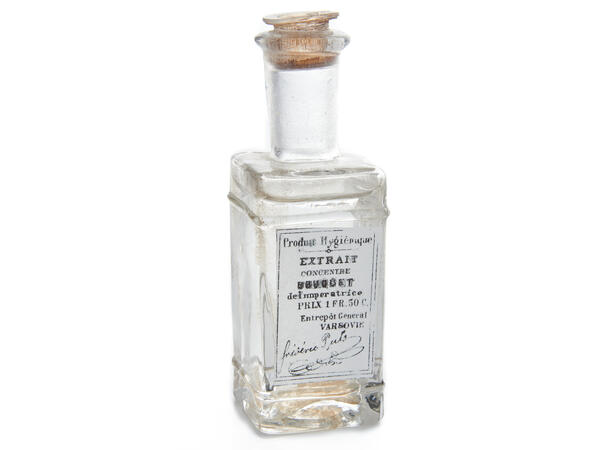
In the second half of the 19th century, not only medicines could be purchased at the pharmacy, but also soap, tooth powder, face powder, bleaching creams, hair growth products, as well as perfumes, and aromatic waters. One of the exhibits of the ‘Old Tula Pharmacy’ is a closed four-sided bottle where perfume water was stored. On one of the sides, one can see an embossed inscription: Frederic Puls Varsovie Paris — the brand name of the manufacturer, the Warsaw perfume factory ‘F. Puls’. The bottle was made in the late 19th — early 20th century. A copy of the label with the inscription and the name of the perfume ‘Bouquet of the Empress’ in French is pasted on it, the original label is stored in the museum funds.
‘Bouquet of the Empress’ perfume was created by the founder of the legendary perfume company ‘Brocard & Co’ Heinrich Brocard in the 70s of the 19th century. They say that it echoed the scent of a flower bouquet that Brocard presented to the daughter of Alexander II, Grand Duchess Maria Alexandrovna. The bouquet was made of fragrant wax, and each flower had its own unique smell.
Later, in 1913, when Russia celebrated the 300th anniversary of the House of Romanov, most entrepreneurs released special merchandise for this occasion.
The leaders of the ‘Brocard and Co’ partnership also joined this movement, recollecting the story about the fragrant bouquet once presented to the Grand Duchess. The perfumer Auguste Michel, who worked with the founder of the company, was assigned to recreate and modernize the smell of the ‘Bouquet of the Empress’ in time for the start of the celebrations.
But in fact, Auguste Michel created a new fragrance: the perfume, in addition to several dozen floral components, included aldehydes — newly invented synthetic substances that gave them an incomparable aroma. This time, the perfume was presented to the mother of Nicholas II, the Dowager Empress Maria Feodorovna. She was delighted with the new fragrance and gave permission to call the perfume ‘The Favorite bouquet of the Empress’. The royal-looking perfume box was decorated with expensive red silk. A portrait of Catherine II was put on the label of the bottle of the ‘Favorite Bouquet of the Empress’, because Maria Feodorovna, according to the testimony of her confidants, considered it immodest to place her own portrait on it. In the same year, 1913, Michel’s company “Heinrich Brocard” was awarded the title “Supplier of His Imperial Majesty”s Court”.
After the revolution, the company “Brocard and Co” was handed over to the state and called “New Dawn”. It is assumed that the production of the fragrance “Favorite Bouquet of the Empress” at the factory was resumed in 1925 under the name “Red Moscow”.
‘Bouquet of the Empress’ perfume was created by the founder of the legendary perfume company ‘Brocard & Co’ Heinrich Brocard in the 70s of the 19th century. They say that it echoed the scent of a flower bouquet that Brocard presented to the daughter of Alexander II, Grand Duchess Maria Alexandrovna. The bouquet was made of fragrant wax, and each flower had its own unique smell.
Later, in 1913, when Russia celebrated the 300th anniversary of the House of Romanov, most entrepreneurs released special merchandise for this occasion.
The leaders of the ‘Brocard and Co’ partnership also joined this movement, recollecting the story about the fragrant bouquet once presented to the Grand Duchess. The perfumer Auguste Michel, who worked with the founder of the company, was assigned to recreate and modernize the smell of the ‘Bouquet of the Empress’ in time for the start of the celebrations.
But in fact, Auguste Michel created a new fragrance: the perfume, in addition to several dozen floral components, included aldehydes — newly invented synthetic substances that gave them an incomparable aroma. This time, the perfume was presented to the mother of Nicholas II, the Dowager Empress Maria Feodorovna. She was delighted with the new fragrance and gave permission to call the perfume ‘The Favorite bouquet of the Empress’. The royal-looking perfume box was decorated with expensive red silk. A portrait of Catherine II was put on the label of the bottle of the ‘Favorite Bouquet of the Empress’, because Maria Feodorovna, according to the testimony of her confidants, considered it immodest to place her own portrait on it. In the same year, 1913, Michel’s company “Heinrich Brocard” was awarded the title “Supplier of His Imperial Majesty”s Court”.
After the revolution, the company “Brocard and Co” was handed over to the state and called “New Dawn”. It is assumed that the production of the fragrance “Favorite Bouquet of the Empress” at the factory was resumed in 1925 under the name “Red Moscow”.
#25
Full name: Faceted perfume bottle with the “Concentrated extrait " Bouquet of the Empress” label
Date: early 20th century
Technique: molding, printing
Place: Warsaw
Copyright: Tula Historical and Architectural Museum
Dimensions: 9×3×3 cm
Date: early 20th century
Technique: molding, printing
Place: Warsaw
Copyright: Tula Historical and Architectural Museum
Dimensions: 9×3×3 cm
#26
Vaseline
#27
#28
The name ‘vaseline’ is formed from two foreign words: the German wasser (water) and the Greek elaion (olive oil). This is a salve-like substance, which has the form of a purified translucent mass without smell and taste. It is produced from oil. Due to its structure, vaseline cannot be dissolved in water or alcohol, but it is soluble in ether, gasoline, and chloroform.
Vaseline was invented in the second half of the 19th century by the English chemist Robert Chesebrough. During a trip to an oil field in Pennsylvania, 22-year-old Robert noticed a jelly-like mass that clogged the filters of the pumps. Later, he found out that workers sometimes used this substance as an ointment to heal cuts and burns.
Chesebrough began to examine the substance, refined it from the smell, made it transparent, and called it oil jelly. Soon the pharmacies began to sell the new product, but it was not popular. Its name scared off buyers: they thought that the substance was flammable. Therefore, the ointment was renamed vaseline.
There are two types of vaseline: natural and artificial. Natural (‘American’) vaseline is obtained by processing and refining deciduous paraffin resins. Natural vaseline is transparent and has a strong viscosity and stickiness, it is difficult to wash off. Artificial vaseline has a yellow tone to it. It is produced at oil plants or cosmetic factories. Artificial vaseline is used as the basis of creams and ointments for medicinal purposes.
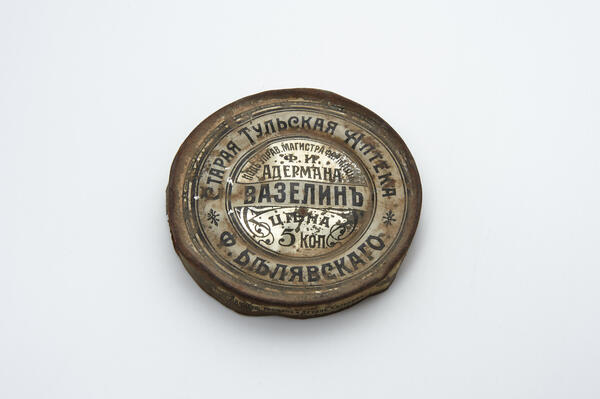
At the end of the 19th century, vaseline could be found on the shelves of pharmacies. In the pharmacy of Ferdinand Belyavsky, it was sold in a flattened tin jar worth 5 kopecks. The article of the ‘Magazine for Housewives’ from 1912, mentioned the useful properties of vaseline: ‘Vaseline is the best tool for skin lubrication. <… > Softens the skin no worse than the most composite and expensive creams.’ The author of the article advised putting the vaseline on one’s hands and face in cold and hot weather before going outside. And before going to bed, it was necessary to rub the body with it.
In those years, vaseline was used not only as a medical remedy. Housewives wiped wooden furniture with it, baseball players wiped the skin of gloves, and swimmers rubbed the body to reduce resistance in the water. Even actresses often put vaseline tears on their faces before the performance.
Vaseline was invented in the second half of the 19th century by the English chemist Robert Chesebrough. During a trip to an oil field in Pennsylvania, 22-year-old Robert noticed a jelly-like mass that clogged the filters of the pumps. Later, he found out that workers sometimes used this substance as an ointment to heal cuts and burns.
Chesebrough began to examine the substance, refined it from the smell, made it transparent, and called it oil jelly. Soon the pharmacies began to sell the new product, but it was not popular. Its name scared off buyers: they thought that the substance was flammable. Therefore, the ointment was renamed vaseline.
There are two types of vaseline: natural and artificial. Natural (‘American’) vaseline is obtained by processing and refining deciduous paraffin resins. Natural vaseline is transparent and has a strong viscosity and stickiness, it is difficult to wash off. Artificial vaseline has a yellow tone to it. It is produced at oil plants or cosmetic factories. Artificial vaseline is used as the basis of creams and ointments for medicinal purposes.
At the end of the 19th century, vaseline could be found on the shelves of pharmacies. In the pharmacy of Ferdinand Belyavsky, it was sold in a flattened tin jar worth 5 kopecks. The article of the ‘Magazine for Housewives’ from 1912, mentioned the useful properties of vaseline: ‘Vaseline is the best tool for skin lubrication. <… > Softens the skin no worse than the most composite and expensive creams.’ The author of the article advised putting the vaseline on one’s hands and face in cold and hot weather before going outside. And before going to bed, it was necessary to rub the body with it.
In those years, vaseline was used not only as a medical remedy. Housewives wiped wooden furniture with it, baseball players wiped the skin of gloves, and swimmers rubbed the body to reduce resistance in the water. Even actresses often put vaseline tears on their faces before the performance.
#29
Full name: Round lid from a vaseline jar
Date: late 19th — early 20th centuries
Technique: metal, printing
Place: Tula
Copyright: Tula Historical and Architectural Museum
Dimensions: 4,5×4,5×0,5 cm
Date: late 19th — early 20th centuries
Technique: metal, printing
Place: Tula
Copyright: Tula Historical and Architectural Museum
Dimensions: 4,5×4,5×0,5 cm
#30
Blacking
#31
#32
Pharmacies of the 19th century sold not only medicines, cosmetics, but also various chemicals — what is now commonly called household chemicals: gasoline, kerosene, wood alcohol, soap, remedies for fleas, lice, and cockroaches. Therefore, one could buy blacking in the pharmacy of Ferdinand Belyavsky. Blacking, also known as shoe polish, was a popular leather shoe care product in the 18th–20th centuries. Not only did it protect the shoes from the effects of the external environment, but it also gave them shine.
In old books, the following recipe for shoe polish is given: beat up an egg with a little soot and dilute the resulting mixture in a few tablespoons of vinegar or beer. The result was a liquid shoe polish, which was used to lubricate the boots and shoes using a brush. Such shoe polish did not add shine to shoes — after drying, leather acquired a harsh whitish-matte color.
In the 18th century, the French introduced the fashion for highly polished shoes. Since then, new recipes for polishing agents began to appear. As a rule, they were based on beeswax and lanolin — animal wax, which was extracted from sheep wool. The black color was given by soot.
By the beginning of the 19th century, London (Great Britain) and Chicago (USA) became the main centers of production of shoe polish — blacking. From there, the blacking was transported to other countries in the form of a paste, which was then packed in oiled paper or round tin cans. There were many recipes for shoe polish. Every manufacturer wanted to to be different and get ahead of its competitors. That led to the appearance of a large number of original recipes. For example, the composition of the highest quality shoe polish of the 19th century included: fish oil — 42%, molasses — 20%, bone black — 20%, sulfuric acid — 9%, caustic soda — 9%.
For a long period, shoe polish was imported into the Russian Empire from abroad. The volume of deliveries reached 40 thousand poods (36 lb, 16.38 kg) per year or about 640 tons. The cost of deliveries was more than 500 thousand rubles — in the modern equivalent, it is half a billion. Most of all, German shoe polish was purchased, which was considered high-quality. From the German word gut — ‘good’ — the second name of this product appeared in Russia (blacking in Russian is ‘gutalin’).
Soon, for each pood, or 16 kg, of imported shoe polish, the state began to collect a fee of 2 rubles 40 kopecks, and as a result, the import of blacking soon decreased, however, Russian manufacturers started to appear.
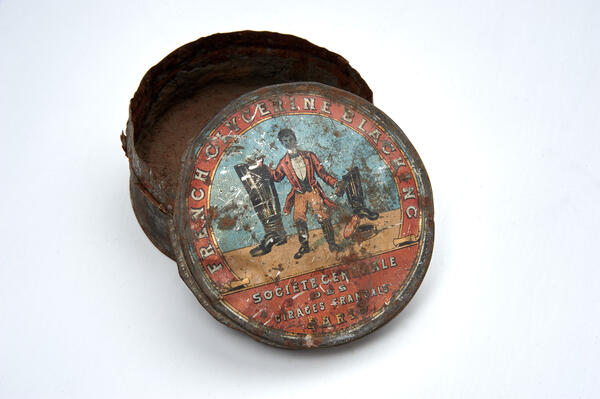
The exhibition presents a shoe polish tin box produced in France.
In old books, the following recipe for shoe polish is given: beat up an egg with a little soot and dilute the resulting mixture in a few tablespoons of vinegar or beer. The result was a liquid shoe polish, which was used to lubricate the boots and shoes using a brush. Such shoe polish did not add shine to shoes — after drying, leather acquired a harsh whitish-matte color.
In the 18th century, the French introduced the fashion for highly polished shoes. Since then, new recipes for polishing agents began to appear. As a rule, they were based on beeswax and lanolin — animal wax, which was extracted from sheep wool. The black color was given by soot.
By the beginning of the 19th century, London (Great Britain) and Chicago (USA) became the main centers of production of shoe polish — blacking. From there, the blacking was transported to other countries in the form of a paste, which was then packed in oiled paper or round tin cans. There were many recipes for shoe polish. Every manufacturer wanted to to be different and get ahead of its competitors. That led to the appearance of a large number of original recipes. For example, the composition of the highest quality shoe polish of the 19th century included: fish oil — 42%, molasses — 20%, bone black — 20%, sulfuric acid — 9%, caustic soda — 9%.
For a long period, shoe polish was imported into the Russian Empire from abroad. The volume of deliveries reached 40 thousand poods (36 lb, 16.38 kg) per year or about 640 tons. The cost of deliveries was more than 500 thousand rubles — in the modern equivalent, it is half a billion. Most of all, German shoe polish was purchased, which was considered high-quality. From the German word gut — ‘good’ — the second name of this product appeared in Russia (blacking in Russian is ‘gutalin’).
Soon, for each pood, or 16 kg, of imported shoe polish, the state began to collect a fee of 2 rubles 40 kopecks, and as a result, the import of blacking soon decreased, however, Russian manufacturers started to appear.
The exhibition presents a shoe polish tin box produced in France.
#33
Full name: Blacking Tin
Date: the end of the 19th century
Technique: stamping, color printing on the lid
Place: France
Copyright: Tula Historical and Architectural Museum
Dimensions: 3×7,5×7,5 cm
Date: the end of the 19th century
Technique: stamping, color printing on the lid
Place: France
Copyright: Tula Historical and Architectural Museum
Dimensions: 3×7,5×7,5 cm
#34
Soap
#35
#36
The Roman scientist and politician Pliny the Elder claimed that the ancient Gauls and Germans knew a soap-making recipe. For its production, they used animal fat and beech tree ash. This mixture was used to clean and dye hair, as well as to treat skin diseases. In the 7th century, a Soap-Makers' Guild was formed in Naples. By the 14th century, soap was available all over Europe. The peak of the art of soap making can be considered the second half of the 19th — early 20th centuries when perfumers took up the task.
In 1864, Heinrich Brocard, the son of a French soap manufacturer, opened a small soap production company in Moscow with a staff of three people, including himself. The equipment was simple: a stone mortar for grinding the components, several containers, and a stove that was heated with firewood. Despite the rather modest conditions, the company produced up to a hundred pieces of soap a day, and there were three types of it: ‘Baby’, ‘Honey’ and ‘Amber’. Heinrich Brocard himself delivered goods to retail stores and pharmacies.
Very quickly, the production of Brocard grew to a large-scale and well-known enterprise. Shaped soap became one of the most popular products. Not only did it have an unusual shape in the form of fruit, vegetables, or animals, but it also had a fragrant aroma. Baby soap was also transformed: the company produced alphabetic soap for children, where each piece of soap was a separate letter. This technique affected sales: some children tried to collect the entire alphabet. Brocard’s most important invention was affordable soap that everyone could buy — “Folk soap”. It could be bought for just one kopeck.
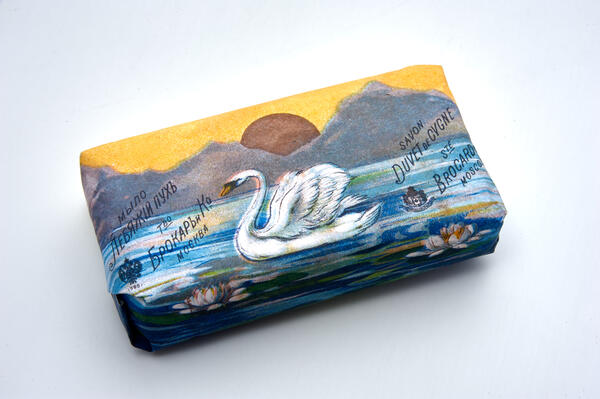
In Tula stores and pharmacies, soap was sold as well — both foreign-made and domestic. Strawberry and rose aromas were considered the most popular in Tula. The Old Tula pharmacy sold soap from the Brocard and Co. factory. After the revolution, the factory of Heinrich Brocard was nationalized, transferred to the ownership of the state, and the name was changed to " Novaya Zarya " (New Dawn). The factory continued to produce the same products but under different, revolutionary names.
In 1864, Heinrich Brocard, the son of a French soap manufacturer, opened a small soap production company in Moscow with a staff of three people, including himself. The equipment was simple: a stone mortar for grinding the components, several containers, and a stove that was heated with firewood. Despite the rather modest conditions, the company produced up to a hundred pieces of soap a day, and there were three types of it: ‘Baby’, ‘Honey’ and ‘Amber’. Heinrich Brocard himself delivered goods to retail stores and pharmacies.
Very quickly, the production of Brocard grew to a large-scale and well-known enterprise. Shaped soap became one of the most popular products. Not only did it have an unusual shape in the form of fruit, vegetables, or animals, but it also had a fragrant aroma. Baby soap was also transformed: the company produced alphabetic soap for children, where each piece of soap was a separate letter. This technique affected sales: some children tried to collect the entire alphabet. Brocard’s most important invention was affordable soap that everyone could buy — “Folk soap”. It could be bought for just one kopeck.
In Tula stores and pharmacies, soap was sold as well — both foreign-made and domestic. Strawberry and rose aromas were considered the most popular in Tula. The Old Tula pharmacy sold soap from the Brocard and Co. factory. After the revolution, the factory of Heinrich Brocard was nationalized, transferred to the ownership of the state, and the name was changed to " Novaya Zarya " (New Dawn). The factory continued to produce the same products but under different, revolutionary names.
#37
Full name: Moulage soap packaging “Swan’s down” (“Brocard and Co” Partnership)
Date: 2011
Technique: printing
Place: Tula
Copyright: Tula Historical and Architectural Museum
Dimensions: 4×8×2 cm
Date: 2011
Technique: printing
Place: Tula
Copyright: Tula Historical and Architectural Museum
Dimensions: 4×8×2 cm
#38
Ministry of Culture of the Russian Federation
read morehide
00:00
00:00
1x
Cosmetics
Exhibition
0
 Point your smartphone camera to open in the app
Open in app
Share