During the Great Patriotic War, the ammunition factory of the People’s Commissariat of USSR Internal Affairs was evacuated from Kharkiv to Siberia — to the village of Chekist, now it is the territory of the closed administrative-territorial formation of Seversk. The main labor force at the plant during the war years was about 800 engineering and technical workers and 2500-3000 prisoners of the correctional labor colony No. 5 (ITK-5).
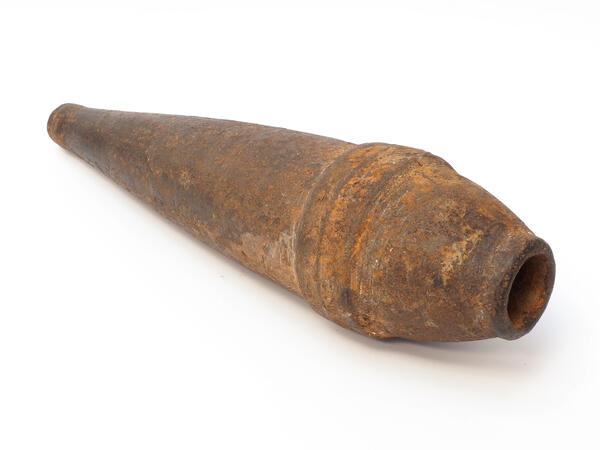
During the construction of the Seversk city in the area of the 10th micro-district, on the site of the former factory, many cases of mines were found, which are now stored in the museum. Among them is the teardrop-shaped case of a high explosive cast-iron mine.
Already in the first quarter of 1942, the plant began to produce mines M-50, M-82, M-120, and special closures — wooden boxes for them. During the four years of operation, the Kharkiv Mine Plant at the Chekist produced about two million cases.
Four workshops worked at the plant, they were connected by a narrow-gauge railway. In the first room, cast iron was melted and the metal was manually poured into molds. This method was considered very dangerous: workers often received severe burns. In the second workshop, the cases were polished, in the third their quality was checked in a special way under pressure. In the fourth, the mines were prepared for transportation: they were packed in special boxes. The cases were sent from the factory without filling, the plant near Novosibirsk ‘filled’ the mines. The war ended in May, but mines were released in the Chekist until June 1945. The plant was liquidated. One of the reasons was that the old equipment was worn out.
The mines that were produced at the factory were intended for a 120-millimeter regiment mortar. It was designed in 1938 at the Frunze Arsenal Design Bureau. The Soviet designer of mortar and rocket weapons Boris Shavyrin supervised the development of the gun.
Mortars of this type were used in all directions during the Great Patriotic War. The guns were remarkable in the way that the soldiers could conduct continuous fire. The rate of fire reached 15 rounds per second. 120 mm mortars fired in such a way that there were 18 mines in the air at the same time — when the first mine exploded on the enemy’s positions, the twentieth one was falling into the barrel.
During the construction of the Seversk city in the area of the 10th micro-district, on the site of the former factory, many cases of mines were found, which are now stored in the museum. Among them is the teardrop-shaped case of a high explosive cast-iron mine.
Already in the first quarter of 1942, the plant began to produce mines M-50, M-82, M-120, and special closures — wooden boxes for them. During the four years of operation, the Kharkiv Mine Plant at the Chekist produced about two million cases.
Four workshops worked at the plant, they were connected by a narrow-gauge railway. In the first room, cast iron was melted and the metal was manually poured into molds. This method was considered very dangerous: workers often received severe burns. In the second workshop, the cases were polished, in the third their quality was checked in a special way under pressure. In the fourth, the mines were prepared for transportation: they were packed in special boxes. The cases were sent from the factory without filling, the plant near Novosibirsk ‘filled’ the mines. The war ended in May, but mines were released in the Chekist until June 1945. The plant was liquidated. One of the reasons was that the old equipment was worn out.
The mines that were produced at the factory were intended for a 120-millimeter regiment mortar. It was designed in 1938 at the Frunze Arsenal Design Bureau. The Soviet designer of mortar and rocket weapons Boris Shavyrin supervised the development of the gun.
Mortars of this type were used in all directions during the Great Patriotic War. The guns were remarkable in the way that the soldiers could conduct continuous fire. The rate of fire reached 15 rounds per second. 120 mm mortars fired in such a way that there were 18 mines in the air at the same time — when the first mine exploded on the enemy’s positions, the twentieth one was falling into the barrel.