#1
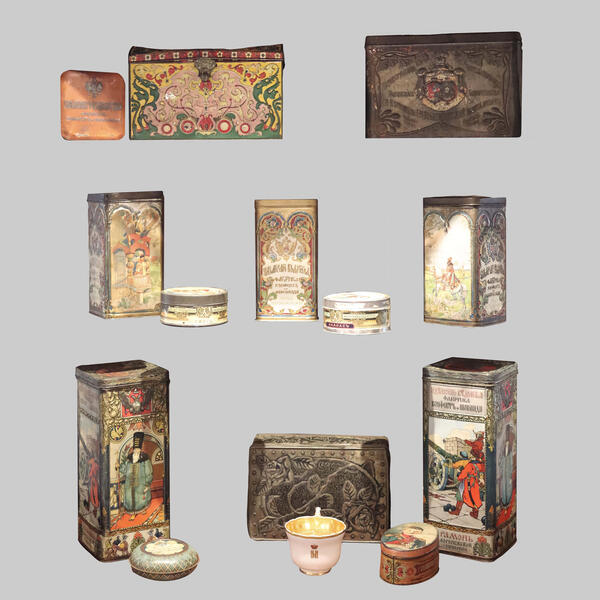
Candy boxes, a tea cup
#8
#2
#3
In 1878, Princess Eugenia of Oldenburg bought the Ramon estate. There was already a house of former owners of Ramon, the Tulinovs, next to which a small candle factory was located, and a sugar factory was situated on the slope to the river. Its productivity was no more than 4 bags of sugar per day.
Eugenia Maksimilianovna built a new two-story sugar factory and equipped it with the best steam technology. After the sugar factory in 1891, the Grand Duchess opened a refinery station and, finally, in 1900, the ‘Steam Factory of Sweets and Chocolate of Her Imperial Highness Princess Eugenia Maksimilianovna of Oldenburg’.
Already by 1905, the factory produced more than 400 types of sweet products: candies ‘Masterpiece’, ‘Grenadier’, types of caramel from the simplest ‘Montpensier’ to exotic ‘Guava’, dark, milk and even liquid chocolate in faceted bottles, fruit candy, marmalade, lollipops and gingerbread.
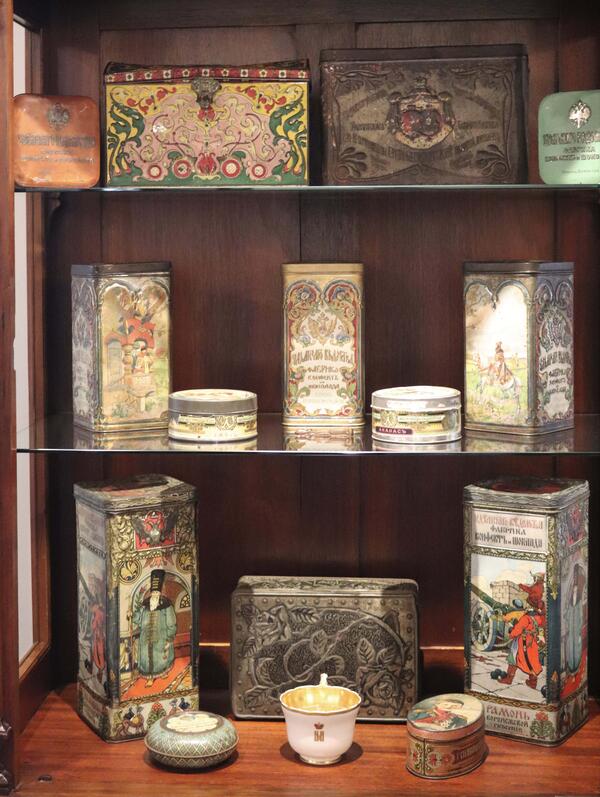
All labels and images on tin boxes in which products were packed were highly artistic. Best artists such as Viktor Vasnetsov, Aleksandr Benois, Ivan Bilibin and Mikhail Vrubel were involved in their development.
The factory brought in a considerable income, products were readily purchased both in the Russian Empire and abroad.
The first specialized packages with advertising slogans and an indication of the manufacturer of the product appeared at the beginning of the 19th century. In addition to decorative elements and advertisements, they often featured useful or entertaining information. To attract customers, confectioners often ordered packages that were in series or sets.
Since the 1880s, when a method of applying an image on tin by chromolithography (metallochromy) was created, tin packaging quickly gained popularity. By the end of the 19th century, its production acquired an industrial scale. The variety of shapes and colorful design of tin boxes made products packed in them even more attractive to buyers and allowed the seller to highlight their products on the shelves. In addition, ‘cans’, as they were called then, more reliably protected products not fit for dampness: biscuits, gingerbread, caramel, and montpensier. Designs on boxes were very different and were applied in different ways - from ordinary paper labels to enamel techniques. coin chasing was also very popular.
Metal boxes for montpensiers were hand-painted. The packaging has also always featured confectionery industry awards received for high quality products at trade shows. Even if an award was given for a separate type of product, for example, montpensier, its image could be placed on the package of any product of that company. As a sign of the highest recognition of quality, confectioners received the right to place the coat of arms of the Russian Empire and the sign ‘Supplier of the court of His Imperial Majesty’ on their products.
Eugenia Maksimilianovna built a new two-story sugar factory and equipped it with the best steam technology. After the sugar factory in 1891, the Grand Duchess opened a refinery station and, finally, in 1900, the ‘Steam Factory of Sweets and Chocolate of Her Imperial Highness Princess Eugenia Maksimilianovna of Oldenburg’.
Already by 1905, the factory produced more than 400 types of sweet products: candies ‘Masterpiece’, ‘Grenadier’, types of caramel from the simplest ‘Montpensier’ to exotic ‘Guava’, dark, milk and even liquid chocolate in faceted bottles, fruit candy, marmalade, lollipops and gingerbread.
All labels and images on tin boxes in which products were packed were highly artistic. Best artists such as Viktor Vasnetsov, Aleksandr Benois, Ivan Bilibin and Mikhail Vrubel were involved in their development.
The factory brought in a considerable income, products were readily purchased both in the Russian Empire and abroad.
The first specialized packages with advertising slogans and an indication of the manufacturer of the product appeared at the beginning of the 19th century. In addition to decorative elements and advertisements, they often featured useful or entertaining information. To attract customers, confectioners often ordered packages that were in series or sets.
Since the 1880s, when a method of applying an image on tin by chromolithography (metallochromy) was created, tin packaging quickly gained popularity. By the end of the 19th century, its production acquired an industrial scale. The variety of shapes and colorful design of tin boxes made products packed in them even more attractive to buyers and allowed the seller to highlight their products on the shelves. In addition, ‘cans’, as they were called then, more reliably protected products not fit for dampness: biscuits, gingerbread, caramel, and montpensier. Designs on boxes were very different and were applied in different ways - from ordinary paper labels to enamel techniques. coin chasing was also very popular.
Metal boxes for montpensiers were hand-painted. The packaging has also always featured confectionery industry awards received for high quality products at trade shows. Even if an award was given for a separate type of product, for example, montpensier, its image could be placed on the package of any product of that company. As a sign of the highest recognition of quality, confectioners received the right to place the coat of arms of the Russian Empire and the sign ‘Supplier of the court of His Imperial Majesty’ on their products.
#4
Full name: Candy boxes for confectionery produced by the Steam Factory of Sweets and Chocolate at the Ramon Sugar Factory
Date: beginning of the 20th century
Technique: stamping, chasing
Collection: Autonomous Cultural Institution of the Voronezh Region Historical-Cultural Center ‘Palace Complex of the Oldenburgs’
Copyright: Autonomous Cultural Institution of the Voronezh Region Historical-Cultural Center ‘Palace Complex of the Oldenburgs’
Date: beginning of the 20th century
Technique: stamping, chasing
Collection: Autonomous Cultural Institution of the Voronezh Region Historical-Cultural Center ‘Palace Complex of the Oldenburgs’
Copyright: Autonomous Cultural Institution of the Voronezh Region Historical-Cultural Center ‘Palace Complex of the Oldenburgs’
#9
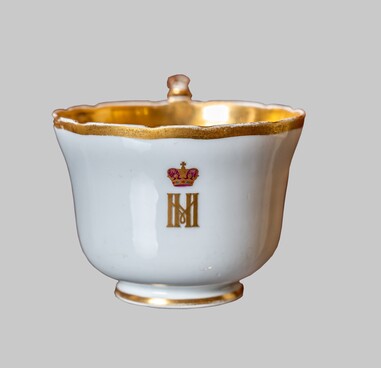
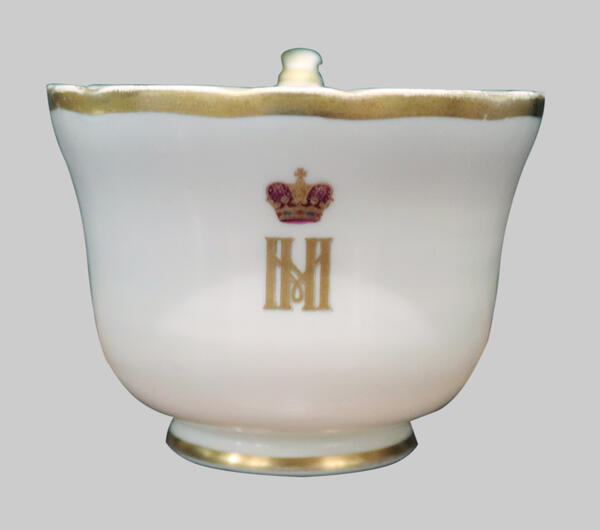
A tea cup with the cipher of Grand Duke Mikhail Nikolayevich
#5
#6
The tea cup is made of white porcelain, the inner surface is gilded. Its lateral part contains an overglaze image of the cipher of Grand Duke Mikhail Nikolayevich - a stylized combination of the letters ‘M’ and ‘N’ made in gold under a purple-gold imperial crown. The handle is decorated with floral elements.
A hallmark in olive green is preserved under the glaze on the cup: the imperial crown, the stylized letter A, the Latin number II - all this is applied in three lines. The Great Imperial Crown is the hallmark of the Imperial Porcelain Factory. The letters and numbers under the crown designate the reigning emperor, that is the cup was made during the time of Alexander II. According to the donor, the cup was part of the china of Grand Duke Mikhail Nikolayevich, as evidenced by the cipher adorning its obverse.
Gliding was used already in the 8th century. The Lucca manuscript of the 8th century evidenced that. That collection of recipes described in detail the recipe for the preparation of polyment - the basis for gilding. Gliding was an integral part of the Slavic icon painting throughout its centuries-old existence.
The Imperial Porcelain Factory is located in St. Petersburg. It was founded in 1744 when Russian Empress Elizaveta Petrovna instructed foreign master ChristopherGunger who was invited and Dmitry Vinogradov who was assigned to him to invent a porcelain recipe and organize its manufacturing in the country.
Initially, the production was called ‘Neva Porcelain Manufactory’, from 1765 - the Imperial Porcelain Factory, from 1917 - the State Porcelain Factory. In 1925, because of the 200th anniversary of the founding of the Russian Academy of Sciences, it was named after Mikhail Lomonosov. At the same time, the enterprise received a new official name - the Lomonosov Leningrad Porcelain Factory.
The plant used a large number of hallmarks. Stamps made during the time of Alexander II were very similar in execution, which was caused by the use of stencils. Hallmarks in the form of an imperial monogram placed in a rounded wreath, a circle of stars or wavy lines belong to that period. That method was used to mark those porcelain products that were created in France and coloured in the Imperial Porcelain Factory.
A hallmark in olive green is preserved under the glaze on the cup: the imperial crown, the stylized letter A, the Latin number II - all this is applied in three lines. The Great Imperial Crown is the hallmark of the Imperial Porcelain Factory. The letters and numbers under the crown designate the reigning emperor, that is the cup was made during the time of Alexander II. According to the donor, the cup was part of the china of Grand Duke Mikhail Nikolayevich, as evidenced by the cipher adorning its obverse.
Gliding was used already in the 8th century. The Lucca manuscript of the 8th century evidenced that. That collection of recipes described in detail the recipe for the preparation of polyment - the basis for gilding. Gliding was an integral part of the Slavic icon painting throughout its centuries-old existence.
The Imperial Porcelain Factory is located in St. Petersburg. It was founded in 1744 when Russian Empress Elizaveta Petrovna instructed foreign master ChristopherGunger who was invited and Dmitry Vinogradov who was assigned to him to invent a porcelain recipe and organize its manufacturing in the country.
Initially, the production was called ‘Neva Porcelain Manufactory’, from 1765 - the Imperial Porcelain Factory, from 1917 - the State Porcelain Factory. In 1925, because of the 200th anniversary of the founding of the Russian Academy of Sciences, it was named after Mikhail Lomonosov. At the same time, the enterprise received a new official name - the Lomonosov Leningrad Porcelain Factory.
The plant used a large number of hallmarks. Stamps made during the time of Alexander II were very similar in execution, which was caused by the use of stencils. Hallmarks in the form of an imperial monogram placed in a rounded wreath, a circle of stars or wavy lines belong to that period. That method was used to mark those porcelain products that were created in France and coloured in the Imperial Porcelain Factory.
#7
Full name: A tea cup with the cipher of Grand Duke Mikhail Nikolayevich
Author: Imperial Porcelain Factory
Date: 1855 – 1881 years
Technique: overglaze and underglaze printing, gilding, firing
Dimensions: 7,5×12,5×9,8 cm
Collection: Autonomous Cultural Institution of the Voronezh Region Historical-Cultural Center ‘Palace Complex of the Oldenburgs’
Copyright: Autonomous Cultural Institution of the Voronezh Region Historical-Cultural Center ‘Palace Complex of the Oldenburgs’
Author: Imperial Porcelain Factory
Date: 1855 – 1881 years
Technique: overglaze and underglaze printing, gilding, firing
Dimensions: 7,5×12,5×9,8 cm
Collection: Autonomous Cultural Institution of the Voronezh Region Historical-Cultural Center ‘Palace Complex of the Oldenburgs’
Copyright: Autonomous Cultural Institution of the Voronezh Region Historical-Cultural Center ‘Palace Complex of the Oldenburgs’
read morehide
00:00
00:00
1x
Candy boxes, a tea cup
Exhibition
5
 Point your smartphone camera to open in the app
Open in app
Share