Reindeer herding is the main business of most indigenous peoples living in the Far North. Each nation has legends about reindeer herding. For example, the legend of Yugan Khanty tells about the Yugan river owner, Yagun-iki, who stole a reindeer from the Kazym goddess. The Kazim Khanty goddess caught up with Yagun-iki and, grabbing the animal, began to pull it towards her. In the end, they tore up the reindeer, and the Yugan owner got a smaller part of it. For this reason, Yugan Khanty say, that their reindeer are smaller than others.
Reindeer herding consists of two types: tundra and taiga herding. Herds make long migrations, travel hundreds of kilometers in the tundra. In summer, they graze on the shores of the northern seas, and in winter — in the forest-tundra or northern taiga. Several thousand reindeer can be in the herd. Shepherds watch the animals around the clock.
Yugan reindeer herding belongs to the taiga type: there is always a small number of reindeer in the herd. In the swamp, the reindeer stick together, in the forest, they scatter. In winter, they walk around the winter yurts. The Yugan Khanty watch over reindeer without shepherds and dogs. Therefore, they put a kot yukh (which means “tree legs”) on one of their front legs, so that the animals do not go far.
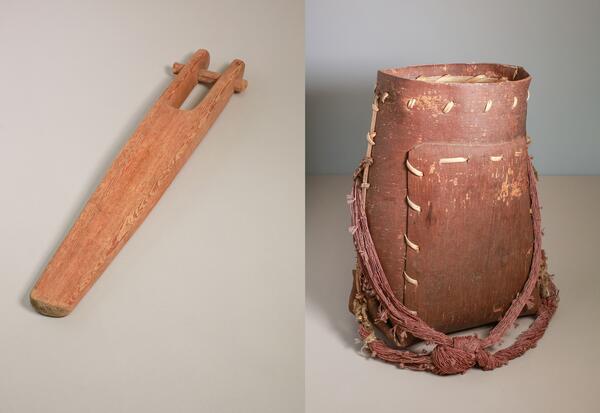
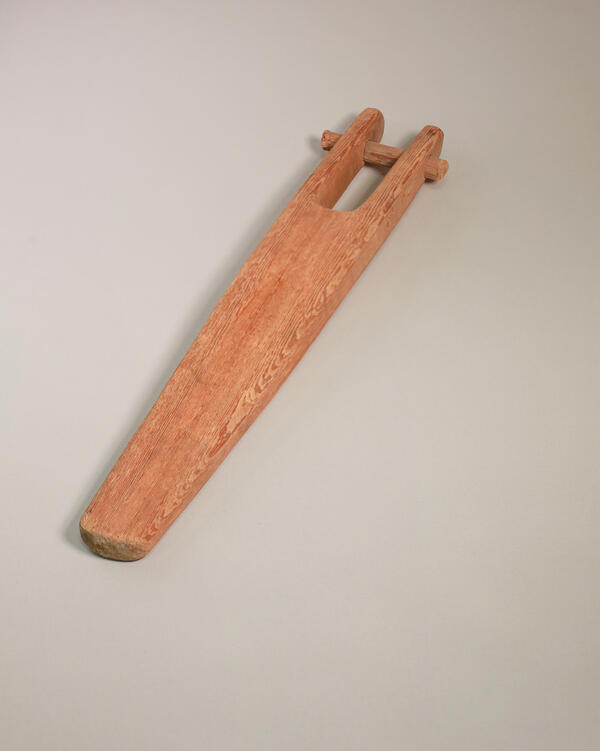
Kot yukh is a shoe, a long wooden bar, one end of which splits and forms an opening for the animal’s leg. The leg in the shoe is fixed with a special peg, for this purpose people use hammers made of elk horn and wood. With such a restraint, an animal can go only 100–200 meters in a day. In most cases, shoes are put on reindeer that are afraid of people, so that they do not run away because of fright.
The shoe from the “Ugra Heritage” exhibition was created in the 1980s and given to the funds in 1997 during an expedition organized by the scientific staff of the Nefteyugansk Museum of Local History.
On the left side of the exhibit, one can see the owner’s tamga — a family sign that is placed on the family property, including cattle. Probably, the initial letters of the surname, name and patronymic — “KLN” — are carved on it. Usually, a reindeer is approached from the left, thus anyone can immediately see who the reindeer owner is.
Reindeer herding consists of two types: tundra and taiga herding. Herds make long migrations, travel hundreds of kilometers in the tundra. In summer, they graze on the shores of the northern seas, and in winter — in the forest-tundra or northern taiga. Several thousand reindeer can be in the herd. Shepherds watch the animals around the clock.
Yugan reindeer herding belongs to the taiga type: there is always a small number of reindeer in the herd. In the swamp, the reindeer stick together, in the forest, they scatter. In winter, they walk around the winter yurts. The Yugan Khanty watch over reindeer without shepherds and dogs. Therefore, they put a kot yukh (which means “tree legs”) on one of their front legs, so that the animals do not go far.
Kot yukh is a shoe, a long wooden bar, one end of which splits and forms an opening for the animal’s leg. The leg in the shoe is fixed with a special peg, for this purpose people use hammers made of elk horn and wood. With such a restraint, an animal can go only 100–200 meters in a day. In most cases, shoes are put on reindeer that are afraid of people, so that they do not run away because of fright.
The shoe from the “Ugra Heritage” exhibition was created in the 1980s and given to the funds in 1997 during an expedition organized by the scientific staff of the Nefteyugansk Museum of Local History.
On the left side of the exhibit, one can see the owner’s tamga — a family sign that is placed on the family property, including cattle. Probably, the initial letters of the surname, name and patronymic — “KLN” — are carved on it. Usually, a reindeer is approached from the left, thus anyone can immediately see who the reindeer owner is.