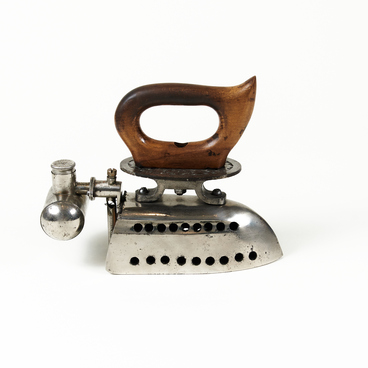
The iron from the museum collection was manufactured in the 19th century in the town of Kasli, Chelyabinsk region. Kasli is still famous for its cast products. Household items (grilles, fences, and monuments) and decorative items (jugs, chandeliers, and candelabras) were made here. In the mid-19th century, the craft has reached its heyday and that was the time when the iron from the museum collection was manufactured, too.
The first simple iron looked like a piece of metal with a flat soleplate, cast iron handle, and pointed end. Such irons were found in China. They are believed to be at least two thousand years old. In addition, there were irons that looked like a cast-iron frying pan with a long handle. They were filled with coal to heat the metal. This simple device was used to iron only large clothes details. It was inconvenient and dangerous: the coals that maintained the temperature of the iron jumped out and burned through the fabric.
In Russia, an iron was mentioned for the first time in the 17th century. There is a note in the expenses record book of the Tsar’s wife Evdokiya dated February 10, 1636, “5 altyns (1 altyn equaled 3 copecks) given to the blacksmith Ivashka Trofimov. And for that money he brought the iron to the room of Tsaritsa”. It was not much easier to use this heavy iron weighing up to 10 kilograms. It should be heated on the stove or on an open fire for a long time and then you should quickly iron all the laundry while it was hot. That is why people sometimes used several irons to speed up the process. There were lighter models, too. They were used for light fabrics, lace, and collars. Such irons weighed approximately 300 grams.
Metal irons, heated in an oven or stove, like the exhibit from the collection, were the simplest in production and reliable to use. They simply had no elements that could break. It was possible to make many irons using one casting mold. Even today, you can heat this device on the cooker and use it.
However, there were some disadvantages of this iron. The most obvious is that the handle was heating with the iron in the oven. In addition, this iron gradually cooled down and you had to put it again in the oven. The heating time of cast iron was very long — at least 30 minutes. It was impossible to take it without a potholder when the iron was hot. Therefore, such irons were modified soon. A detachable handle and two cast-iron soles appeared in the kit. While one sole was used for ironing, the second sole was heated.
The first simple iron looked like a piece of metal with a flat soleplate, cast iron handle, and pointed end. Such irons were found in China. They are believed to be at least two thousand years old. In addition, there were irons that looked like a cast-iron frying pan with a long handle. They were filled with coal to heat the metal. This simple device was used to iron only large clothes details. It was inconvenient and dangerous: the coals that maintained the temperature of the iron jumped out and burned through the fabric.
In Russia, an iron was mentioned for the first time in the 17th century. There is a note in the expenses record book of the Tsar’s wife Evdokiya dated February 10, 1636, “5 altyns (1 altyn equaled 3 copecks) given to the blacksmith Ivashka Trofimov. And for that money he brought the iron to the room of Tsaritsa”. It was not much easier to use this heavy iron weighing up to 10 kilograms. It should be heated on the stove or on an open fire for a long time and then you should quickly iron all the laundry while it was hot. That is why people sometimes used several irons to speed up the process. There were lighter models, too. They were used for light fabrics, lace, and collars. Such irons weighed approximately 300 grams.
Metal irons, heated in an oven or stove, like the exhibit from the collection, were the simplest in production and reliable to use. They simply had no elements that could break. It was possible to make many irons using one casting mold. Even today, you can heat this device on the cooker and use it.
However, there were some disadvantages of this iron. The most obvious is that the handle was heating with the iron in the oven. In addition, this iron gradually cooled down and you had to put it again in the oven. The heating time of cast iron was very long — at least 30 minutes. It was impossible to take it without a potholder when the iron was hot. Therefore, such irons were modified soon. A detachable handle and two cast-iron soles appeared in the kit. While one sole was used for ironing, the second sole was heated.