Font
Color
Graphics
Изображение точки

To see AR mode in action:

1. Install ARTEFACT app for iOS or Android;

2. Find the exhibition «Ugra Heritage»

3. Push the «Augmented reality» button and point your phone's camera at the exhibit;

Скрыть точки интересаПоказать точки интереса
Показать в высоком качестве

Temple ring, Pendants, Buckle with ornament

Exhibition
1
Open in app
#1
Temple ring, Pendants, Buckle with ornament
#26
Temple ring
#25
People have been making and wearing jewelry since ancient times: the age of the earliest shell beads is 75 thousand years. Originally, primitive materials such as feathers, stones, and dried flowers were used as accessories. Then, metals, and later, alloys were used. As time went by, jewelers began to make more and more sophisticated and skillful adornments, jewelry works of art.

One of the most ancient jewelry pieces is a temple ring which has been known since the Bronze Age. They were attached to a band or a strap near the temples one pair at a time or several pairs at a time, and sometimes they were just woven into the hair. One ring weighs 24.07 grams, about the same weight as a teaspoon. Headbands with several pairs of temple rings were quite heavy.

Temple rings are found in many archaeological cultures among different peoples. Archaeologists find beaded temple rings in the European part of Russia, Central Asia, Western Siberia. Each tribe had its special form of rings. For example, women of the Slavic tribal union of Vyatichi wore rings with seven petals, and the northerners made them in the form of a spiral. Three-bead temple rings, which are found in Western Siberia, were also used by Dregovichi.

Temple rings are found mainly in the graves of young women. Other types of rings are found in the graves of young girls and older women.

The rings still raise a lot of questions among scientists. Scientists believe that jewelry made of precious metals was found in these places due to trade between the local population and the Kama river people. And the jewelry was made by Kama, Russian and Bulgar craftsmen.

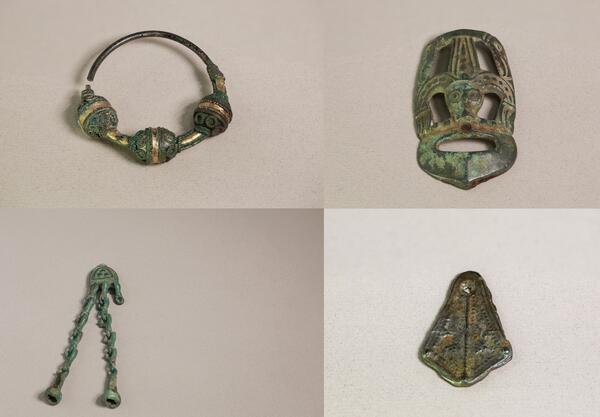
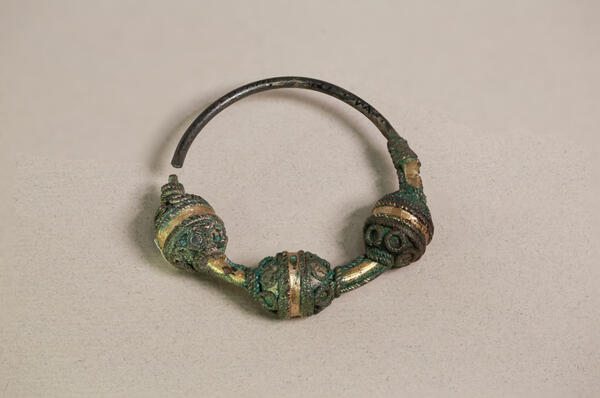
Three-bead temple rings, displayed at the exhibition “Ugra Heritage” are made by casting, filigree, and silvering techniques. They were found during the excavation of the archaeological monument Kintusovskoye 4 in upstream of the Bolshoy Salym river. The age of these rings is about 500 years. Probably, the temple rings from the museum complex funds belonged to a wealthy young woman from a princely family of the medieval period.
#18
Полное наименование: Three-bead temple rings
Дата создания: the 15th–16th centuries
Техника: сasting, filigree, silvering
Место создания: Volga Bulgaria
Размеры: diameter 5.4 cm
Коллекция: History and Art Museum Complex
Правообладатель изображений: History and Art Museum Complex
#24
Duck foot pendant
#23
The cult of waterfowl was widespread among many peoples in the territory of Western Siberia. Their veneration began more than one millennium ago. The formation of this cult was influenced by the world order idea of the ancient inhabitants of Siberia. The Ob-Ugrians, as Khanty and Mansi people were called, believed that the universe was three-tiered. Each animal lived on its tier, and only waterfowl had access to all three floors: the sky of the upper world, the ground of the middle world, and the water surface of the lower world. This is how the idea of birds as intermediaries between worlds was born.

Waterfowl also appeared in ancient legends. For example, among the Ob-Ugrians, the main character of the myth of the origin of life on the earth was a loon Luli (in other sources, it was a wader). Many years ago, a bird took a piece of silt from the bottom of the ancient ocean. This piece grew in length and width and turned into a land. Another legend has it that a duck laid an egg, and it became continents among the ancient ocean.

The cult flourished in the Middle Ages: it was then that the bird was most often depicted on breast, waist, and shoe decorations.

Bronze duck foot pendants are very common in Western Siberia, they are also found during excavations on the territory of the Nefteyugansk District. Researchers believe that the birthplace of such pendants is the Middle Kama region. Prototypes of these accessories appeared long before present era.

Now medieval small metal plastics are found as cult attributes in the home sanctuaries of the Khanty. They were used as decorations for women’s sewing bags and as amulets tied to children’s cradles.

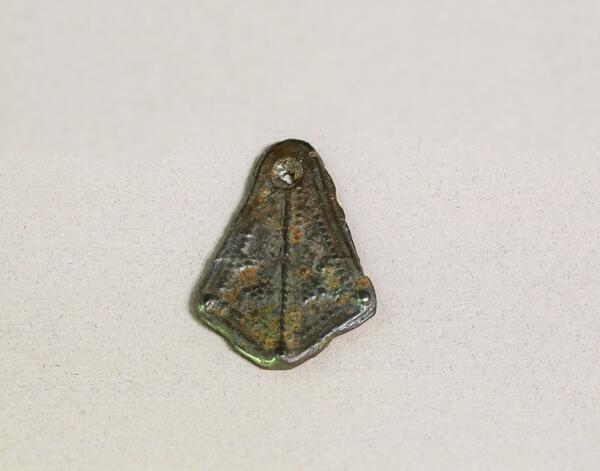
The item displayed at the exhibition “Ugra Heritage” was presumably made in the Kama region in the 10th — 15th century, and it appeared in the Nefteyugansk District as the result of a barter trade. The item was found on the territory near the Bolshoy Balyk River during an archaeological expedition of the Center for the Protection and Use of Historical and Cultural Legacy. In 1997, the “duck foot” was transferred for storage to the Nefteyugansk Museum of Local History (now the Museum of the Ob River).

The bronze pendant is an image of a duck foot. The outer surface is decorated with a relief pattern. There is a hole at the top for hanging on clothes and fake braids.
#6
Полное наименование: Duck foot pendant
Дата создания: the 10th — 15th century AD
Техника: casting
Место создания: the Kama region
Размеры: 4.3×2.7 cm
Коллекция: History and Art Museum Complex
Правообладатель изображений: History and Art Museum Complex
#22
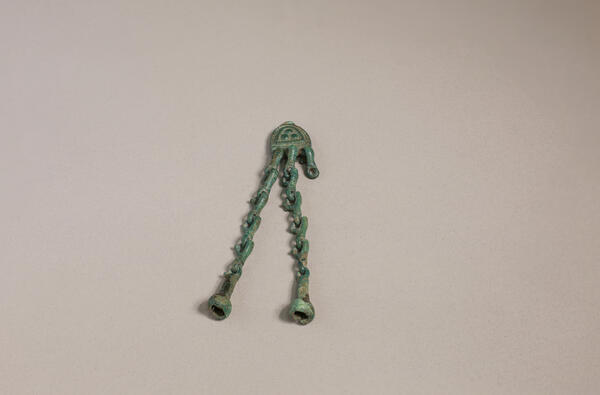
Noise-making pendant
#21
The Northern peoples believed that metal ringing scares evil spirits, so such jewelry was often worn, especially by shamans, women, and children. These items consisted of several elements or had pendants that made a rattling sound when a person was walking.

Noise-making pendants from the museum collection appeared in the Middle Ages; they belong to Kintusovo culture. Kintusovo culture is a complex of finds dating back to the 9th — 13th centuries AD. The monument of this period is known to historians as “Kintusovo burial ground”. It was first explored in 1911. Now it has been renamed to “Ensemble Kintusovskoye 4”. It includes an ancient settlement, a hillfort, a cemetery, and a sanctuary, which, although dating back to different periods, are located on the same territory.

The decorations found in the burial ground are notable for their artistic expressiveness, therefore archaeologists assume they were made by the masters from Volga Bulgaria. Metalworking is one of the ancient crafts of the Bulgars. Scientists note that the Volga craftsmen mastered almost all jewelry art of that time, which made them famous all over the world. Bulgarian artworks were exported to the Baltics, Western Europe, the Middle East, sold in Siberia and the Southern Urals. The wealthy residents of Western Siberia exchanged furs for exquisite jewelry of recognized masters.

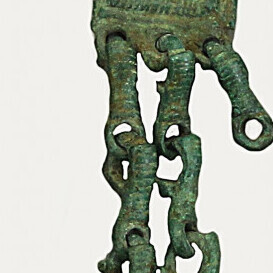
The shield of the bronze pendant from the Nefteyugansk collection is ornamented in the center with a pattern of metal pearls in the form of a pyramid. The pearls are edged with an imitation of a curl cord. The outer edge of the shield is decorated with the same cord. There is a loop at the top of the shield, and chains of six links are attached to it from below. One of the three chains is lost. Perhaps, the decoration got into the burial ground already in this state. There is an ancient tradition, according to which objects were deliberately damaged before being buried with a person. It was done so that the items could take their “real” form and serve the deceased as they did in the world of the living.
#9
Полное наименование: Noise-making pendant
Дата создания: the 10th — 13th century
Техника: casting
Место создания: Volga Bulgaria
Размеры: shield — 3.2×2.2 cm
Коллекция: History and Art Museum Complex
Правообладатель изображений: History and Art Museum Complex
#20
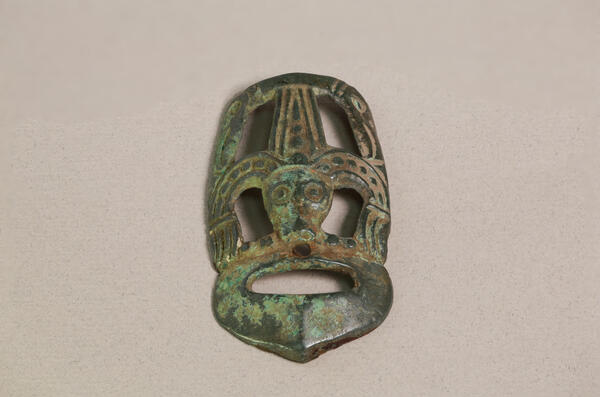
Buckle with zoomorphic ornament
#19
Perm animal style is a kind of bronze metal plastics produced by medieval Ural craftsmen. In the 6th — 13th centuries, this type of casting was widely popular in the Urals, Trans-Urals, and the taiga zone of the Ob River. The artifacts were discovered with buried treasures, in burials, and at former sites of the metallurgical complexes. Researchers suggest that in the metal, craftsmen depicted spirits, tribal and personal totems — creatures or objects that were deemed tribes ancestors or patrons. Such items were of a cult nature; they were used in sacred rituals, such as shaman’s interaction with the spirit world.

The plots with a bear and an elk were the most frequent in the Perm animal style. The elk cult among the Khanty, inhabiting the Nefteyugansk District, does not stand out conspicuously nowadays. However, the bear cult has persisted for more than a millennium. The Khanty and some other indigenous peoples of Western Siberia still celebrate “Bear Feast” — a set of rituals following the successful bear hunt. The animal carcass is dressed, the hide is laid in a sacrificial pose — the head is between the paws of a bear — and the meat is boiled. The ceremonies are accompanied by playing musical instruments, ritual and entertainment dances, and singing.

An open-work bronze buckle with zoomorphic ornament is displayed at the exhibition “Ugra Heritage”. It was received by the Museum of the Ob River funds in 1997 after the excavations of the archaeological site Kintusovskoye 4 near Lake Syrkovy Sor. The outer side of the buckle is polished, the reverse is untreated. An image of a bear in the sacrificial pose is depicted on the face plate. The bear’s forelegs are covered with a row of round semi-bead ornaments. The same ornaments are along the spine bone and at the connection point. There is an image of two elk heads facing in opposite directions on the frame.

For medieval inhabitants of the Salym District, the bear image had protective and magical functions. It was considered a male sign. The image of this animal on the hunter’s belt buckle should protect him from evil spirits and bring good fortune in the hunt.
#11
Полное наименование: Buckle with zoomorphic ornament
Дата создания: the 10th — 13th centuries
Техника: casting
Место создания: the Kama region
Размеры: 7×3.8×0.3 cm
Коллекция: History and Art Museum Complex
Правообладатель изображений: History and Art Museum Complex
#17
read morehide
00:00
00:00
1x

Temple ring, Pendants, Buckle with ornament

Exhibition
1
Point your smartphone camera to open in the app
Share
VkontakteOdnoklassnikiTelegram
Share on my website
Copy linkCopied
Copy
Open in app
To see AR mode in action:
  1. Install ARTEFACT app for 
  2. iOS or Android;
  3. Find and download the «Paintings in Details» exhibition
  4. Push the «Augmented reality» button and point your phone's camera at the painting;
  5. Watch what happens on your phone screen whilst you flip through the pictures.
 
We use Cookies
Cookies on the Artefact Website. We use cookies to ensure that we give you the best experience on our website. If you continue without changing your settings, we'll assume that you are happy to receive all cookies on the Artefact website. However, if you would like to, you can change your cookie settings at any time.
Learn more about useHide
Content is available only in Russian

X

Нашли опечатку?...

%title%%type%