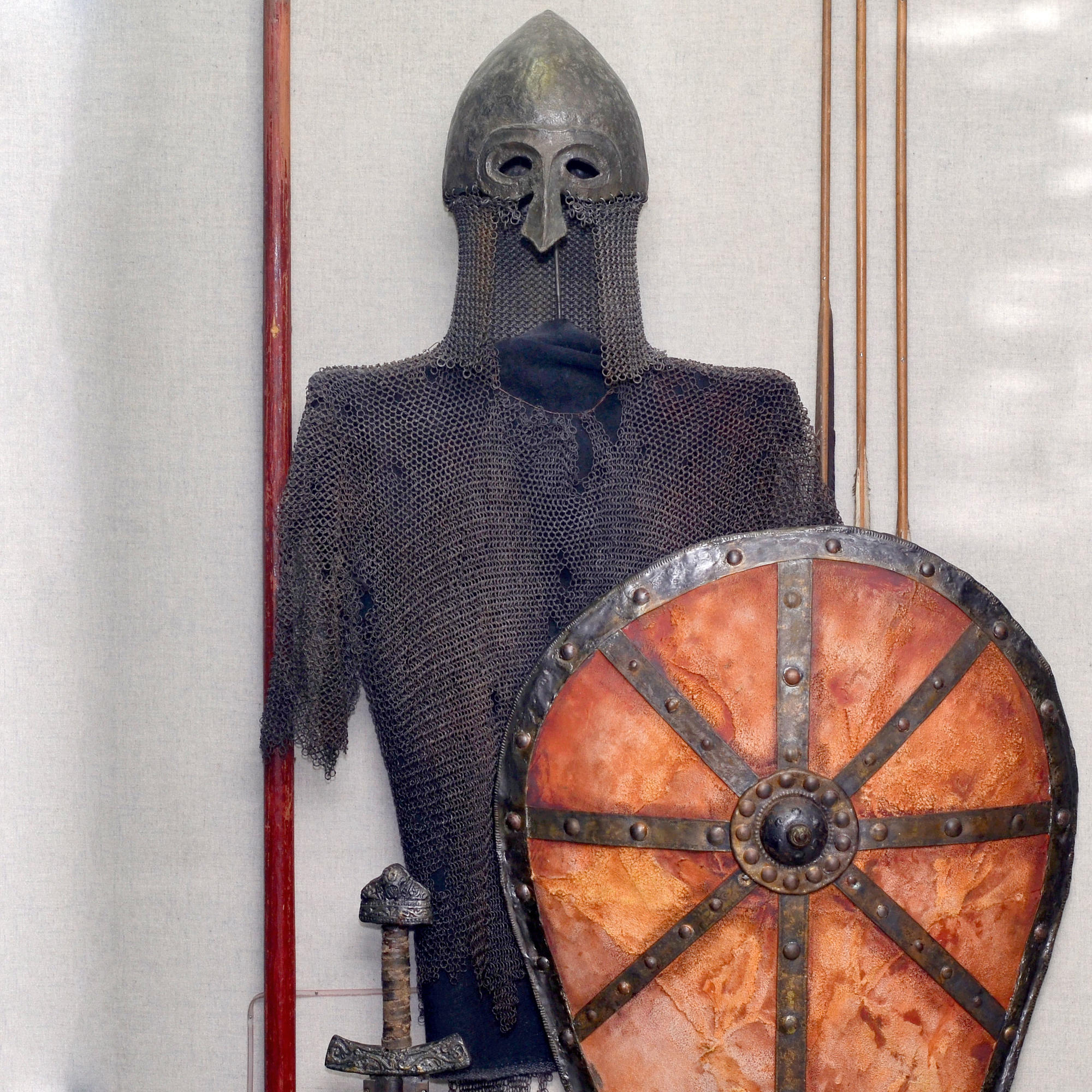
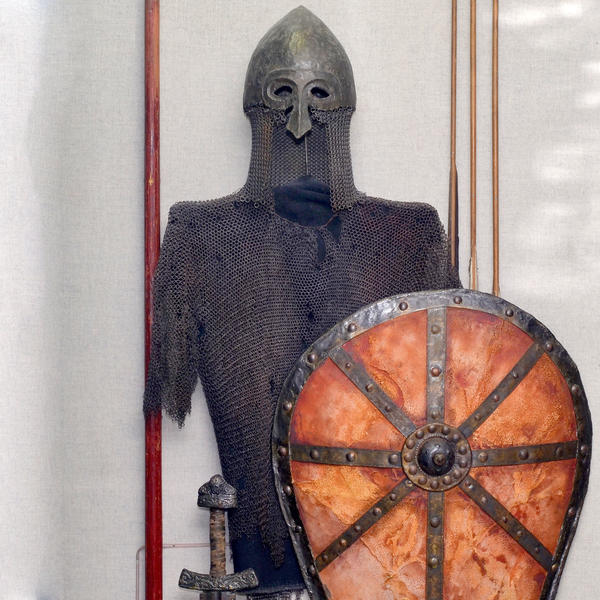
Chain armor was the most widespread type of armor with the Russian warriors of X–XIII centuries. It was made from small metal rings connected in various manners, and then fixed with rivets. Such armor withstood hits by spear, saber, sword or dagger. Some varieties also protected from arrows.


#1
Chain armor
#2
#3
Before 1971, archaeologists discovered in various Russian regions 127 ancient Russian chain armors, with 40 fully preserved and fragments remaining of the rest.
The chain armor represented in Bryansk Antiquities exhibition was discovered in 1966 in the village of Novy Ropsk, Klimov Region. According to the archaeologists the discovery looked like ‘a lump of rusty iron’. It was flattened out, cleaned from traces of corrosion, deformed parts were straightened.
#4
The restoration revealed that the chain armor was well preserved. It consisted of 39 thousand metal rings, each about 8 millimeters in diameter. миллиметров. It had short sleeves, was 75 centimeters long, with the shoulder width of about one meter. The armor weighed 6.6 kilograms.
#5
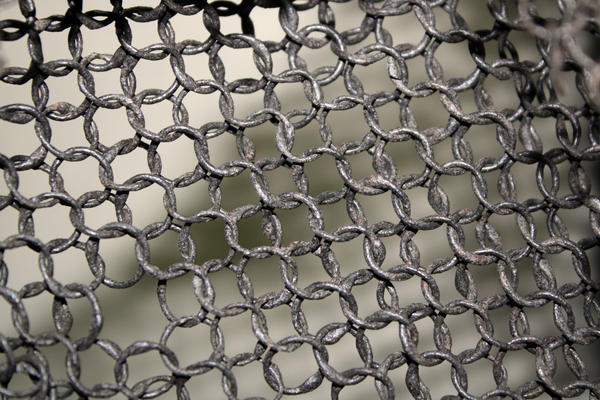
The chain armor
#6
The chain armor differed from other types in that it protected only part of the body — from the shoulders to mid-thighs. It was lighter than a harness that fully covered a warrior. A quilted arming doublet was worn under chain armor: it provided additional protection and did not let metal rings scratch the body.
#7
Making of one chain armor could take several months. It was woven from thin metal wire that was produced in different ways: thin rods were forged, narrow strips were cut from metal sheet and polished or stretched. Then the wire was spooled on a special bar to produce a spiral. It was then cut into rings of the same diameter. Open ends were riveted or welded in the weaving process.
Rows of riveted and welded rings usually alternated in the armor making it stronger and more reliable. The elements were connected by various methods, the most popular one was fixing every ring to the four neighboring rings. Sometimes bronze or copper parts were added to the silver ones, most often for edge trim. If armor was made to order, inscriptions were sometimes made on the rings.
#8
#9
Spearhead
#10
Arrowheads and spearheads represent most frequent archeological finds on the sites of early man settlements in the Bryansk region. Over a period of 10th through 13th centuries, such settlements usually were camps of military servants and defense fortifications. Conventional weapons of the time were swords, arches, battle axes and spears known as lances.
#11
Old Russian spears were of two kinds — light throwing spears and heavier ones used in close-in engagement. They all had a wooden shaft which had a special name in the pre-Mongol Russia — stroozhye or oskepische, and a sharpened metal head. The shaft length differed depending on the weapon’s use: a small throwing spear (soolitsa) no longer than 1.5 meters; spears for dismounted combat could reach 2 meters. Horsemen typically used spears up to 3.6 meters long, which enabled then to throw the enemy off the horse from a safe distance.
#12
Such spears featured tips of various shapes. The most common shape was an elongated triangular blade with a massive shank, which inflicted deep wounds on the enemy. Heavy boar spears usually had tips shaped as the laurel leaf, and their striking component was forged into the shape of a long quadrangular stick.
#13
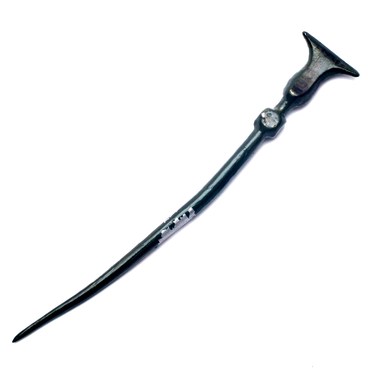
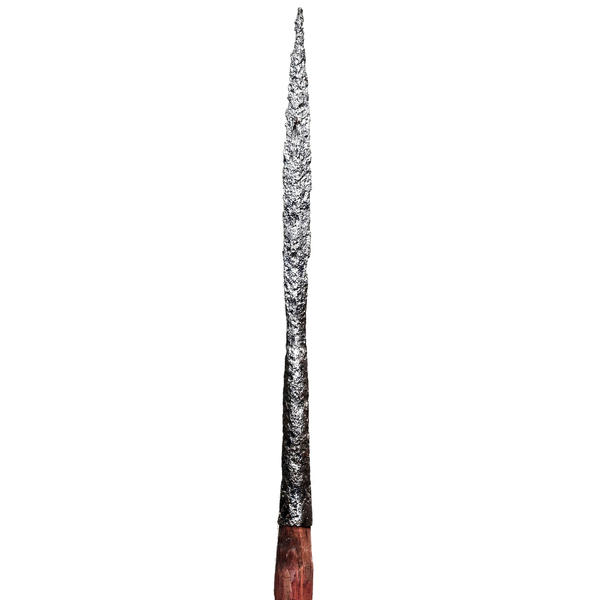
The spearhead from the Bryansk collection of ancient relics has the shape of a surgical instrument, lancet, which is rarely found in Russia. Such weapons are more typical of Scandinavian warriors. Archeologists assumed that mercenaries from the North served in Bryansk military units and brought their own spears of more familiar shape. The lance-shaped tips easily penetrated the armor and inflicted deep stab-wounds on the enemy.
The spearhead kept in the Bryansk National Museum of Local History was forged from steel in the early 11th century; it is merely 2 cm wide and about 36 cm long. The blade slightly tapering downwards smoothly extended to the shank, to which the shaft was fixed. The shank had two holes left so that it could be secured to the shaft with nails or rivets. The lance-shaped blade is strengthened by a raised rib running in its center, which kept the weapon from bending in battle even after hitting the ring-mail.
read morehide
00:00
00:00
1x
Chain armor, Spearhead
Dimensions
Archaeology
Technique
Steel, forging
Collection
Exhibition
0
 Point your smartphone camera to open in the app
Open in app
Share