#1

Rings, Candles, Sprig of orange blossom
#2
#12

#3
The museum collection includes wedding rings of the late 19th century. They are considered one of the main attributes of the wedding ritual and the future family life of those entering into marriage. Many songs are dedicated to this jewelry, a great many legends and various superstitions are associated with it. They call it a symbol of happiness and loyalty.
Wedding rings were first worn in ancient Egypt. According to legends, it was the Egyptians who put the jewelry on the ring finger of the left hand, because the so-called vein of love flows from there. By the ‘vein of love, ’ they understood the line on the hand, going from the ring finger to the fold of the palm. However, according to another version, wedding rings appeared and became widespread in Classical antiquity culture. They were worn by married women, and the ring was a kind of sign that a woman already belonged to a particular man. The male wedding ring in comparison with the female one appeared relatively recently. It is about two hundred years old.
In all cultures, the wedding ring has a deep symbolic meaning. It has no beginning or end. It has a shape of a closed circle that symbolizes eternity. At the same time, in ancient cultures, the circle was a symbol of the heavenly bodies — the Sun and the Moon, which in turn were perceived as deities. Also, the orifices of the ring are often considered as a gateway to some other world. The precious metal of which the rings were made served as a symbol of purity and chastity. Wedding rings may contain ornaments, images, and inscriptions that have a symbolic meaning for the couple.
In Europe, there has long been a tradition of wearing two types of rings — an engagement ring, presented by the groom to his bride at the time of the engagement, and wedding rings, the newlyweds put to finger of each other during the ceremony. It was customary in Russian society to wear one ring. But few could afford gold rings adorned with precious stones. Most people in the country could not afford them, and instead of gold rings they used copper rings. The copper itself resembled gold in appearance but was much cheaper. Such pieces are kept in a museum. Such rings were made either by craftsmen using copper plates or coins, or with the help of a blacksmith.
#4
Full name: Wedding Rings
Date: the end of the 19th century
Technique: brazing, polishing
Place: Turukhansky District
Copyright: Krasnoyarsk Regional Museum of Local History
Dimensions: Diameter — 2,2 cm
Goskatalog Number: 17473792
Date: the end of the 19th century
Technique: brazing, polishing
Place: Turukhansky District
Copyright: Krasnoyarsk Regional Museum of Local History
Dimensions: Diameter — 2,2 cm
Goskatalog Number: 17473792
#5
Church wedding candles
#13

#6
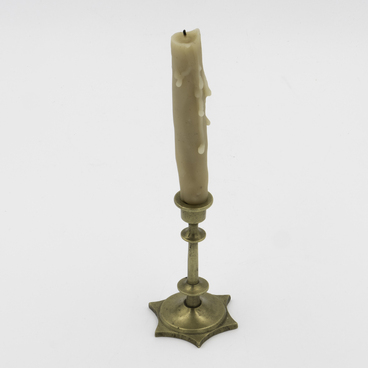
Church wedding candles are considered one of the main attributes of the Orthodox marriage ceremony. During the sacrament, the newlyweds hold candles in their hands. According to tradition, the master of ceremonies, i.e., the godfather of the groom, bought the candles before the marriage ceremony. After the ceremony, the candles were carefully kept by the spouses throughout their lives. Sometimes they were attached to the icon.
There are only two types of unity candles — wax and paraffin. Wax ones are considered the most high-quality and safe because they are made of natural material. During the ceremony, such candles do not burn completely but slowly melt. They usually have a tint of yellow, which the newlyweds don’t like much. The museum collection includes paraffin candles, which are made of a synthetic substance. They are usually white or translucent in color.
Paraffin was first obtained in 1830 by the German chemist Karl von Reichenbach during the development of oil purification products. The only drawback of this material was the low melting point. Because of this, paraffin candles guttered faster than they burned. However, this drawback was eliminated by adding the stearin to them. As a result, stearin candles quickly replaced traditional wax candles.
The Orthodox marriage ceremony is a rather long process. It can last for more than an hour. The essence of it is the blessing of a new family. Following the priest, the bride and groom enter the middle of the temple with lit candles. The choir greets them with singing. The priest blesses the young family and says the prayers.
Also, two icons are needed for the ceremony: the Most Holy Mother of God and the Savior. They are usually passed down from generation to generation and are considered a symbol of a close-knit family. Icons are needed to bless the newlyweds for happy family life. During the wedding, two embroidered towels are thrown over them. A small rug (or towel), on which the bride and groom stand in front of the altar, is also considered a mandatory attribute.
At the ceremony, candles act as a symbol of love and mutual understanding, as well as a kind of talisman against family troubles in the future. They can be either simple, without decorations, or with them. For decoration, chains, glass beads, lace, ribbons, fabric are used. The only thing important is that the decor elements were paired, like two rings. It is customary to light these unity candles after the marriage ceremony on holidays — for example, on the wedding anniversary.
Many superstitions are also associated with candles. For example, a flickered out wedding candle foreshadows all sorts of troubles for the new family: a difficult life in marriage or the early death of one of the spouses.
#7
Full name: Church wedding candles
Date: 1902
Technique: manufacturing
Place: Krasnoyarsk
Copyright: Krasnoyarsk Regional Museum of Local History
Dimensions: Length — 26,5 cm
Date: 1902
Technique: manufacturing
Place: Krasnoyarsk
Copyright: Krasnoyarsk Regional Museum of Local History
Dimensions: Length — 26,5 cm
#8
Sprig of orange blossom for the bride’s wedding
#14

#9
A wedding is one of the most important family rituals that formalize marriage and the creation of a new family. At different times and in different cultures, there have been different features and essential attributes of this rite. Even the smallest details were of great importance — including the bride’s festive decorations. Flowers are considered one of the indispensable attributes of a wedding dress. The museum collection contains a sprig of orange blossom from the early 20th century.
Initially, this was the name of the orange tree blossoms, which served as part of the bride’s wedding dress in different countries. They could be woven into a crown, decorate a dress or make a wedding bouquet. In many countries, the white flowers of orange blossom symbolize purity and virginity.
According to Greek mythology, on the eve of the wedding, the god of thunder Zeus presented his future wife Hera with a beautiful orange garden as a gift. She decided to use the gift of her chosen one to keep his love for many years. In order to attract Zeus, who had a passion for young beauties, Hera visited the orange grove every day and inhaled the fragrance of blooming flowers. This ritual restored her youth and beauty.
In Christianity, the orange blossom symbolizes both innocence and fertility and is thus considered a symbol of Immaculate Conception. This metaphor is related to the fact that orange flowers and fruit can appear on the same tree at the same time.
The very custom of using orange tree blossoms in a wedding ceremony originated in England in the 17th century. At that time, these flowers began to be attached to the veil and hem of wedding the ladies of the court. The fashion for wild orange flowers was revived by Victoria, Queen of Great Britain, who in 1840 married Prince Albert wearing a veil decorated with orange blossom and ornaments with elements of these flowers. Fleur d’orange became an integral element of royal weddings.
Soon the tradition spread throughout Europe and reached Russia. However, in our country, orange flowers were rare and expensive. Not every girl could afford them. Therefore, artificial flowers made of wax, satin, paper, and other materials were used to replace them.
Only a girl who was getting married for the first time had the right to a crown of orange flowers. Widows and women who were married for the second time decorated themselves with roses and lilies of the valley. The tradition of decorating the bride’s dress or her hairdo with orange blossom has been preserved in our time.
#10
Full name: Sprig of orange blossom for the bride’s wedding bouquet
Date: 1913
Technique: hand work
Place: Russian Empire
Copyright: Krasnoyarsk Regional Museum of Local History
Dimensions: Length — 24 cm
Goskatalog Number: 7478030
Date: 1913
Technique: hand work
Place: Russian Empire
Copyright: Krasnoyarsk Regional Museum of Local History
Dimensions: Length — 24 cm
Goskatalog Number: 7478030
#11
Ministry of Culture of the Russian Federation
read morehide
00:00
00:00
1x
Rings, Candles, Sprig of orange blossom
1
 Point your smartphone camera to open in the app
Open in app
Share