After the establishment of the Imperial Porcelain Factory, private porcelain manufacturers gradually began to appear in Russia. Among the first ones was the factory of the merchant Francis Gardner in the village of Verbilki, Moscow Governorate.
Founded in 1766, the Gardner Manufactory immediately earned a reputation for its high quality. Its products were on par with not only the ones of the Imperial Porcelain Factory but also those of renowned German manufacturers.
Alongside luxury porcelain, the Gardner Manufactory also produced more affordable dinnerware. Dinner services, plates, and cup and saucer sets were of high quality and enjoyed strong demand. The company earned well-deserved fame for its porcelain figurines, which depicted people of various nationalities, as well as small statues from the series “The Peoples of Russia”.
The coffee set from the museum’s collection was produced in Verbilki at the end of the 19th century. It is an example of mass-market tableware. The shape of the pieces is rather simple and typical of the Art Nouveau style that was fashionable in those days.
In Europe, the new style was known by different names. While in France the movement was described as Art Nouveau, meaning “New Art”, in Austria it was called the Secession, meaning that the artists broke away from the mainstream.
The pieces were given a simple, cylindrical shape. Many details show the influence of the Art Nouveau style, including the L-shaped handles rounded at the bottom, the minimalistic design of straight teapot and creamer spouts, and the flat lids with triangular handles at the top.
The porcelain was decorated with lilac flowers using the technique of decal. This is a method of transferring a picture onto the surface of products. Often, the resulting image is completed by hand using paints or opaque enamels.
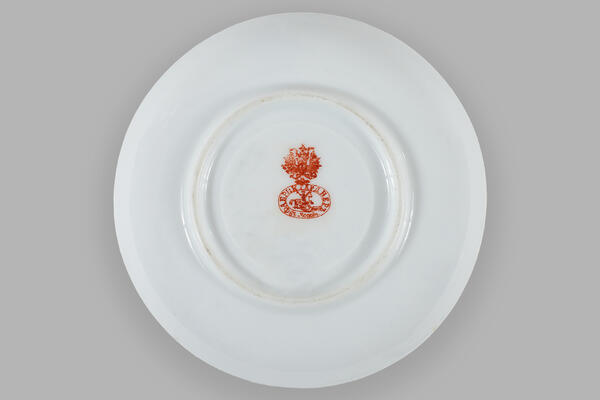
In 1891, the Gardner Manufactory joined “the porcelain empire” of the well-known industrialist Matvey Kuznetsov. Being a very talented entrepreneur, Kuznetsov acquired the enterprise with the right to use the famous Gardner brand in combination with the coat of arms of Moscow and the awards which the Gardner Manufactory had been granted for its products.
Founded in 1766, the Gardner Manufactory immediately earned a reputation for its high quality. Its products were on par with not only the ones of the Imperial Porcelain Factory but also those of renowned German manufacturers.
Alongside luxury porcelain, the Gardner Manufactory also produced more affordable dinnerware. Dinner services, plates, and cup and saucer sets were of high quality and enjoyed strong demand. The company earned well-deserved fame for its porcelain figurines, which depicted people of various nationalities, as well as small statues from the series “The Peoples of Russia”.
The coffee set from the museum’s collection was produced in Verbilki at the end of the 19th century. It is an example of mass-market tableware. The shape of the pieces is rather simple and typical of the Art Nouveau style that was fashionable in those days.
In Europe, the new style was known by different names. While in France the movement was described as Art Nouveau, meaning “New Art”, in Austria it was called the Secession, meaning that the artists broke away from the mainstream.
The pieces were given a simple, cylindrical shape. Many details show the influence of the Art Nouveau style, including the L-shaped handles rounded at the bottom, the minimalistic design of straight teapot and creamer spouts, and the flat lids with triangular handles at the top.
The porcelain was decorated with lilac flowers using the technique of decal. This is a method of transferring a picture onto the surface of products. Often, the resulting image is completed by hand using paints or opaque enamels.
In 1891, the Gardner Manufactory joined “the porcelain empire” of the well-known industrialist Matvey Kuznetsov. Being a very talented entrepreneur, Kuznetsov acquired the enterprise with the right to use the famous Gardner brand in combination with the coat of arms of Moscow and the awards which the Gardner Manufactory had been granted for its products.