#1
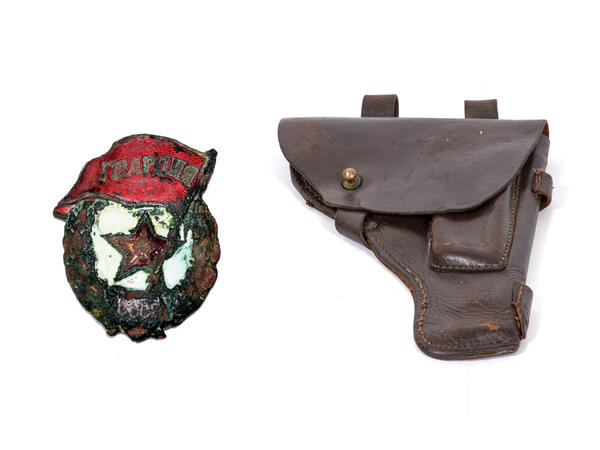
Pistol Holster, “Guards” badge
#3
#4
#5
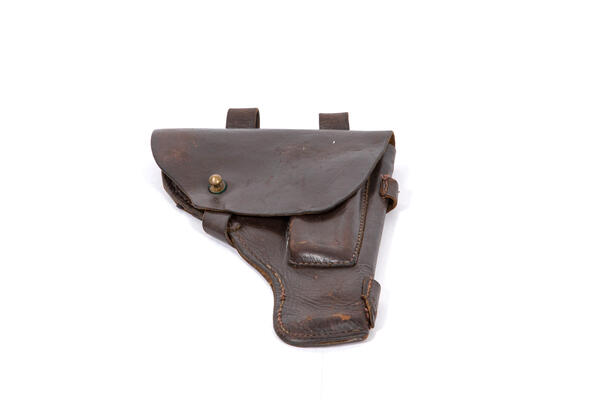
The holster housed in the collection of the Museum Resource Center was made for a Tokarev pistol model 1933. This was the first domestically-made semi-automatic pistol adopted by the Workers’ and Peasants' Red Army (WPRA).
The TT pistol, or Tula Tokarev pristol, was developed by the Fedor Tokarev’s design team for a tender held in 1929. The army leadership set the task to replace Nagant revolvers and imported pistols with a domestic analog. The standard munition of the future weapon was prechosen — a 7.63 caliber cartridge with a 25 mm Mauser cartridge case. The pistol was specifically designed for this cartridge case.
In February 1931, the Revolutionary Military Council of the USSR ordered the first batch of new pistols (couple thousand pieces). Mass production of TT pistols began in 1933 at the Tula Arms Plant. By the beginning of the Great Patriotic War, more than 100 thousand pistols were produced per year. TT was used as a service weapon of the Armed Forces of the USSR up until the early 1960s and of law enforcement agencies until the mid-1970s. In 1952, the Makarov pistol was adopted, and the production of TT was stopped.
Several types of holsters (small leather cases) were developed for TT. A closed leather holster with a protective flap became a standard military holster. It was attached to the waist belt. The gun was placed vertically in it. The high-quality holster fixed the weapon in a certain position, holding it in place when the soldier was running or jumping. It was small and comfortable, dust and water resistant, and kept its shape for a long time.
Holsters were made of light leather for the Command Staff of the Red Army. They were worn on a waist belt or on a Sam Browne belt — a military leather belt specifically designed for carrying weapons. Unsophisticated holsters were made of brown leather. In wartime, kirza (a strong multi-layer textile fabric), tarp, or plastic plywood could be used, as well. The museum displays a holster made of brown leather.
Since 1942, the importance of holsters was reconsidered and it started to be attributed directly to weapons since it became clear that it is possible to use a pistol effectively only if it is stored in a high-quality and reliable holster. A professional holster reduces the number of manipulations with a weapon to four: a fighter can grab a pistol and simultaneously release it from the elements of equipment, take it out and remove the safety, choose the optimal arm position and send a cartridge into the chamber, point at the target and shoot.
#6
Full name: TT-30 (Tokarev) Pistol Holder of the Command Staff of the Workers' and Peasants' Red Army
Date: before 1945
Technique: factory-made
Place: USSR
Copyright: Museum Resource Center of Noyabrsk
Dimensions: 15,2×22×3,4 cm
Goskatalog Number: 16663671
#7
“Guards” badge
#8
#2
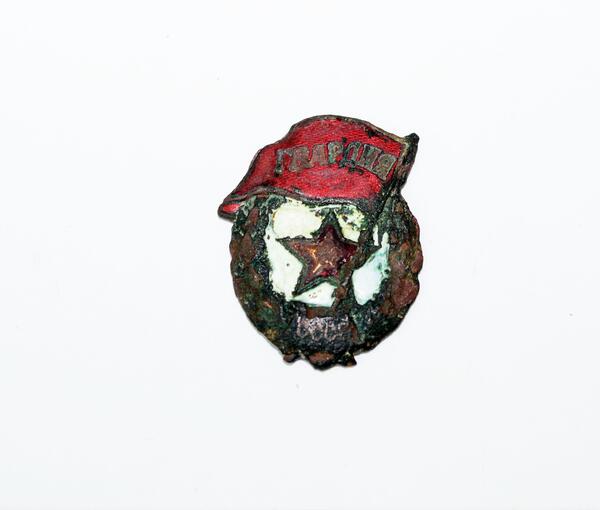
The Soviet badge ‘Guards’ is oval-shaped and framed by a laurel wreath, the upper part of which is covered by an unfolded red banner. Golden letters are stamped onto it — ‘Guards’, and a red five-pointed star on a white field is depicted in the middle of the wreath. A relief inscription ‘USSR’ on a shield is in the lower part of the breastplate.
Elite military units have existed since the antient times: for example, the praetorian guards in ancient Rome, the corps of ‘immortal’ bodyguards of the Persian King Darius I, and others. In Russia, the Leibgarde (the Life-Guard) appeared during the reign of Peter I. It was organized on the basis of Peter’s former toy army (so called amusement forces) — Preobrazhensky and Semenovsky Regiments of the Guard. These regiments accompanied the monarch on his military campaigns, and in peacetime were located in the capital.
In the Workers’ and Peasants' Red Army, Guards units appeared at the very beginning of World War II. From July 10 to September 10, 1941, during the Smolensk strategic defensive operation, the Red Army managed to disrupt the German ‘Lightning War’ strategy to take Moscow. Not far from Smolensk, the Wehrmacht soldiers were ordered by Adolf Hitler for the first time to go from an offensive to a defensive plan. The 100th, the 127th, the 153rd, and the 161st Rifle Divisions distinguished themselves in the battle. For the heroism and courage, they had shown, on September 18, 1941, by decision of the Headquarters of the Supreme High Command, by order of the People’s Commissar of Defense of the USSR Joseph Stalin No. 308, these four rifle divisions were transformed into the 1st, 2nd, 3rd, and 4th Guards.
To affirm the status of the guards, it was necessary to distinguish them among the rest of the fighters. It was impractical to create a new form during the war, so in April 1942 artist Sergey Dmitriev was instructed to develop a special breastplate. Stalin personally chose one of the sketches, and on May 21, 1942, the Presidium of the Supreme Soviet of the USSR made the ‘Guards’ badge official.
From 1941 to 1945, many regiments were awarded Guards designations: 11 combined arms and 6 tank armies, rifle, cavalry, tank, mechanized and aviation corps, many divisions and units of almost all types and branches of the troops.
Commanders presented the ‘Guards’ badge to each soldier personally in a solemn atmosphere in front of their formation. The badge was supposed to be worn on the right side of the chest on all uniforms, except for the work-clothes.
#9
Full name: Badge of the Soviet “Guards”
Date: before 1945
Technique: factory-made
Place: USSR
Copyright: Museum Resource Center of Noyabrsk
Dimensions: 4,5×3,5 cm
Goskatalog Number: 16663720
#10
Ministry of Culture of the Russian Federation
read morehide
00:00
00:00
1x
0
 Point your smartphone camera to open in the app
Open in app
Share