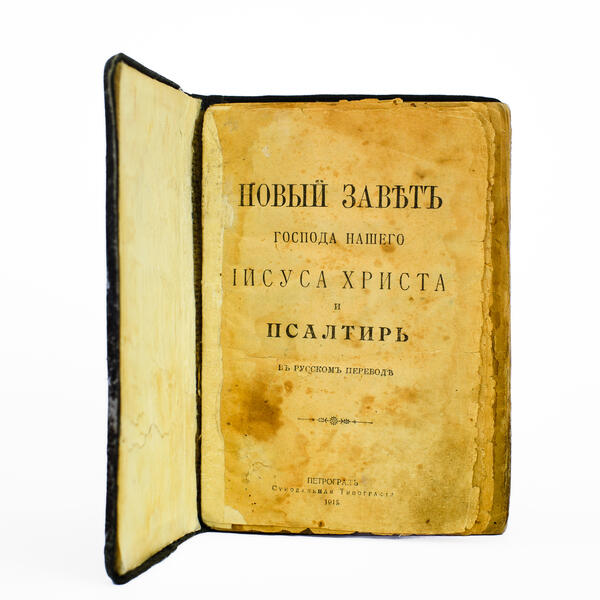


Among other valuable religious artifacts, the Museum Complex of Kuybyshev houses the book “New Testament of Our Lord Jesus Christ and the Psalter”. The brochure was printed by the Synod Printing House of St. Petersburg over a hundred years ago, in 1915.
The New Testament is a part of the Bible, a collection of the most important texts for all Christians. The phrase “new testament”, according to legend, was used by Jesus Christ himself at the Last Supper. That is what He called a new period for humanity, which the Son of God Jesus began with His appearance. The New Testament is needed for people to arrange their lives in a new way, based on God’s laws.
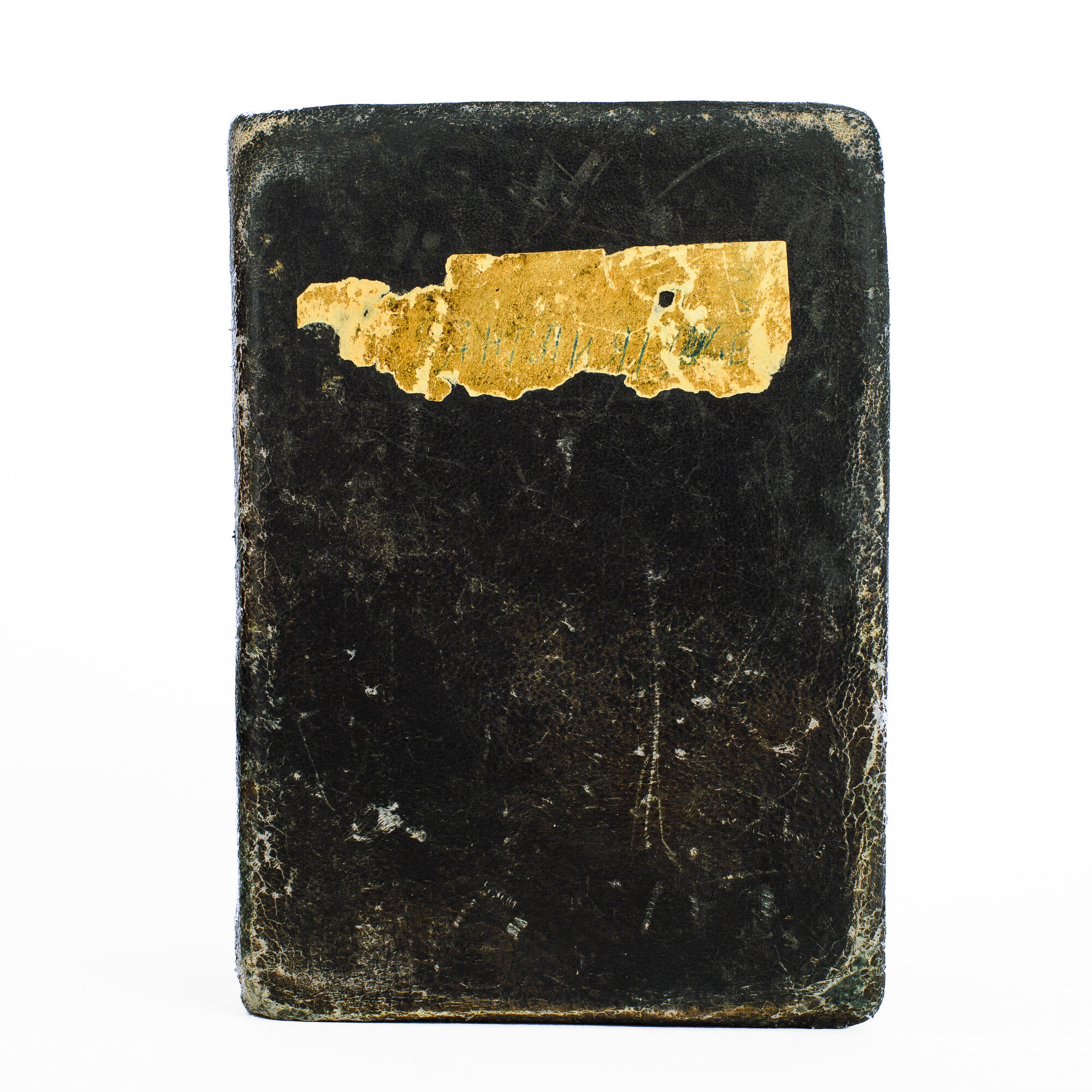
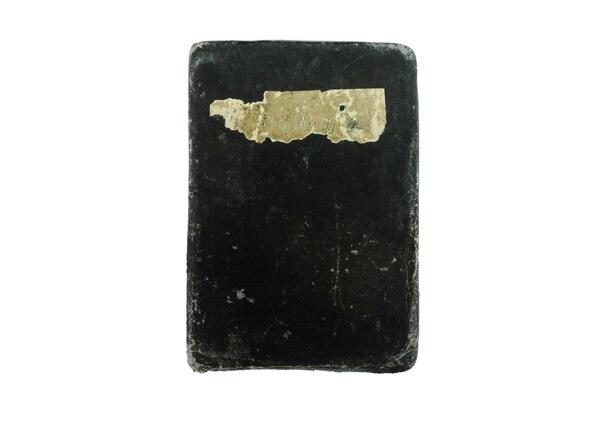
The cover of the displayed edition is made of cardboard wrapped in black leather. It is glued to the cardboard from the front side, its edges are not processed. The binding of the book is new and made of fabric. In the center of the top cover is a sticker made of white paper. There was an inscription on it in blue ink, but over time it became too faint to read.
The text is printed in black ink on thin white paper. The book is a Russian translation of the New Testament. The norms of spelling correspond to the late 19th-century orthography. On the page, the text is divided by a vertical bar into two columns. At the top of each page is the title of the section (for example, “Acts of the Apostles and the Epistles”), the chapter number and the page. There are no illustrations in the book.
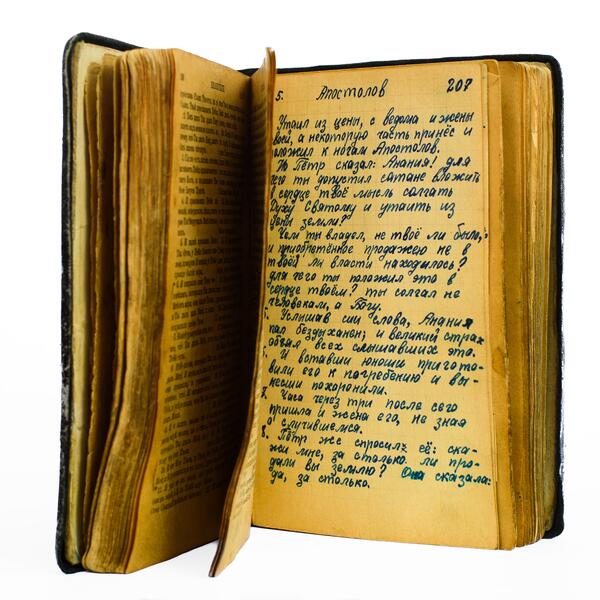
Judging by the state of the publication, it is clear that the “New Testament…” was often and carefully read and studied by the owner — this is evidenced by a plethora of notes and entries inside. Important episodes from the life of Jesus Christ, gospel parables, and conversations of the Son of God are highlighted in blue pencil in the text. In the margins, next to the indicated text, the title of the parable or a note about the episode is written.
In addition, the book contains hand-written copies of the pages that came off the “Acts of the Holy Apostles” section. Several notebook sheets were cut to the size of the book and sewn to the binding. The text is written in blue ink. All this suggests that the owner of the book was a believer, for whom it was important to keep the gospel intact.
The New Testament is a part of the Bible, a collection of the most important texts for all Christians. The phrase “new testament”, according to legend, was used by Jesus Christ himself at the Last Supper. That is what He called a new period for humanity, which the Son of God Jesus began with His appearance. The New Testament is needed for people to arrange their lives in a new way, based on God’s laws.
The cover of the displayed edition is made of cardboard wrapped in black leather. It is glued to the cardboard from the front side, its edges are not processed. The binding of the book is new and made of fabric. In the center of the top cover is a sticker made of white paper. There was an inscription on it in blue ink, but over time it became too faint to read.
The text is printed in black ink on thin white paper. The book is a Russian translation of the New Testament. The norms of spelling correspond to the late 19th-century orthography. On the page, the text is divided by a vertical bar into two columns. At the top of each page is the title of the section (for example, “Acts of the Apostles and the Epistles”), the chapter number and the page. There are no illustrations in the book.
Judging by the state of the publication, it is clear that the “New Testament…” was often and carefully read and studied by the owner — this is evidenced by a plethora of notes and entries inside. Important episodes from the life of Jesus Christ, gospel parables, and conversations of the Son of God are highlighted in blue pencil in the text. In the margins, next to the indicated text, the title of the parable or a note about the episode is written.
In addition, the book contains hand-written copies of the pages that came off the “Acts of the Holy Apostles” section. Several notebook sheets were cut to the size of the book and sewn to the binding. The text is written in blue ink. All this suggests that the owner of the book was a believer, for whom it was important to keep the gospel intact.