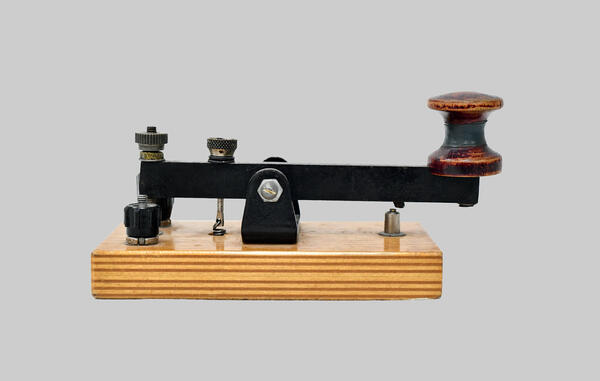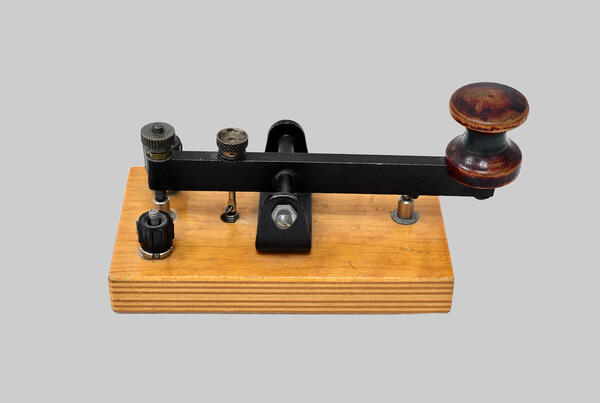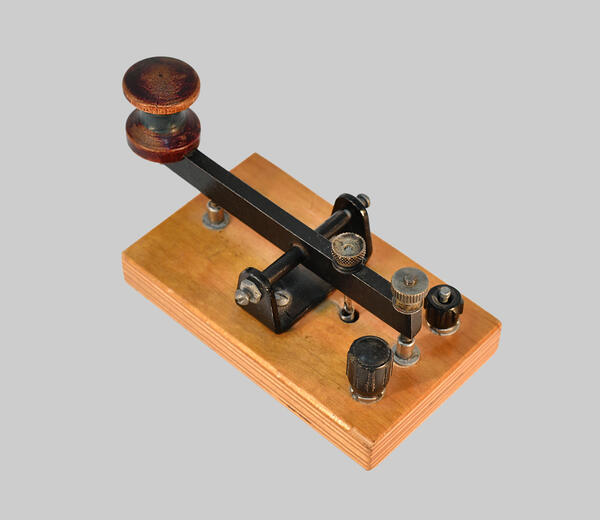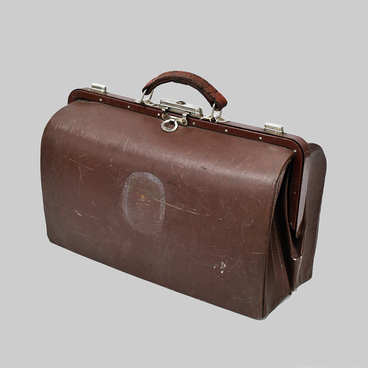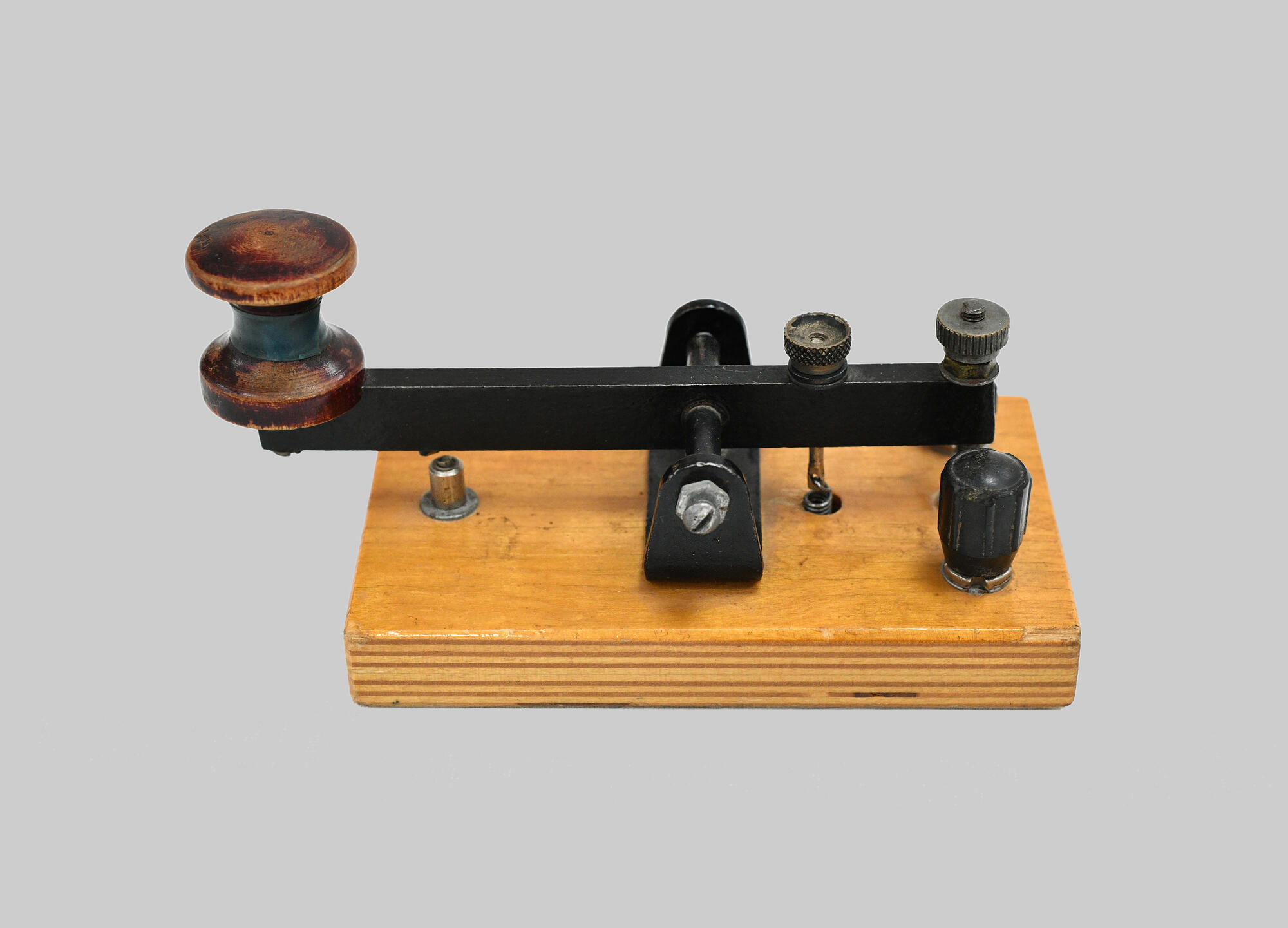


The Museum of the 112th Bashkir Cavalry Division keeps a telegraph key (a Morse code key).
The symbols of the Morse Code, named after Samuel Morse, one of the creators of the code, are formed by a sequence of dots and dashes. A traditional telegraph key, a spring-loaded bar that swung vertically, was used to transmit these characters. The operator pressed the knob, closed an electric circuit and transmitted a short or long signal — a dot or a dash.
There are several ways to operate a mechanical code key: the operator’s forearm can rest on the table, with the elbow leaning on the table, or the arm can be suspended in the air. The key is pressed with the fingers or wrist, and the fingers on the knob of the key can be arranged in various combinations. Depending on a country and a period, one or another method prevailed. Different keys were used accordingly: either those with a large rounded knob, or, alternatively, those that had flat knobs that were lowered to the table, or those with or without a finger support.
Radio communication was one of the main means of controlling the troops throughout the Great Patriotic War, ensuring quick and efficient interaction of various kinds of troops on the battlefield. It was used in reconnaissance, aviation and the navy.
In a combat situation, the role of the radio operator was of particular importance. Using Morse code and tapping up to 120 beats per minute with a telegraph key, radio operators transmitted valuable information. They decoded the dots-dashes they received and transmitted the message to the commander as a text.
It was crucial to prevent the telephone wire from breaking. Under a hail of bullets and shell fragments, and sometimes in pitch darkness, the radio operator had to crawl to find the damaged wire and restore communications.
The symbols of the Morse Code, named after Samuel Morse, one of the creators of the code, are formed by a sequence of dots and dashes. A traditional telegraph key, a spring-loaded bar that swung vertically, was used to transmit these characters. The operator pressed the knob, closed an electric circuit and transmitted a short or long signal — a dot or a dash.
There are several ways to operate a mechanical code key: the operator’s forearm can rest on the table, with the elbow leaning on the table, or the arm can be suspended in the air. The key is pressed with the fingers or wrist, and the fingers on the knob of the key can be arranged in various combinations. Depending on a country and a period, one or another method prevailed. Different keys were used accordingly: either those with a large rounded knob, or, alternatively, those that had flat knobs that were lowered to the table, or those with or without a finger support.
Radio communication was one of the main means of controlling the troops throughout the Great Patriotic War, ensuring quick and efficient interaction of various kinds of troops on the battlefield. It was used in reconnaissance, aviation and the navy.
In a combat situation, the role of the radio operator was of particular importance. Using Morse code and tapping up to 120 beats per minute with a telegraph key, radio operators transmitted valuable information. They decoded the dots-dashes they received and transmitted the message to the commander as a text.
It was crucial to prevent the telephone wire from breaking. Under a hail of bullets and shell fragments, and sometimes in pitch darkness, the radio operator had to crawl to find the damaged wire and restore communications.