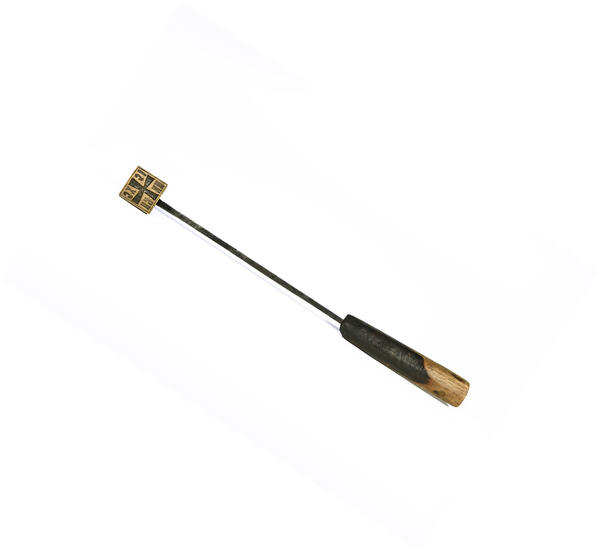
A metal stamp with a long handle was used to make prOsphora — special church bread that priests gave at the Divine Liturgy to parishioners. The bread consisted of two parts: they were baked separately and then joined together. The lower half embodied the earthly human nature, and the upper half symbolized the spiritual divine one. On top, there was an imprint with Christian symbols made with a special stamp.
The exhibit from the collection of the Bishop’s House is made of copper. The square-shaped seal is attached to the long round handle by a metal fastener. The part that is used to leave the imprint has an embossed image of the cross. Above its bars we can see short inscriptions — “IC”, “XC”, “NИ”, “KA”. They are abbreviations of a Greek phrase, which means “Jesus Christ the Victorious”.
The dough for the prosphora was made from wheat flour, salt, yeast, and holy water. It was thought that the yeast symbolized the life-giving power of the Holy Spirit, and the holy water represented the grace of God. The round shape of these loaves was intended to remind of eternity and infinite divine love. The proshora bread was baked once a year, on Holy Thursday before Easter. It was believed that on that day, on the eve of his execution, Christ made the first communion in the world. The breads were prepared in special bakeries at churches or monasteries, separately from ordinary food, because they were considered sacred.
At all times, the church bread was treated with special reverence. It was not to be thrown away or given to animals. If this bread went stale, it had to be taken to the temple, where it was burned with prayer, and the ashes were out into running water, or buried in places where people did not walk.
The exhibit from the collection of the Bishop’s House is made of copper. The square-shaped seal is attached to the long round handle by a metal fastener. The part that is used to leave the imprint has an embossed image of the cross. Above its bars we can see short inscriptions — “IC”, “XC”, “NИ”, “KA”. They are abbreviations of a Greek phrase, which means “Jesus Christ the Victorious”.
The dough for the prosphora was made from wheat flour, salt, yeast, and holy water. It was thought that the yeast symbolized the life-giving power of the Holy Spirit, and the holy water represented the grace of God. The round shape of these loaves was intended to remind of eternity and infinite divine love. The proshora bread was baked once a year, on Holy Thursday before Easter. It was believed that on that day, on the eve of his execution, Christ made the first communion in the world. The breads were prepared in special bakeries at churches or monasteries, separately from ordinary food, because they were considered sacred.
The leavened bread is still used in that part of the service, which deals with the Nativity of the Blessed Virgin Mary and Christ, and then the suffering and death of the Savior. After the service, the priest breaks the bread into small pieces and gives them to the congregation. It is believed that such a sacred gift helps to get rid of illnesses and strengthen one’s faith. The remains of the bread are usually taken home and eaten on an empty stomach on the day when they cannot come to church.
At all times, the church bread was treated with special reverence. It was not to be thrown away or given to animals. If this bread went stale, it had to be taken to the temple, where it was burned with prayer, and the ashes were out into running water, or buried in places where people did not walk.