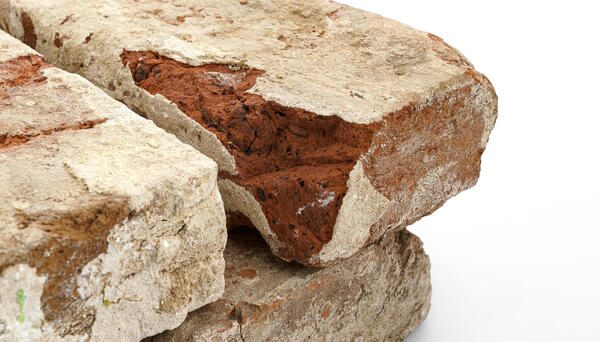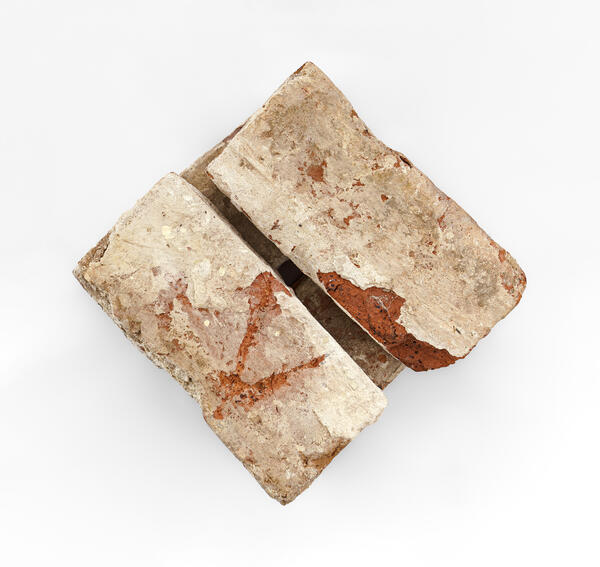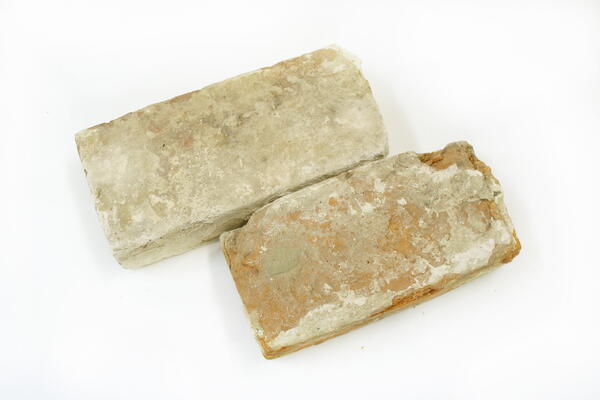
The bricks were donated to the museum by the local historian and long-time resident Mariya Fyodorovna Shemyakova. According to her, the bricks were collected on the site of the destroyed walls of the monastery’s Dormition Cathedral.
During the demolition of cathedrals in Sarov in 1951–1954, people were allowed to collect the bricks of the cathedral walls for private purposes. The unusable fragments and debris were removed and used to fill in ravines. Mariya Shemyakova kept these bricks from the main cathedral of the Sarov Monastery at her dacha for many years. She donated them to the museum, where they were used for the exhibition “Monastery Hall” in 1991.
In the late 18th century, such large bricks were used for monastery buildings. During that time, stone buildings were actively constructed to replace wooden structures.
The Sarov Monastery produced its own bricks. The bricks for the church were made near the monastery at its brickworks.
The late 18th century was marked by the construction of the first stone Dormition Cathedral (known as the Demidovskaya Church) and the new church of Saints Zosimas and Savvatiy of Solovki. Also, various residential buildings and auxiliary structures were built. These included stone brethren’s cells in the southern part of the monastery, from the south-western tower to the refectory, as well as the Bishop’s House, the Old Refectory facing the monastery courtyard, the hospital, the Governor’s Building, the blacksmith shop behind the walls of the monastery, and the eastern section of the monastery with its three towers. Two of the towers were placed at the angles, and the central one was located above the gates. The construction of the new Sarov bell tower also began at this time.
Churches were constructed by an artel. At first, apprentice surveyors determined the cost of the work. The artel’s working day was 12 hours, split into 6 hours before lunch and 6 hours after lunch. The builders worked throughout summer. In the 19th century, various buildings were being constructed, rebuilt, and overbuilt in Sarov. Gradually, all the wooden buildings were replaced by more sturdy stone ones.
In total, nine churches were constructed at the monastery, as well as a bell tower, monastic cells, guesthouses, stables, baths, carpenter’s workshops, a granary, a cellar, a bakery, an almshouse, a prosphora building, a forestry office, and many other buildings. The stone construction was completed by 1915. By that time, all the structures of the Sarov Monastery were made of stone.