Khakassia is located in Southern Siberia in the Sayano-Altai Uplands and the Khakass-Minusinsk Basin. There are various natural landscape zones here: from semi-deserts to highlands, alpine meadows and tundra. This diversity and the relatively mild climate of the basin contributed to the fact that the population density in this area at all times was slightly higher than in other regions of Siberia.
It is difficult to calculate the exact number of archaeological monuments in Khakassia, there are about 13 thousand objects here: camps, sanctuaries, burial mounds, ancient settlements, steles, fortresses. This makes Khakassia the owner of the largest archaeological fund in Siberia.
Researchers suggest that the first settlements appeared here more than 300 thousand years ago. The oldest finds date back to a later period — about 100 thousand years BC.
In the middle of the 3rd millennium BC, Caucasian tribes came to the territory of Khakassia from the west. They raised livestock and practiced primitive agriculture. The ancient settlers were pagans.
Stone idols, according to one version, arose as idols-amulets, according to another — as the personification of a deceased ancestor. The statue was erected presumably at burial sites and mounds. The main element of the sculpture was a mask, a schematic representation of a face.
Ancient craftsmen not only applied images to the stone, but also tried to give them some volume. For their works, sculptors chose elongated stone blocks. The material used was mainly sandstone and granite.
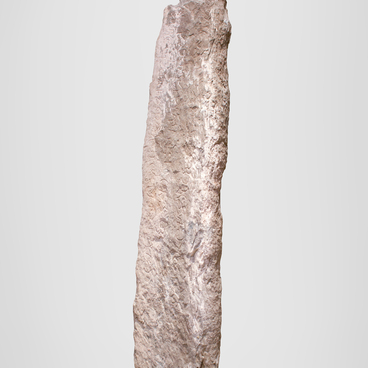
“Kime tas” (“stone boat” in Khakass) is the tallest stone statue of the known sculptures of the Early Bronze Age in Khakassia. It was made it from a single piece of red sandstone. This monument was discovered in the 1960s; the statue lay on the side of a country road 600 meters northwest of the spurs of Mount Khyzyl-Khas near Lake Black.
A face is carved in the center of the pillar-shaped stone; it is divided into three parts by horizontal lines. This idol also has “cow horns”, stylized animal ears. In the traditional Khakass culture, there is a legend recorded by the ethnographer Viktor Butanaev: the statue served as a cult hitching post for the horses of mountain spirits. A hitching post is a stone to which horses are tied to during camping.
It is difficult to calculate the exact number of archaeological monuments in Khakassia, there are about 13 thousand objects here: camps, sanctuaries, burial mounds, ancient settlements, steles, fortresses. This makes Khakassia the owner of the largest archaeological fund in Siberia.
Researchers suggest that the first settlements appeared here more than 300 thousand years ago. The oldest finds date back to a later period — about 100 thousand years BC.
In the middle of the 3rd millennium BC, Caucasian tribes came to the territory of Khakassia from the west. They raised livestock and practiced primitive agriculture. The ancient settlers were pagans.
Stone idols, according to one version, arose as idols-amulets, according to another — as the personification of a deceased ancestor. The statue was erected presumably at burial sites and mounds. The main element of the sculpture was a mask, a schematic representation of a face.
Ancient craftsmen not only applied images to the stone, but also tried to give them some volume. For their works, sculptors chose elongated stone blocks. The material used was mainly sandstone and granite.
“Kime tas” (“stone boat” in Khakass) is the tallest stone statue of the known sculptures of the Early Bronze Age in Khakassia. It was made it from a single piece of red sandstone. This monument was discovered in the 1960s; the statue lay on the side of a country road 600 meters northwest of the spurs of Mount Khyzyl-Khas near Lake Black.
A face is carved in the center of the pillar-shaped stone; it is divided into three parts by horizontal lines. This idol also has “cow horns”, stylized animal ears. In the traditional Khakass culture, there is a legend recorded by the ethnographer Viktor Butanaev: the statue served as a cult hitching post for the horses of mountain spirits. A hitching post is a stone to which horses are tied to during camping.