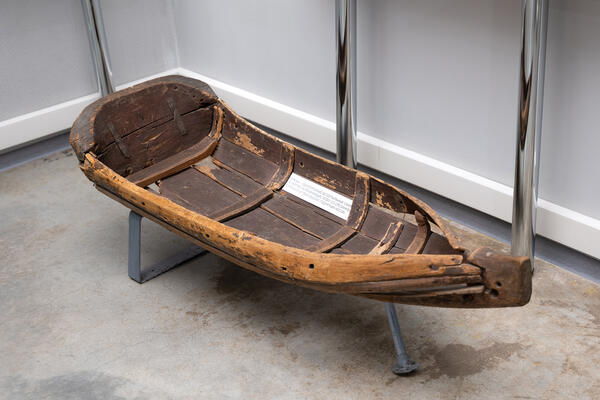
The keryozha can be attributed with good reason to the oldest type of sleds, looking like something between a boat and skis. Such sleds were widespread both among the Sami of the Kola Peninsula and those living outside Russia.
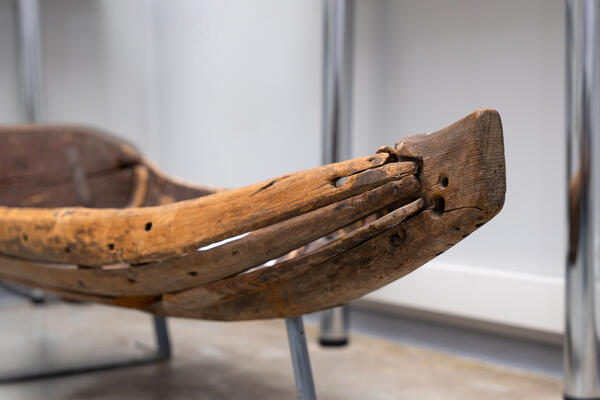
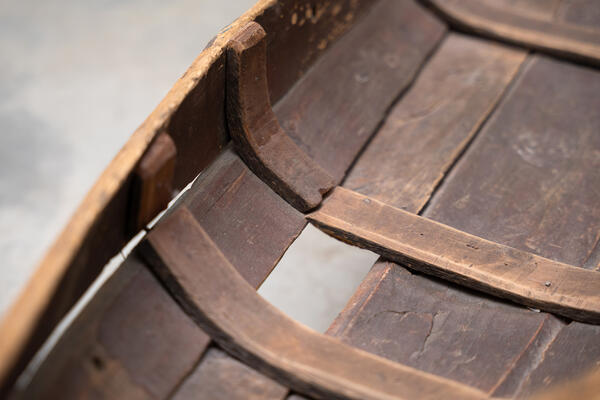
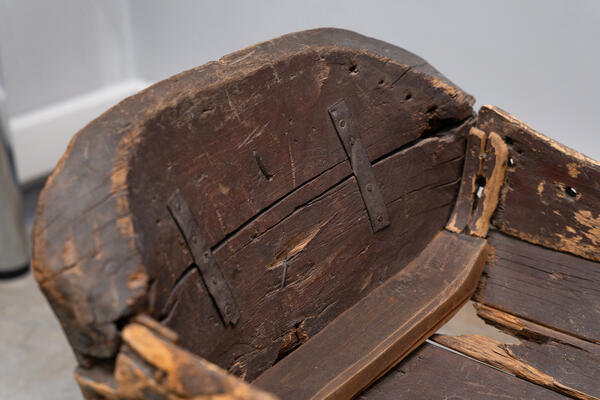
A keryozha looks like a narrow boat with a cropped stern. It was designed as a boat, or a small ship. The center of the keryozha is a bent birch or spruce runner (el). There are five pairs of seven bent ribs along the runner, to which three or four narrow planks are nailed parallel to the runner on both sides, making up the sides of the keryozha. The cone-shaped bow is slightly raised to prevent the keryozha from digging into the snow, the back is bent for the rider’s comfort. On the usually decorated back of the sled, there is an iron ring screwed in for tying the reindeer when they moved in a raida (string). In the recent past, the sides of the keryozha were joined with tree roots or wooden nails.
There were riding and cargo keryozha sleds. The latter ones were larger than the first ones.
Four leather loops were made in the sides of the keryozha, closer to the bow, to secure the luggage. A reindeer harnessed to a keryozha sled could carry no more than 100 kilograms of cargo and a person together.
When traveling, dry grass was put in the front part of the sled for warmth, the legs of the passenger were wrapped in reindeer skin and tied with a belt, using the lobes on the sides. The passenger sat in the sled, leaning on the backrest and stretching his or her legs forward (sometimes with his or her left leg hanging over the side). For warmth and greater safety (the keryozha would fall over from side to side when moving), a cover was built in the front part of the keryozha, secured with straps. According to some information, in ancient times, the keryozha’s runner was semicircular underneath, which increased the swaying of the sled when riding, so the passenger tied themselves with belts or ropes.
The arrival of the Izhma-Komi and Nenets reindeer
herding groups to the Kola Peninsula in the 1880s had a significant impact on
reindeer husbandry and the entire material culture of the Sami. In the late
19th and early 20th centuries, the Sami borrowed many features of Komi-Nenets
reindeer husbandry, in particular the Nenets type of narty sleds and harnesses.