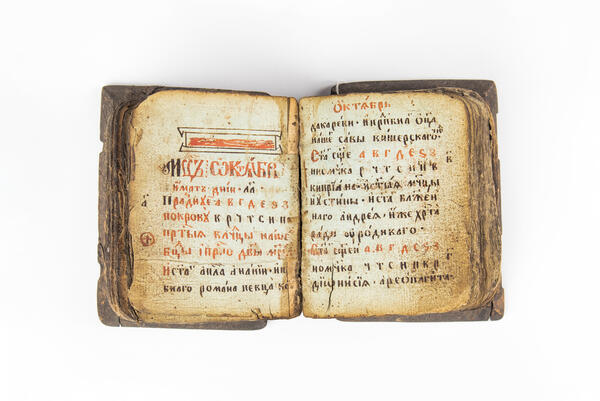
The handwritten canon of the 19th century was created no earlier than 1813. This small object comes from a family of Old Believers who lived in the village of Bogoslovka in the Republic of Khakassia. The text of the canon book was rewritten from an earlier copy, the creator of the canon book used ink, cinnabar, black, red, yellow, pink and green paints.
The text was written in Church Slavonic in a small semi-uncial font, a form of Cyrillic alphabet that originated in the second half of the 14th century. When creating the book, two types of paper were used: a yellowish laid paper without watermarks and stamps, as well as a blue laid paper with watermarks and a stamp, the coat of arms of the Simbirsk province.
The binding was made of pine wood, covered with leather. The outer side of the front cover has become cracked over the centuries, and remnants of leather and nail holes have been preserved. On the inside of the binding, one can see five nails, and the remains of a dense coarse blue fabric with gray stripes. One side of the cover features slots for locks along its edge. On the opposite side, also along the edge, the creator of the canon made three holes and threaded cords into them. The spine of the book is made of gauze.
The handwritten canon contains “Troparia” — short prayer hymns; religious texts “On Communion, ” “Confession, ” “Psalms” on the 15th, 23rd and 26th pages, “Canon to the Most Holy Theotokos, ” “Prayer to the Guardian Angel, ” “Following, ” “On Communion, Eucharist, ” and “Confession before the image.” In total, there are 159 pages in this book of the 19th century.
The initial letters of the chapters in the handwritten canon deserve special attention. They were made stand out in color and size, and were artfully decorated. The creator of the canon book executed a multicolored vyaz (Cyrillic calligraphy), used a white space in the text, that is an indentation, in the form of a triangle at the end of chapters.
The book block was
exposed to fire, so its condition is rather dilapidated, the boards of the
cover are singed, and the first pages of the book — from the first to the ninth
— have been preserved only partially. Wax stains and candle holes are present on
many pages of the canon, the back cover is torn off from the spine.