The candelabrum with a figure of an Egyptian woman is a remarkable example of interior bronze sculpture created in the Empire style of the 1800s. It was produced by Russian craftsmen in St. Petersburg based on an original model by the famous Parisian bronze-maker Pierre-Philippe Thomire.
The sketch for the candelabrum was made by Charles Percier, one of the inventors of the Empire style, an architect and an interior decorator. Similar copies of famous French designs were widespread in the Russian Empire in the early 19th century.
The Empire style appeared in France in the late 18th century and was originally intended to glorify the rule of Napoleon Bonaparte. In French, “Empire” means “imperial” or “the Emperor’s”. It carried on the traditions of Classicism, but unlike the latter, it was inspired not by the art of ancient Greece and Rome in general, but rather by Imperial Rome.
Empire artists also drew their inspiration from the art of Ancient Egypt, discovered by the Europeans as a result of Napoleon’s Egyptian expeditions between 1798 and 1801. The new style of art was intended to reflect the magnificence, splendor, and grandeur of the new era. During this period, items made of dark patinated bronze with gilded details became particularly popular as an element of interior décor.
The candelabrum from the museum’s collection is a splendid example of the art of that period. The composition is distinguished by the monumentality, grandeur, and symmetry typical of the Empire style. The candelabrum is based on a bronze figure of a half-naked Egyptian priestess. Her headdress is crowned with a sacred falcon — the symbol of the Egyptian god of the sun and the sky.
Above the priestess’ head, there are four gilded branches shaped like horns of plenty. They stand upon the bucrania — decoration in the form of ox heads. The priestess also holds two candlesticks in her hands. Their gilded bases are shaped like fasces — a bound bundle of wooden rods, symbolizing the power of the ancient kings of Rome.
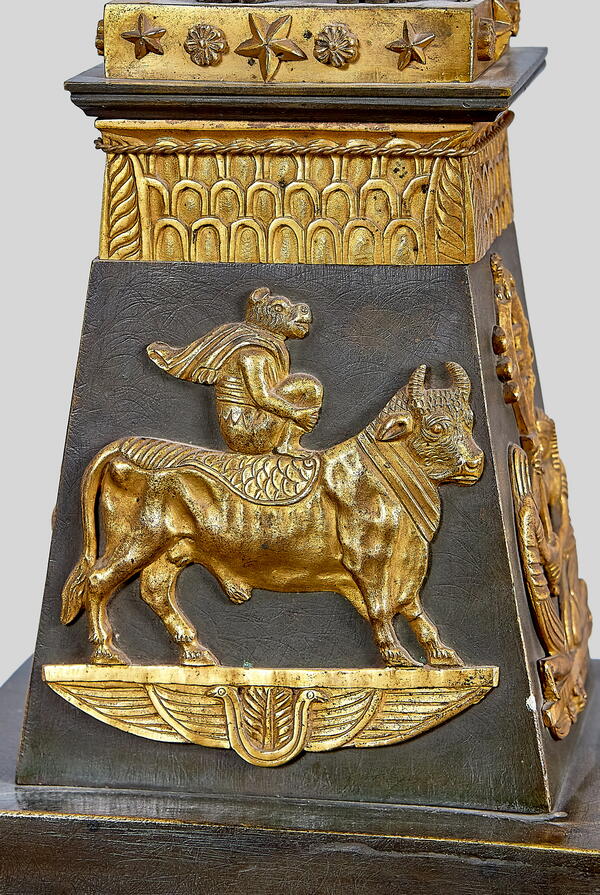
A powerful contrast was achieved by placing gilded plates with relief images against the dark patinated bronze of the candelabrum’s pyramidal base. On the obverse, there is a mythological creature with the body of a man and the head of an animal seated on a bull. The sides of the base are decorated with plates depicting two kneeling figures. They face each other and each hold the ancient Egyptian cross called the ankh.
The sketch for the candelabrum was made by Charles Percier, one of the inventors of the Empire style, an architect and an interior decorator. Similar copies of famous French designs were widespread in the Russian Empire in the early 19th century.
The Empire style appeared in France in the late 18th century and was originally intended to glorify the rule of Napoleon Bonaparte. In French, “Empire” means “imperial” or “the Emperor’s”. It carried on the traditions of Classicism, but unlike the latter, it was inspired not by the art of ancient Greece and Rome in general, but rather by Imperial Rome.
Empire artists also drew their inspiration from the art of Ancient Egypt, discovered by the Europeans as a result of Napoleon’s Egyptian expeditions between 1798 and 1801. The new style of art was intended to reflect the magnificence, splendor, and grandeur of the new era. During this period, items made of dark patinated bronze with gilded details became particularly popular as an element of interior décor.
The candelabrum from the museum’s collection is a splendid example of the art of that period. The composition is distinguished by the monumentality, grandeur, and symmetry typical of the Empire style. The candelabrum is based on a bronze figure of a half-naked Egyptian priestess. Her headdress is crowned with a sacred falcon — the symbol of the Egyptian god of the sun and the sky.
Above the priestess’ head, there are four gilded branches shaped like horns of plenty. They stand upon the bucrania — decoration in the form of ox heads. The priestess also holds two candlesticks in her hands. Their gilded bases are shaped like fasces — a bound bundle of wooden rods, symbolizing the power of the ancient kings of Rome.
A powerful contrast was achieved by placing gilded plates with relief images against the dark patinated bronze of the candelabrum’s pyramidal base. On the obverse, there is a mythological creature with the body of a man and the head of an animal seated on a bull. The sides of the base are decorated with plates depicting two kneeling figures. They face each other and each hold the ancient Egyptian cross called the ankh.