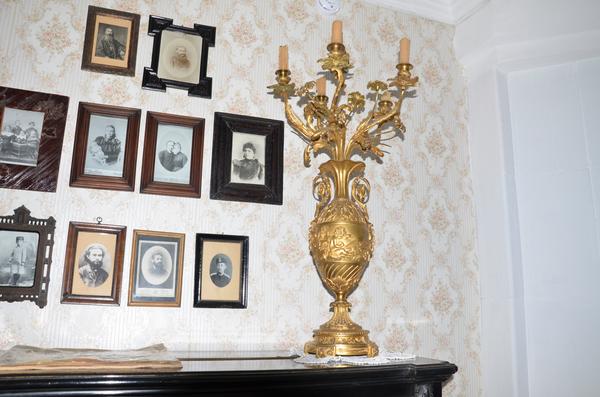
The Ryazan house with a mezzanine on Nikolskaya Street, where the academician Ivan Petrovich Pavlov spent his childhood and adolescence, has preserved many items of everyday life of the 19th-century nobility. On the piano in the living room, there are two candelabra holding six candles each — they served as the main decoration of the room where the Pavlov family liked to receive guests and spend time in the evenings.
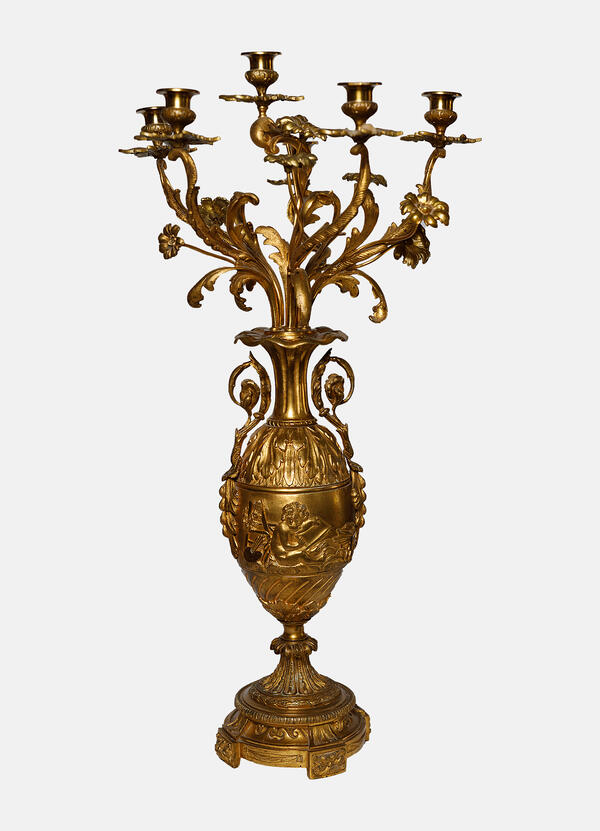
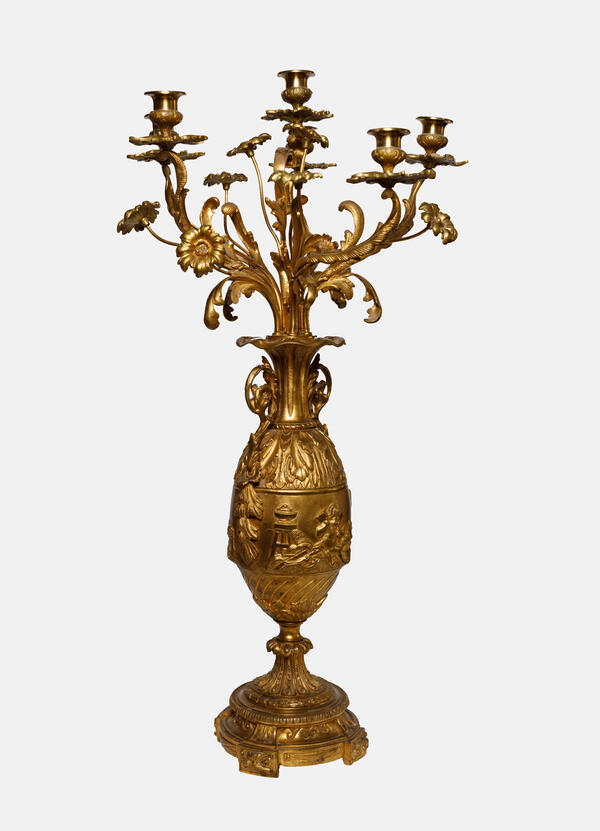
A candelabrum is a figured candlestick for several candles. This source of light was used to illuminate a large space and could be easily transferred to another part of the room or house. The candelabrum in the Pavlov house is shaped like a Greek vase with a narrow neck, which ends with a wavy lip in the form of a flower. The upper part of the vase body is decorated with falling leaves, the middle section features a cupid with a sheet and a pen holder, as well as a scroll, an easel, a wreath, a brush, and a palette. On the opposite side of the candelabra in the center is a curly cupid with a small hammer.
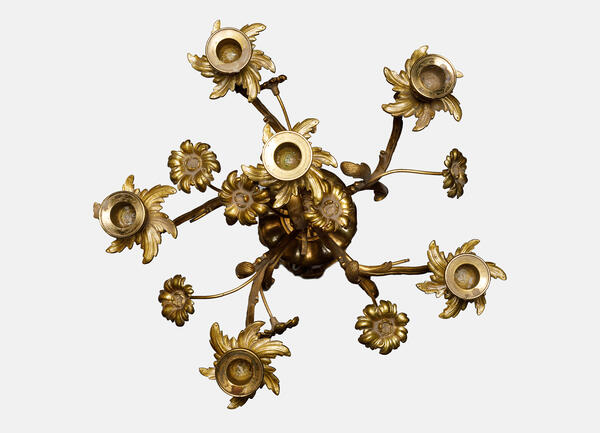
The figured candlestick handles are adorned with flowers, leaves, and branches. The bottom of the body consists of curved grooves coming out of wide flowers and leaves that are pointed downward. The round base of the vase has multiple levels, decorated with floral patterns. The vase is topped with a bouquet with thin branches. The stems end with six figured candlesticks and four screw-in flowers. In the Pavlov house, the candelabrum candles were lit only on special occasions.
Up until the 19th century, only wealthy people could afford elegant and expensive candlesticks. At first, candelabra were made from bronze and precious metals, but later cast iron was added to that list. It was more durable and reliable, and most importantly — cheaper and more affordable. So, candlesticks gained popularity among common people as well, and the variety of their shapes and sizes increased significantly.
In the second half of the 19th century, candelabra began to be made from marble and alabaster, and later — from transparent and colored glass and crystal. Candelabra and tall candlesticks were used as interior decorations and embellishments during grand dinners. Candelabra and candlesticks had their heyday before being replaced by kerosene lamps and electric lighting.
A candelabrum is a figured candlestick for several candles. This source of light was used to illuminate a large space and could be easily transferred to another part of the room or house. The candelabrum in the Pavlov house is shaped like a Greek vase with a narrow neck, which ends with a wavy lip in the form of a flower. The upper part of the vase body is decorated with falling leaves, the middle section features a cupid with a sheet and a pen holder, as well as a scroll, an easel, a wreath, a brush, and a palette. On the opposite side of the candelabra in the center is a curly cupid with a small hammer.
The figured candlestick handles are adorned with flowers, leaves, and branches. The bottom of the body consists of curved grooves coming out of wide flowers and leaves that are pointed downward. The round base of the vase has multiple levels, decorated with floral patterns. The vase is topped with a bouquet with thin branches. The stems end with six figured candlesticks and four screw-in flowers. In the Pavlov house, the candelabrum candles were lit only on special occasions.
Up until the 19th century, only wealthy people could afford elegant and expensive candlesticks. At first, candelabra were made from bronze and precious metals, but later cast iron was added to that list. It was more durable and reliable, and most importantly — cheaper and more affordable. So, candlesticks gained popularity among common people as well, and the variety of their shapes and sizes increased significantly.
In the second half of the 19th century, candelabra began to be made from marble and alabaster, and later — from transparent and colored glass and crystal. Candelabra and tall candlesticks were used as interior decorations and embellishments during grand dinners. Candelabra and candlesticks had their heyday before being replaced by kerosene lamps and electric lighting.