

#1
Kalfak, Kamzul-a sleeveless jacket
#2
A kalfak is a Tatar female headdress
#5
#3
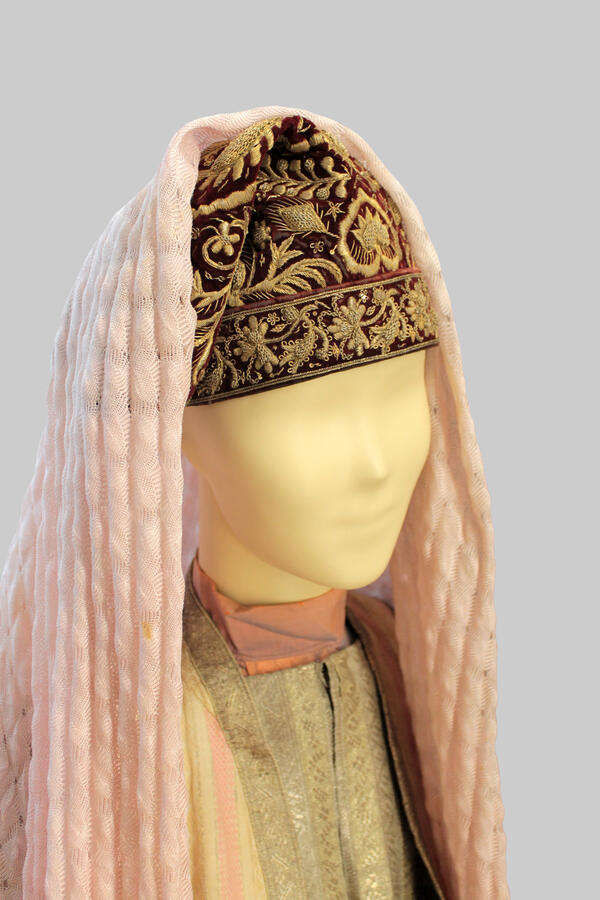
A kalfak is a Tatar female headdress for girls and women There were girls' kalfaks made without a hard browband (knitted, cloth, and something called kalfak-chachak), which looked like a long cap with a tassel at the end. It was worn on the head, and the tapered end was folded back (or worn to the side). Girls' kalfaks were not covered with anything, except for the headband, which was part of the traditional set of this attire.
In the middle of the 19th century, kalfaks knitted from multi-colored silk threads with transverse stripes were also worn. Those are sometimes dubbed ‘urban’. The length of the kalfaks reached up to 50 cm. They did not have a hard band, but did have a lapel. Among those, some were richly ornamented with chenille embroidery and appliqués made using the ‘guide’ technique.
There was also a long garment knitted of white cotton threads, which was a stocking with a tassel at the end called an ‘ak kalfak’. When put on, that kind of kalfak was folded several times, thickening the edge of the garment. The fringe and crown of the kalfak were decorated with a geometric pattern.
Starting in the second half of the 19th century, velvet kalfaks with a hard band came into fashion in cities and the nearby suburbs. They differed in size, including the width of the band, its color, and decorative design. But with all this diversity, they still retained the function of headwear to be worn under something else: the kalfak was always worn on or fastened to the hair (closer to the forehead) and covered with a scarf on top. Wearing a kalfak by married women as stand-alone attire was only done with family, or in a circle of other women.
Regardless of size, the velvet kalfak consisted of two parts: a soft top and a hard band. These kalfaks were richly decorated with gold embroidery, regular embroidery, beads, and fresh-water pearls. The pattern on the band usually differed from the pattern on the lobes of the kalfak, which indicated the constituent nature of the garment. The soft lobe on this kind of kalfak was not put on the head but stayed flat and hung down on the side. There are many similarities in terms of the technique used to decorate and the composition of the pattern on both large and medium velvet headdresses. The pattern was floral, and most often it was a bouquet (one large or several small ones). Gold embroidery is often combined with an appliqué made of gilded coins that act as petals or leaves.
The territory where velvet kalfaks originated is Kazan and the area around Kazan, where their production took on the nature of a business. At the beginning of the 20th century, kalfaks, in conjunction with factory-made scarves, were called the national dress of Tatar women.
#4
Full name: A kalfak is a Tatar female headdress
Date: second half of the 19th century
Technique: cannetille sewing
Dimentions: 31×25 cm
Collection: ‘Textiles’, National Museum of the Republic of Bashkortostan
Copyright: National Museum of the Republic of Bashkortostan
Date: second half of the 19th century
Technique: cannetille sewing
Dimentions: 31×25 cm
Collection: ‘Textiles’, National Museum of the Republic of Bashkortostan
Copyright: National Museum of the Republic of Bashkortostan
State catalog number: 20419252
#6
Kamzul-sleeveless holiday and everyday Tatar women’s garment
#7
#8
The kamzul sleeveless jacket is an integral part of a Tatar woman’s holiday and everyday outfit. Kamzuls (camisoles) were sewn fitted long, down to the knees, or short, down to the hips, either with short sleeves cut off at the elbows or without sleeves, with high sides or with a deep chest cut, with a wrap in front or without one (“end-to-end”). Camisoles were sewn from velvet and other silk and semi-silk fabrics with lining; the edges of the sides, hem, and armholes for the sleeves were decorated with stripes of braiding, galloon, and bird (or swan or other types) of down. It is typical that there is no embroidery on traditional camisoles, although patterned silk fabrics, such as brocade, are used to sew them.
The camisole was worn over a dress, and it was part of a holiday outfit. To give the back more tightness, it was cut from two halves (with a vertical axial seam in the middle of the back) that expanded from the waist to the hips through side wedges; the central and two side seams formed folds (the three-seam camisole).
The width of the camisoles along the hem ranged from 170 to 230 centimeters. Wealthy Tatar women had camisoles up to 360 centimeters wide.
Unlike the Kazan Tatars, for the Kryashen people camisoles were the daily clothing for young women. For the sake of decency, during the first year of marriage she had to wear a camisole all the time. These camisoles were sewn long (down to the knees), with high sides (with a closed chest), and were worn with an apron.
From the late 19th to the early 20th centuries, girls wore short (hip-length), tight-fitting, camisoles that were sometimes single-breasted, meaning without a wrap (end-to-end). This version of the camisole, influenced by European fashion, lost some of the features of the traditional camisole worn by the Tatar people. The most common camisole colors were black, green, various shades of red, and yellow. Some fashionable women ordered camisoles made from the same fabric as dresses.
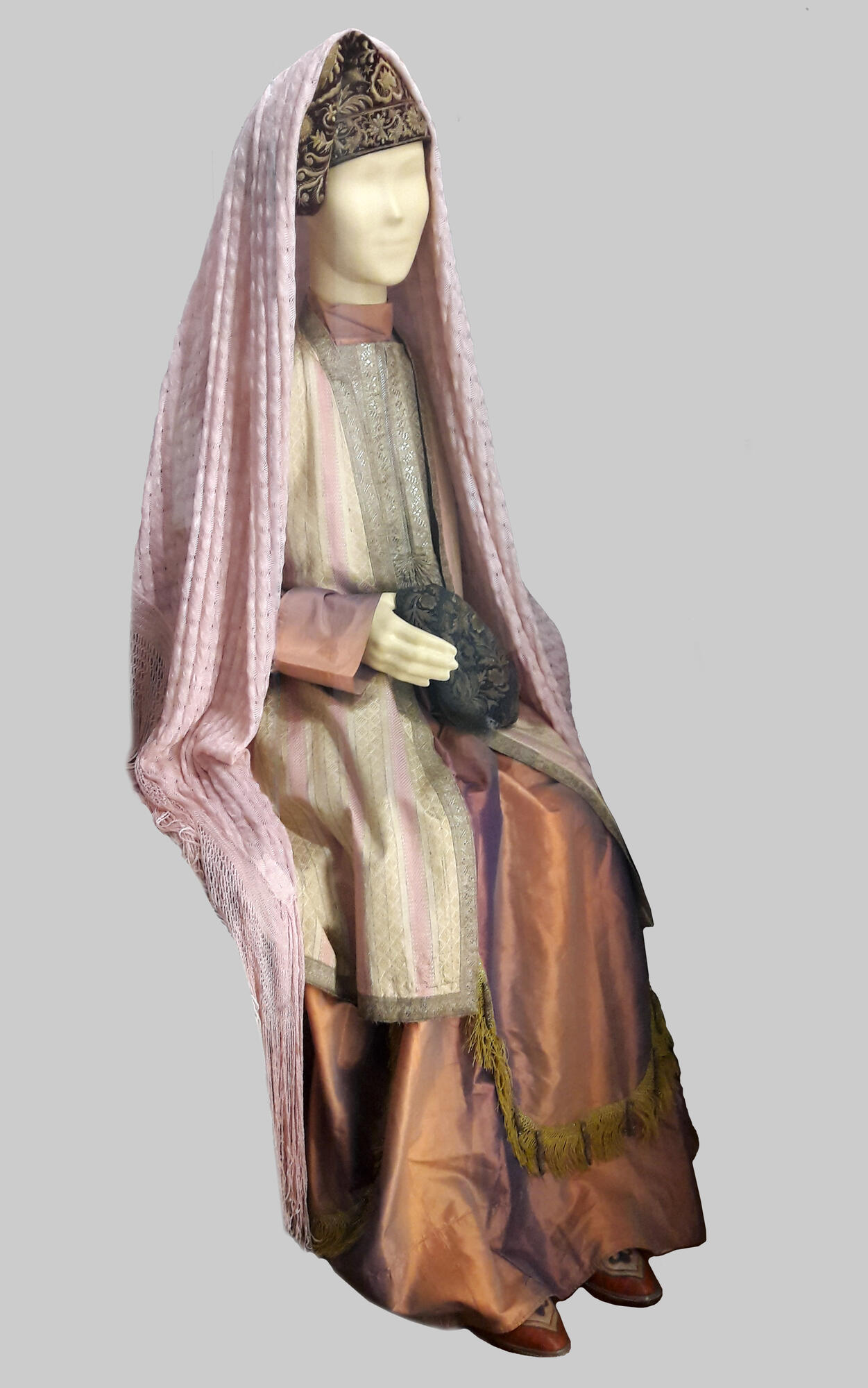
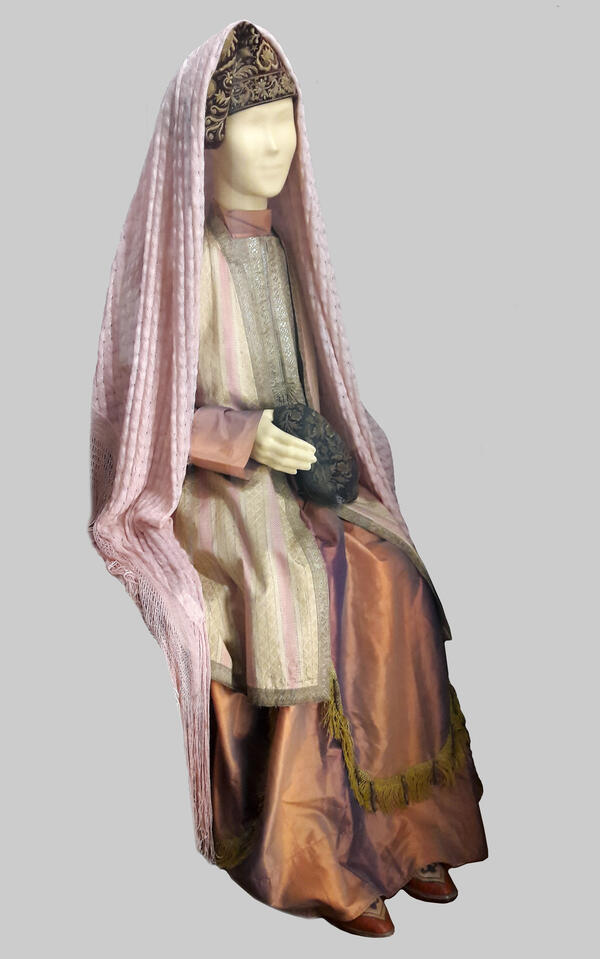
The fitted camisole from the museum’s collection has a three-seam back, sewn of silk fabric in pale pink and pale golden vertical stripes. The lining is a brown semi-silk fabric. There are inserts that start from the armholes. The hem is flared with small gussets. The armholes, flaps, and hem are trimmed with golden braiding. Faux pockets are sewn to the camisole, which are also trimmed with braid.
The camisole was worn over a dress, and it was part of a holiday outfit. To give the back more tightness, it was cut from two halves (with a vertical axial seam in the middle of the back) that expanded from the waist to the hips through side wedges; the central and two side seams formed folds (the three-seam camisole).
Young women sewed their camisoles with five seams. To do this, below the opening of the sleeves to the hem, or only running from the openings to the waist (if the width of the fabric allowed, the sides were fitted without a wedge), additional inserts were made.
The width of the camisoles along the hem ranged from 170 to 230 centimeters. Wealthy Tatar women had camisoles up to 360 centimeters wide.
Unlike the Kazan Tatars, for the Kryashen people camisoles were the daily clothing for young women. For the sake of decency, during the first year of marriage she had to wear a camisole all the time. These camisoles were sewn long (down to the knees), with high sides (with a closed chest), and were worn with an apron.
From the late 19th to the early 20th centuries, girls wore short (hip-length), tight-fitting, camisoles that were sometimes single-breasted, meaning without a wrap (end-to-end). This version of the camisole, influenced by European fashion, lost some of the features of the traditional camisole worn by the Tatar people. The most common camisole colors were black, green, various shades of red, and yellow. Some fashionable women ordered camisoles made from the same fabric as dresses.
The fitted camisole from the museum’s collection has a three-seam back, sewn of silk fabric in pale pink and pale golden vertical stripes. The lining is a brown semi-silk fabric. There are inserts that start from the armholes. The hem is flared with small gussets. The armholes, flaps, and hem are trimmed with golden braiding. Faux pockets are sewn to the camisole, which are also trimmed with braid.
#9
Full name: Kamzul — sleeveless holiday and everyday Tatar women’s garment
Date: late 19th century
Technique: sewing work
Dimentions: 96×36 cm
Collection: “Textiles”, National Museum of the Republic of Bashkortostan
Copyright: National Museum of the Republic of Bashkortostan
Date: late 19th century
Technique: sewing work
Dimentions: 96×36 cm
Collection: “Textiles”, National Museum of the Republic of Bashkortostan
Copyright: National Museum of the Republic of Bashkortostan
State catalog number: 4033243
read morehide
00:00
00:00
1x
Kalfak, Kamzul-a sleeveless jacket
0
 Point your smartphone camera to open in the app
Open in app
Share