Font
Color
Graphics
Изображение точки

To see AR mode in action:

1. Install ARTEFACT app for iOS or Android;

2. Find the exhibition «The Ethnography of Transbaikal»

3. Push the «Augmented reality» button and point your phone's camera at the exhibit;

Скрыть точки интересаПоказать точки интереса
Показать в высоком качестве

Evenki clothing and household items

0
Open in app
#1
Evenki clothing and household items
#2
Evenk calendar (aksan)
#15
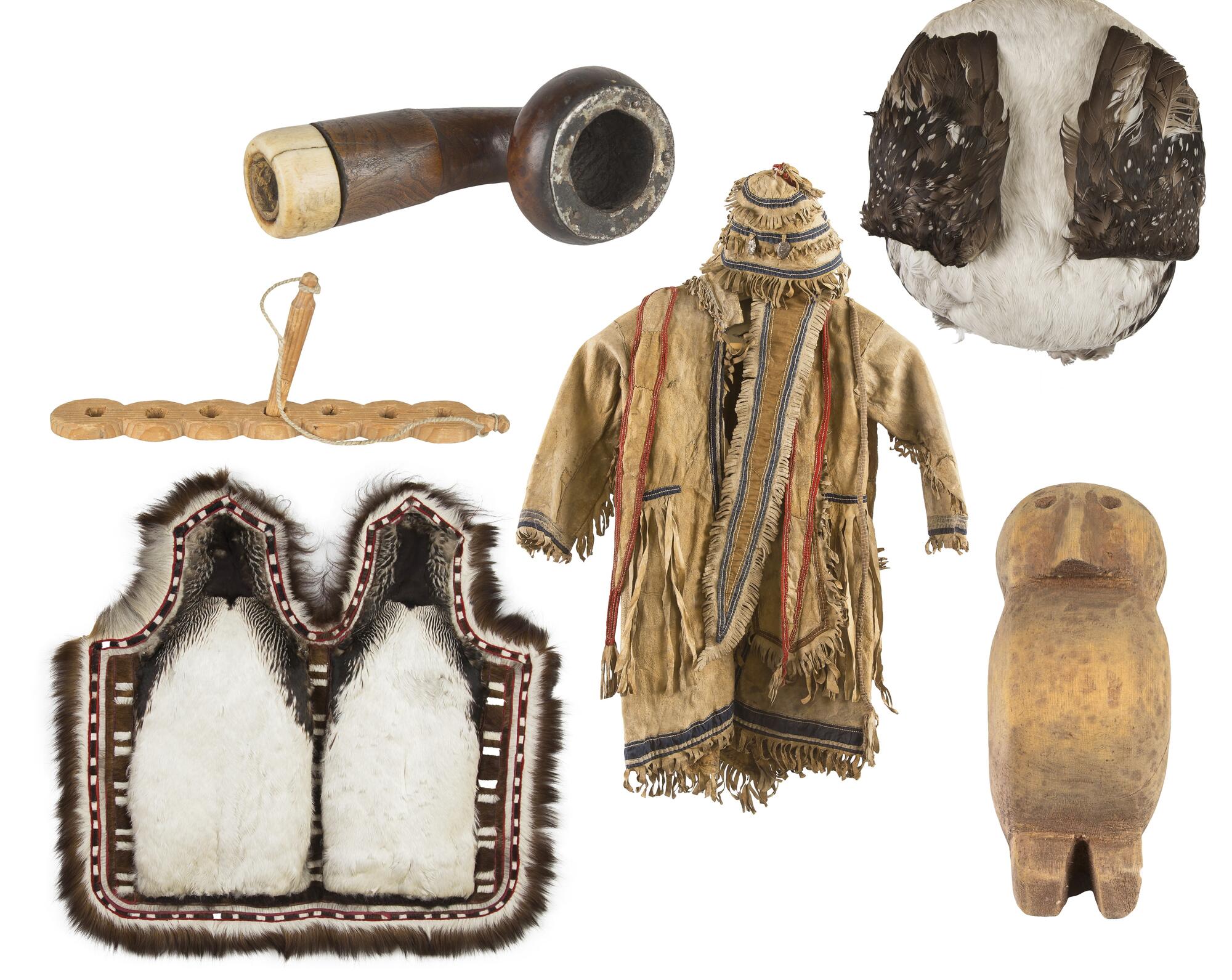
The Transbaikal Regional Museum of Local Lore houses an Evenk aksan. It was made in the 20th century. It is a version of the modern calendar. Seven holes correspond to the seven weekdays, from Monday through Sunday.

The set included a wooden stick on a string. Every morning it was moved to a new hole: that is how the Evenks kept track of when the week ended.

The Evenks used to be a nomadic people, so their life and perception of time depended on the seasons of the year, as well as on the hunting and gathering seasons. The ancient representatives of this people did not use the concepts of “24 hours”, “a week”, “a decade”, hours or minutes.

The Evenks traditionally divided the year into two separate seasons — summer (“dugani”) and winter (“tugeni”), as well as into thirteen lunar months. Their names indicated the seasonal changes in nature and the occupations that were associated with them. For example, “muchun” meant the time when needles appear on larches, the first grass and blooming buds. In the month of “irkin”, mosquitoes disappeared and deer hunting began. In the month of “giravun”, the month of winter ice hunting, a thick crust of snow appeared.

For the Evenks, the new year started in spring, which was the most important season with the nature coming back to life after the cold. Usually, folk festivals were held at this time and lasted for three days. Tribes from different districts gathered to welcome spring. Guests sang, danced khorovods (traditional round dances) and made treats.

A special ritual ceremony was performed at the festival: people saw off the old sun and welcomed the new one. To welcome the warm season, the guests, led by a shaman, did a circle dance.

The Evenks divided spring into three periods. During the “nelkeni” — early spring — deer began to calve. Then came the “nevkeni”. It was also called the “spring of water” — the snow melted and thawed patches appeared. In Transbaikal, it happened in May. During the “nennani”, grass appeared, leaves bloomed and birds usually came back from the south. This period corresponded to June.

Under the influence of Russian neighbors, the Evenk calendar became more similar to the modern one: the number of months decreased and the concepts of weeks and days appeared.
#3
Полное наименование: Evenk calendar (aksan)
Техника: wood, carving
Размер: 20 cm
Дата создания: the 20th century
Коллекция: Ethnography
№ Госкаталога: 9985772
Место создания: Trans-Baikal Territory (Trans-Baikal Region) 

#4
Evenk smoking pipe
#16
An Evenk smoking pipe — umugun — is displayed in the Transbaikal Regional Museum of Local Lore. It was made in the middle of the 20th century. The stem of the pipe is made of wood while the shank is made of bone. There is a draught hole inside.

Practically all Evenks smoked pipes. Leaf tobacco came to these places from different regions. The western groups that live between the Yenisey and the Lena Rivers were introduced to it by their neighbors, and the northeastern tribes acquired it through the Russian population.

As well as tobacco, the Evenks borrowed the ganza pipe — a metal smoking pipe with a long mouthpiece and a small shank, a hollow wooden rod for smoking. Later, they were used only by women.

Along with metal pipes, homemade wooden ones were also used. The Evenks called them “omugun”, “umugun” or “umusun”. Such items consisted of a bowl for tobacco, a massive and thick shank and an attachable mouthpiece — the part that was brought to the lips.

The bowl was filled tightly with tobacco, which was then lit, so that a person simultaneously inhaled and drew smoke from the mouthpiece. The pipe was smoked slowly; depending on the size of the tobacco chamber, the process could take 20 to 45 minutes.

Evenk pipes usually had a very small bowl; thus, they were usually smoked quicker. Most often whole-leaf tobacco without any additional compounds was used; it was replaced only on rare occasions. For example, when they ran out, the Evenks could smoke tree bark crushed into small pieces. Some people scraped the soot out of their pipes after smoking, saved it, and later mixed it with the bark.

Most parts of the smoking pipe were made from tree root, most often birch tree root was used. When hunting in the field, the Evenks cut the item out of branches and made two small holes: a bowl for tobacco on top and a smaller hole for smoking on the bottom. This pipe made of improvised materials was called “nyukeme”. It was uncomfortable to smoke: the tobacco had to be pressed down with a finger all the time, so after two or three puffs it was thrown away.

Besides, the Evenks also chewed tobacco, but did not snuff it. However, this activity did not become popular.
#5
Полное наименование: Evenk smoking pipe
Дата создания: the 1950s
Размер: 8×2.5 cm
Техника: wood, bone, metal
Место создания: Trans-Baikal Territory (Trans-Baikal Region)
#6
Evenk hat
#17
An Evenk hat exhibited in the Transbaikal Regional Museum of Local Lore was made of loon skin, which is a small waterfowl the size of a small goose. Its body is 58–73 centimeters in length, while its wingspan is 110–130 centimeters. The Arctic loon lives in northern regions, including Transbaikal.

The Evenks had a loon cult: the bird was especially revered and often depicted on clothing items. In many legends the loon was involved in the creation of the world and helped shamans to communicate with spirits.

Researchers have suggested that such feathered headdresses were part of the Evenk ritual clothing. For instance, during hunting — which was accompanied by ritual ceremonies — men used to wear a “meta” — skin of a goat, a roe deer, or a young deer with antlers and ears. The same word was used by the Eastern and Western Evenks to denote ordinary headwear.

The Transbaikal Evenk population had different kinds of headwear. Women wore a “capor” — a cap made of a skin from the frontal part of a deer. In some Transbaikal regions, such hats were made until the 1930s. The capors were decorated with beaded embroidery and pendants. In the Ilimpiyskiy District, present-day territory of Krasnoyarsk Krai, such hats were worn by men as well.

Moreover, the Evenks wore another headdress, known as “avun”. It was made of two long longitudinal strips of fur that covered the ears of the wearer and a short one that covered the back of their head and vertex. On top of the head there was a hole through which the braids were passed. Later it was sewn up with an oval piece of fur.

Furthermore, the Evenks wore shawls. Men rolled them into a bundle, wrapping them around their heads and tying them at the back under their hair. Women covered the back of their heads and tied the ends at the top of their heads. In winter, they wore a warm woolen shawl to protect their face and ears from harsh frosts.

The Evenks did not cut their hair, wearing it very long instead. For convenience, it was tied up in different ways. Young girls had thin braids, and married women had two thick braids. Over time, the Evenks began to cut their hair, and the tradition has almost disappeared.
#7
Полное наименование: Evenk hat
Техника: loon skin
Дата создания: the 20th century
Размер: 23×11 cm
Место создания: Trans-Baikal Territory (Trans-Baikal Region)
#9
Breast-ornament. Part of Evenk women’s costume
#18
The Evenks, or Evenki, were one of the indigenous peoples of Eastern Siberia. The origin of the Evenks is the result of complex processes, involving the mixing of different ancient aboriginal tribes that moved across the Transbaikal area in the 5th–7th centuries. Until the 1930s, they were called the Tungus, and later the term “Evenki” was popularized; was based on the group’s endonym.

The Transbaikal Regional Museum of Local Lore displays an Evenk dwelling, household items and national costumes. The collection also includes a woman’s fur breast-ornament decorated with thin strips of cloth and beaded embroidery. It was hung around the neck by braids, and covered the torso.

The main feature of the Evenk costume was the large number of elements. Women wore a caftan, a breast-ornament, natazniks (a kind of panties), which were put on their hips, nogovitsy (leggings) — stockings made of thick wool — and winter shoes, unty.

The tradition of decorating the breast area was formed a long time ago among the Evenks. Even in ancient times they wore a large metal jewelry piece on the neck. At first breast-ornaments were made of fur and thin skins of deer, goat and elk. Cloth began to be used in the 18th century.

Breast-ornaments, like other garments, have always been decorated. The one for rituals featured beaded embroidery, casual ones — a pattern of fur strips. The lower edge of the breast-ornament was embroidered with braided stitch using white hair and the gaps between the stitches were covered with paint. Short strips of black and white deer, dog or goat fur were added over the pattern.

In addition, women decorated their clothing with fringe, small metal figurines, and horsehair. There were regional differences as well. Researchers noted that the Evenks, who inhabited the territory of the Yablonovy Range (near the territory of modern Chita) and the Stanovoy Range (the territory of the modern Republic of Sakha-Yakutia) wore a more modest caftan.
#8
Полное наименование: Breast-ornament. Part of Evenk women’s costume
Размер: 59×65 cm
Teхника: fur; sewing
Дата создания: the 20th century
Место создания: Trans-Baikal Territory (Trans-Baikal Region)
#11
Chipiche-chiche bird
#19
The Transbaikal Regional Museum of Local Lore houses a wooden sculpture of a bird. It is not big: 13 centimeters in height, and 8 centimeters in width. The name of the figurine “chipiche-chiche” translates from the Evenki language as “titmouse”.

The chipiche-chiche figurine was an amulet: it protected a child from diseases and evil spirits. The Evenk tribes of Transbaikal had a bird cult. Birds were regarded as shaman’s assistants in various rituals: healing, obtaining deer’ souls and hunting luck, and others.

The Evenks worshipped the raven (“oli”), the eagle (“kiran”), the swan (“gakh”), the loon (“ukan”), the teal ducks (“chirkoni”), the black woodpecker (“kirokta”), the cuckoo (“ku-ku”), the wader (“chukchumo”), the snipe (“oliptykin”) and the titmouse (“chipiche-chiche”). It was strictly forbidden to kill these birds or eat their meat.

A figurine of a titmouse was often put by the Evenks into the bed of a newborn boy. On the 6th or 7th day of the child’s life, his father made him a new wooden cradle, if they did not keep the old one from other children. They made cradles from birch bark and lined them with rovduga — reindeer or elk hide.

Before putting the child into the new cradle, they kept a hammer and knife in it for three days so that the boy would be a good hunter. A wooden figurine of a bird was placed there as well, so that the newborn was healthy.

They attached various pendants to the headboard and side edges. Each of them had its meaning: the front lower teeth of a hoofed animal — for the newborn to become a skillful hunter in the future; the teeth of a bear, fox, squirrel, ermine — for the child to easily climb mountains and defeat enemies. Human figurines were believed to substitute the child’s soul when it traveled when the baby was asleep, they guarded and comforted the child.

Pendants in the shape of toads and frogs protected the sleeping child from stomach pain, while coins and circles above the headboard signified future wealth.

If the child fell ill despite the chipiche-chiche amulet, he would temporarily be given a frightening name to scare away the spirit that caused the disease. Most often in this case he was named after amphibians or insects.
#10
Полное наименование: Chipiche-chiche bird
Техника: wood, carving
Коллекция: Ethnography
Дата создания: the 20th century
Размеры: 13×8×2 cm

#13
Children’s costume of the Evenks of Transbaikalia
#20
The Transbaikal Regional Museum of Local Lore houses an Evenk costume for a child, created at the end of the 19th century. It was made of beige suede — fine skin of a deer or an elk. Due to a special manufacturing technology, the material was soft and supple, and its surface had a velvet-like texture.

The Evenks are an indigenous people of Eastern Siberia who live in the Transbaikal area. Before the 1930s, they were also called the Tungus people.

In summer and early autumn, children of the Evenk tribes did not wear clothes and walked barefoot. In the 19th century, people began to import cloth into the region, thus, women started sewing shirts and dresses for children. These garments were similar to those of adults, the only differences being in jewelry and pendants, which were taken from the child’s cradle. In colder weather, they wore unty — warm boots with a wider calf at the top. In front, they were sewn to the waistband of the shirt.

In winter, during migrations, children were dressed in fur clothing with the sleeves sewn underneath and a capor — a wide hood. Children wore a second pair of high fur boots over thin and short unty for better protection from severe frost.

The Evenks had strict cultural traditions for infants. For example, children didn’t have their hair cut until they were two years old, and didn’t wash it until three. Later, after each haircut, the hair was preserved. In some tribes, a special order was established of how one should cut their hair, including, pre-soaking it in water with ashes.

Children were given names related to their birthplace, the weather on their birthday, or their character traits. For example, Kayocha was a name for a boy born near Lake Kayo, Garpakcha — for someone who was born at dawn. Garpan in the Evenk language means “ray”.

Babies who cried a lot were called Sonocho. If a child was born with the first wet snow — “libae”, a baby girl was called Libgerik.

Their costumes were decorated with small human figures. The Evenks believed that the soul goes on a journey while sleeping. The ornaments on their clothes protect the child and guard their body from evil spirits.
#12
Полное наименование: Children’s costume of the Evenks of Transbaikalia
Дата создания: the end of the 19th century
Техника: suede, cotton, metal; sewing
Коллекция: Ethnography
Размер: Kaftan height — 67 cm, w. — 33 cm; hat — 23×63 cm
Место создания: Trans-Baikal Territory (Trans-Baikal Region)

#14
read morehide
00:00
00:00
1x

Evenki clothing and household items

0
Point your smartphone camera to open in the app
Share
VkontakteOdnoklassnikiTelegram
Share on my website
Copy linkCopied
Copy
Open in app
To see AR mode in action:
  1. Install ARTEFACT app for 
  2. iOS or Android;
  3. Find and download the «Paintings in Details» exhibition
  4. Push the «Augmented reality» button and point your phone's camera at the painting;
  5. Watch what happens on your phone screen whilst you flip through the pictures.
 
We use Cookies
Cookies on the Artefact Website. We use cookies to ensure that we give you the best experience on our website. If you continue without changing your settings, we'll assume that you are happy to receive all cookies on the Artefact website. However, if you would like to, you can change your cookie settings at any time.
Learn more about useHide
Content is available only in Russian

X

Нашли опечатку?...

%title%%type%