

#1

Women’s kaftan, Gaiters
#2
#4
#3
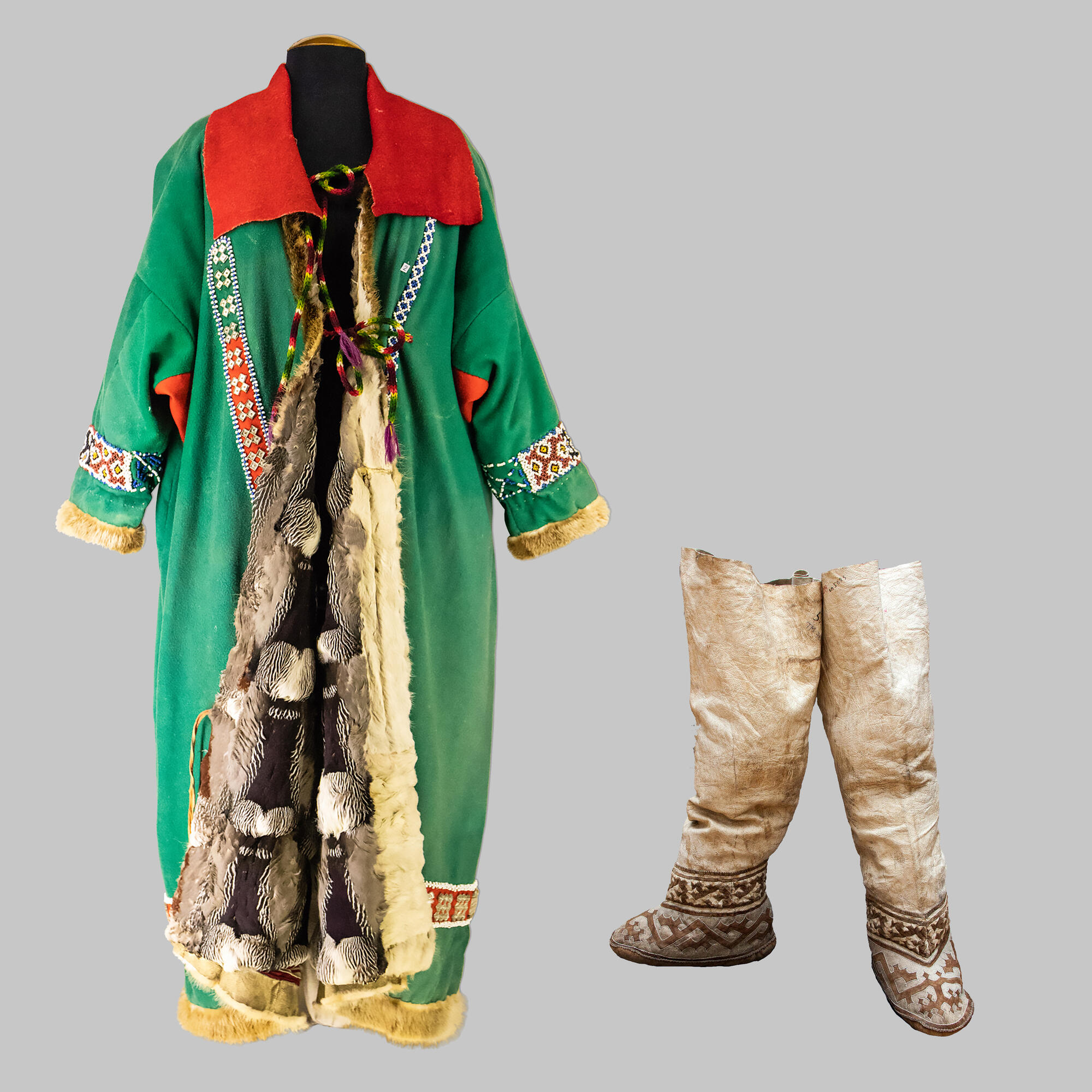
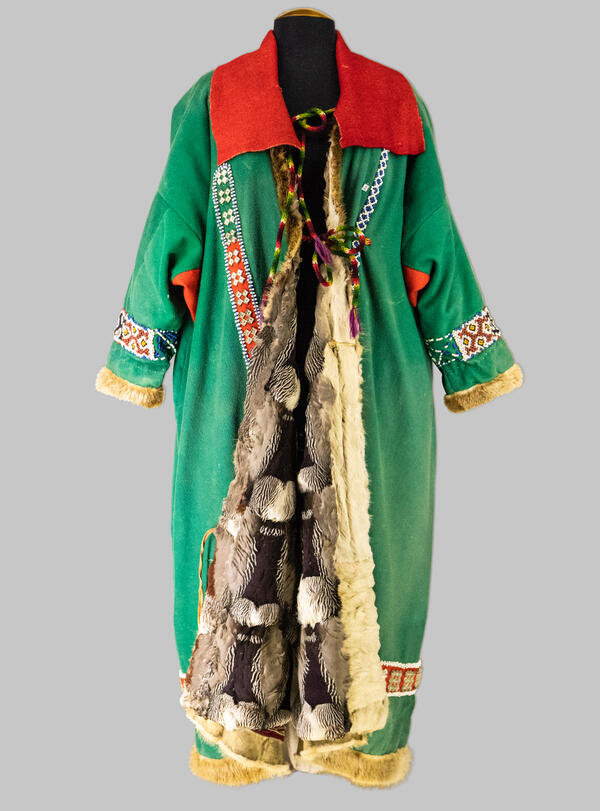
The women’s kaftan from the collection at the Tobolsk Provincial Museum is hand-sewn from green broadcloth and 83 fragments of necks from black-throated loons, a waterfowl game bird that is widespread in West Siberia. According to legend, the loon accompanied the shamans on their travels, helped them to overcome water obstacles, and to find and destroy evil spirits in the underwater world.
A kaftan is a loose-fitting garment with a straight line cut down the front and converging hems. The artisan used dark and white reindeer skins for the lining, and connected the fur parts of the kaftan with sinew threads. The sleeves were trimmed with fur from the skins of the loons’ abdomens, and the collar is a turn-down collar made from red broadcloth, with the back cut out of a single piece of green broadcloth. The artisan sheathed the edges of the sleeves, the hem, and the edge of the sides with strips of seal skin, and decorated the shelves and flanges with bands of beads and tin. These beautiful and expensive kaftans were only worn by rich Khanty women. The kaftan came to the museum’s funds when the Tobolsk Provincial Museum was collecting items on the Yugan River in Surgut District for the first West Siberia Exhibition in 1911.
The peoples in the Russian Far North traditionally used beads - small glass beads - to decorate clothes. The beads came to the Far North, and other regions in Siberia, in the 18th – 19th centuries: Russian and foreign merchants, and fur traders, exchanged them for furs. Before glass beads appeared, locals used beads carved from mammoth bone - circles, balls, and columns - and colored with natural dyes. Even the smallest, most mundane items of clothing, and household items, were decorated with rich, intricate, ornamental beaded embroidery. The northern Khanty embroidered leather moccasins with beads: white, black, blue, and red geometric patterns.
The peoples of Siberia draw a distinction between two types of sewing techniques with beads. The first type is a sew-on technique: beads are drawn onto a needle with a thread and placed on the base along a pattern contour that has been drawn out beforehand. With another needle and thread, they fasten the beads, fastening the fabric with a needle through each bead. Beads are sewn on bands, rosettes, or squares, which are then sewn onto the finished item, or between its two parts.
A less common technique than the sew-on method is one of stringing the beads: the beaded threads are not attached to the base, but are left free, intertwining with each other. Thread from both ends is threaded onto two needles, and the beads are collected with one needle and lowered along the thread to the middle, while the second needle passes through the beads in the opposite direction, and tightens the thread. The sleeves of the women’s kaftan from this collection are decorated using the latter method.
A kaftan is a loose-fitting garment with a straight line cut down the front and converging hems. The artisan used dark and white reindeer skins for the lining, and connected the fur parts of the kaftan with sinew threads. The sleeves were trimmed with fur from the skins of the loons’ abdomens, and the collar is a turn-down collar made from red broadcloth, with the back cut out of a single piece of green broadcloth. The artisan sheathed the edges of the sleeves, the hem, and the edge of the sides with strips of seal skin, and decorated the shelves and flanges with bands of beads and tin. These beautiful and expensive kaftans were only worn by rich Khanty women. The kaftan came to the museum’s funds when the Tobolsk Provincial Museum was collecting items on the Yugan River in Surgut District for the first West Siberia Exhibition in 1911.
The peoples in the Russian Far North traditionally used beads - small glass beads - to decorate clothes. The beads came to the Far North, and other regions in Siberia, in the 18th – 19th centuries: Russian and foreign merchants, and fur traders, exchanged them for furs. Before glass beads appeared, locals used beads carved from mammoth bone - circles, balls, and columns - and colored with natural dyes. Even the smallest, most mundane items of clothing, and household items, were decorated with rich, intricate, ornamental beaded embroidery. The northern Khanty embroidered leather moccasins with beads: white, black, blue, and red geometric patterns.
The peoples of Siberia draw a distinction between two types of sewing techniques with beads. The first type is a sew-on technique: beads are drawn onto a needle with a thread and placed on the base along a pattern contour that has been drawn out beforehand. With another needle and thread, they fasten the beads, fastening the fabric with a needle through each bead. Beads are sewn on bands, rosettes, or squares, which are then sewn onto the finished item, or between its two parts.
A less common technique than the sew-on method is one of stringing the beads: the beaded threads are not attached to the base, but are left free, intertwining with each other. Thread from both ends is threaded onto two needles, and the beads are collected with one needle and lowered along the thread to the middle, while the second needle passes through the beads in the opposite direction, and tightens the thread. The sleeves of the women’s kaftan from this collection are decorated using the latter method.
#5
Date: late 19th century
Technique: handsewn and finished broadcloth, neck portion of a black-throated loon, beads, tin, seal skin
Place: Surgut District, Russia
Dimensions: 119×77 cm
Collection: Ethnography of Siberian Tatars and the Peoples in the Russian Far North
Copyright: Tyumen Province State Autonomous Cultural Institution ‘Tyumen Museum and Educational Association’, Structural Division ‘Tobolsk Historical and Architectural Museum Reserve’
Goskatalog Number: 10584897
Technique: handsewn and finished broadcloth, neck portion of a black-throated loon, beads, tin, seal skin
Place: Surgut District, Russia
Dimensions: 119×77 cm
Collection: Ethnography of Siberian Tatars and the Peoples in the Russian Far North
Copyright: Tyumen Province State Autonomous Cultural Institution ‘Tyumen Museum and Educational Association’, Structural Division ‘Tobolsk Historical and Architectural Museum Reserve’
Goskatalog Number: 10584897
#6
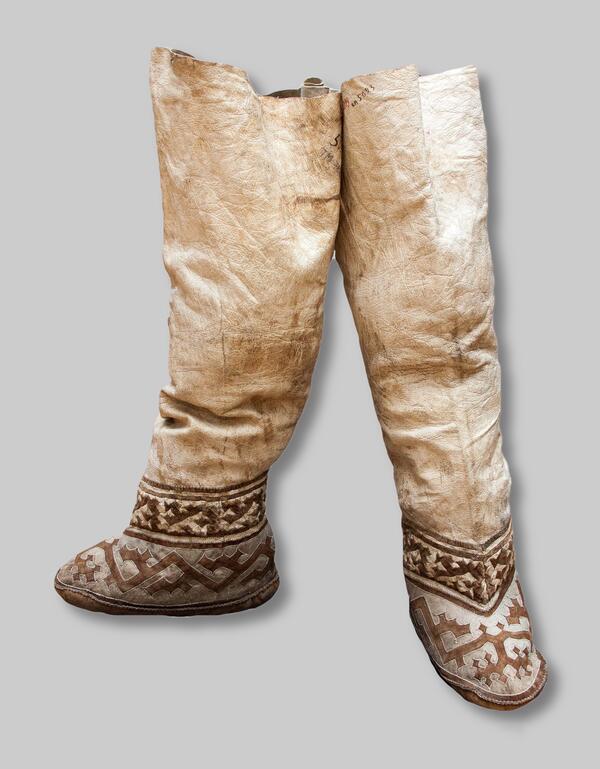
Gaiters, the Khanty women’s shoes
#7
#8
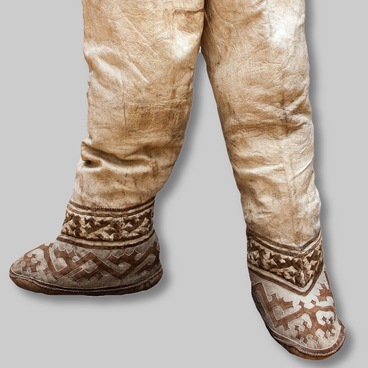
Gaiters are the national Khanty women’s shoes. The exhibit came to the funds from forwarding collections of the Tobolsk Provincial Museum on the Ob in Uryevskiye Yurty of the Lokosovskaya Administration of the Surgut District for the first West-Siberian exhibition, which opened in Omsk on 15 June 1911.
Researchers attribute gaiters to a special plunger-shaped type of footwear of indigenous Northern peoples. In this case, the shoes consisted of a piston sole and a top sewn thereto. Tobolsk gaiters are hand-sewn with sinew thread of rawhide that is durable skin taken from the legs of deer. The sole was made of sheared deerskin with wool inside for extra warmth. A wide saddle is sewn to it with a small seam. The top was cut from a single piece of leather and sewn to the saddle. The craftswoman decorated the saddle with an ornament sewn from thin strips of rawhide and deer hair, and also placed an ornament made of white and dark brown leather between the top and the lower part. This geometric pattern is called “sable”.
Rawhide is a rare leather material. The process of obtaining it in the Far North has traditionally been difficult. The removed skin of a deer intended for rawhide dressing was laid out on the snow with its hair down and carefully straightened. After that, the frozen skin was cleaned of hide scrapings, such as clots, films, and fat. Then the raw skin was tightly rolled up and placed in a warm place for several days. Under the influence of heat, the enzymes in the skin destroyed the hair follicles, which facilitated subsequent processing.
After two or three days, the skin was unwrapped, and the wool was removed with a scraper. If the action of the enzymes was not enough, the skin was smeared with fish entrails and rolled up again. After that, the wool was scraped out again. After the wet skin was dried in the wind, then it was thickly smeared with fish oil, frozen yogurt, or buttermilk, i.e. the liquid left after churning the oil.
At the next stage, the skin was kneaded for several days on a special machine and sanded using special tools. In order for the rawhide to become waterproof, it was “smoked”, that is, hung on a frame over a weakly smoldering fire made of logs of resinous wood. After that, it was painted with willow and birch bark, ochre, and white clay. Such gaiters were used by women as summer shoes. In winter, they were worn only when women had to stay in the house for a long time.
Researchers attribute gaiters to a special plunger-shaped type of footwear of indigenous Northern peoples. In this case, the shoes consisted of a piston sole and a top sewn thereto. Tobolsk gaiters are hand-sewn with sinew thread of rawhide that is durable skin taken from the legs of deer. The sole was made of sheared deerskin with wool inside for extra warmth. A wide saddle is sewn to it with a small seam. The top was cut from a single piece of leather and sewn to the saddle. The craftswoman decorated the saddle with an ornament sewn from thin strips of rawhide and deer hair, and also placed an ornament made of white and dark brown leather between the top and the lower part. This geometric pattern is called “sable”.
Rawhide is a rare leather material. The process of obtaining it in the Far North has traditionally been difficult. The removed skin of a deer intended for rawhide dressing was laid out on the snow with its hair down and carefully straightened. After that, the frozen skin was cleaned of hide scrapings, such as clots, films, and fat. Then the raw skin was tightly rolled up and placed in a warm place for several days. Under the influence of heat, the enzymes in the skin destroyed the hair follicles, which facilitated subsequent processing.
After two or three days, the skin was unwrapped, and the wool was removed with a scraper. If the action of the enzymes was not enough, the skin was smeared with fish entrails and rolled up again. After that, the wool was scraped out again. After the wet skin was dried in the wind, then it was thickly smeared with fish oil, frozen yogurt, or buttermilk, i.e. the liquid left after churning the oil.
At the next stage, the skin was kneaded for several days on a special machine and sanded using special tools. In order for the rawhide to become waterproof, it was “smoked”, that is, hung on a frame over a weakly smoldering fire made of logs of resinous wood. After that, it was painted with willow and birch bark, ochre, and white clay. Such gaiters were used by women as summer shoes. In winter, they were worn only when women had to stay in the house for a long time.
#9
Date: second half of the 19th - beginning of the 20th century
Technique: rawhide, painting with vegetable paint, hand sewing
Place: Tyumen Region, Russia
Dimensions: 50×24 cm
Collection: Ethnography of Siberian Tatars and the Peoples in the Russian Far North
Copyright: Tyumen Province State Autonomous Cultural Institution “Tyumen Museum and Educational Association”, Structural Division “Tobolsk Historical and Architectural Museum Reserve”
Goskatalog Number: 10584971, 10585294
Technique: rawhide, painting with vegetable paint, hand sewing
Place: Tyumen Region, Russia
Dimensions: 50×24 cm
Collection: Ethnography of Siberian Tatars and the Peoples in the Russian Far North
Copyright: Tyumen Province State Autonomous Cultural Institution “Tyumen Museum and Educational Association”, Structural Division “Tobolsk Historical and Architectural Museum Reserve”
Goskatalog Number: 10584971, 10585294
read morehide
00:00
00:00
1x
0
 Point your smartphone camera to open in the app
Open in app
Share