#1
Red deer, Nutcracker, Black grouses performing courtship rituals
#2
#3
#4
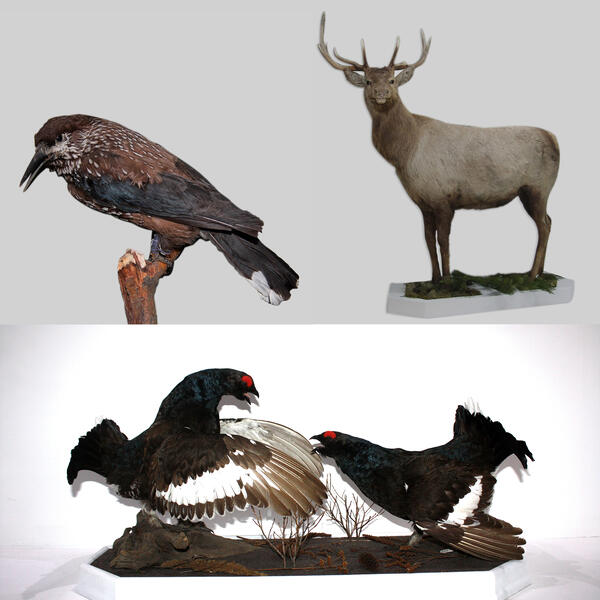
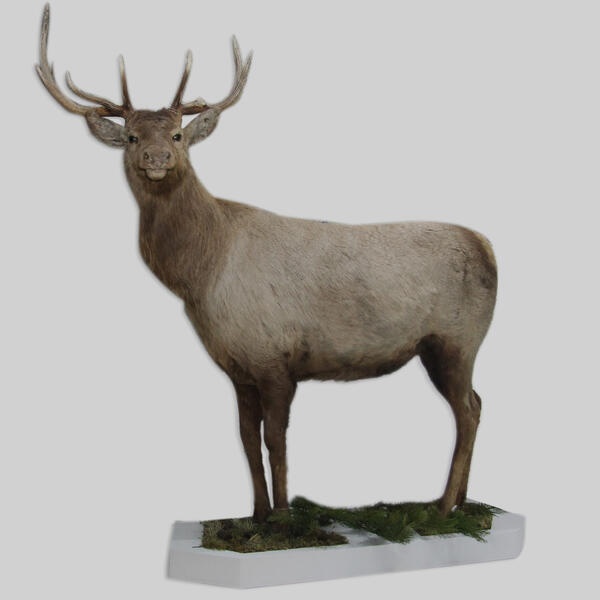
Red deer are common in the mountain taiga zone of the Republic of Buryatia. In summer, Manchurian wapiti can be found even in the area of mountain Alpine meadows. The Khamar-Daban Mountain Range is the border of two subspecies of red deer. To the East lives Manchurian wapiti, and to the West - a larger maral. The weight of an adult male can reach 200-260 kilograms, and the body length can be up to 230 centimeters.
In summer, deer are active in the early morning and late evening. They prefer to stay in the shadows. In the heat, they often go into the water or lay down on patches of snow that has not melted. In winter, on the contrary, they prefer sunny slopes. They can graze almost around the clock, especially in severe frost. In addition to various herbs, young twigs, roots and bark, deer also eat salt. Deer often come to natural and artificial salt pans in search of unusual treats.
During the mating season in early September, one can hear the roar of male red deer, which is heard for many kilometers through the forest. During this period, the deer can make a wide variety of sounds ranging from hoarse to low and prolonged sounds resembling a lowing. The best word for the roar of deer is ‘trumpet’. It is the sound of a trumpet that is closest to the voice of a red deer.
The roaring deer was often depicted in paintings. A head thrown on its back with magnificent horns, and hooves spreading the ground. All this is characteristic of these animals. During the rut, fights between males are possible, due to which animals establish primacy. The opponents face with each other’s horns, thus attempting to knock down each other. Weaker males quickly leave the battlefield. It is possible to tell whether a male is strong or weak not only by its appearance, but even by its voice. A strong and more experienced deer has a hoarse and low voice, while a young and weak one has a higher and clearer voice. Once a year, at the beginning of spring, male deer shed their old antlers leaving only small appendages in their place, from which new, powerful branches grow by the end of summer. Non-ossified antlers of deer are called velvet antlers. They produce valuable raw materials for the pharmaceutical industry.
The most dangerous of the natural enemies of the deer is the wolf. In addition, bears, wolverines, and lynxes hunt it. But the greatest danger is man. The deer is a cautious animal and can smell the enemy at a distance of about 300 meters. The red deer is one of the fastest animals in the world. The speed of a deer running away from predators can reach up to 55 kilometers per hour, and in a jump it can cover a distance of 5-6 meters.
#5
Место создания: Ulan-Ude
Коллекция: Natural science
Полное наименование: Red deer (Cervus elaphus L.)
Автор: Postnikov A.I.
Дата создания: 1975
Техника: Sculptural method
Размеры: 205×86×220 cm
#6
Nutcracker
#7
#8
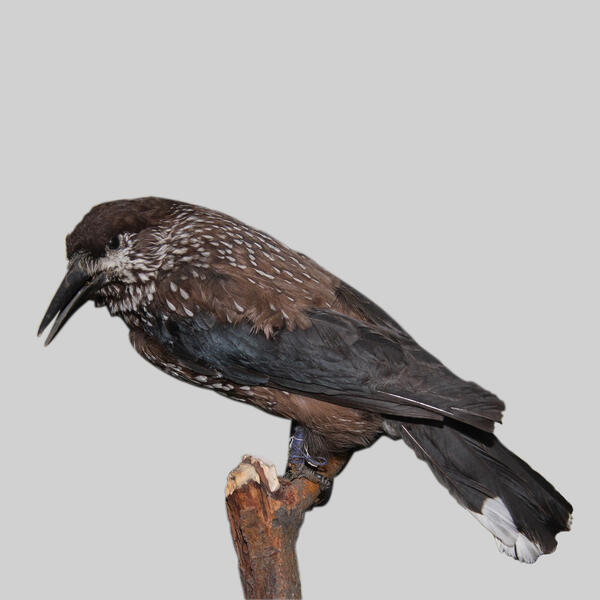
The bird got its name because of pine nuts, which are the main food of a nutcracker. It has brown-chocolate plumage with white spots, which helps it to disguise itself in the forest. Its paws are powerful with prehensile claws, which it deftly holds the cones when they are peeling. It uses its long, strong beak to extract pine nuts from cones and extract kernels. To do this, the a nutcracker opens its beak slightly and hits the shell. The blow falls on two points at once and splits the shell. These birds prefer pine nuts in their diet, but in many areas where broad-leaved forests predominate, they eat hazel nuts, beech seeds, and other plants. During the short Siberian summer, one nutcracker manages to collect about 50 kg of pine nuts. At one time the bird moves more than 100 nuts. For this purpose, it has a special sublingual pouch. When collecting nuts, the nutcracker discards unusable, damaged, and rotten nuts, and leaves only the best ones.
The nutcracker hides supplies in small portions, usually for 10-20 nuts, under moss, tree bark, rotten stumps, and logs. It especially likes to do this in crevices and on rocky slopes. The bird easily finds its reserves under the snow, but it is still unknown how it remembers their location. Caches with reserves that are not used by nutcrackers make it possible for future cedar seedlings to appear. This bird is the main distributor of both Siberian pine and cedar elfin high in the mountains and far to the North. In addition, other animals, such as chipmunks, squirrels, and bears, use the nutcracker’s supplies. The lifestyle of this woodland bird varies from season to season. During nesting season, it finds a secret corner in the forest and rarely leaves them. At other times of the year, they are not afraid of people at all and can stay close to housing, thus knowing that there is always something to profit from. Nutcrackers, like other corvids, are very resourceful. Ornithologists observed how they extracted pine moth caterpillars in November directly from under the snow, thus making oblique passages in the snow cover.
#9
Место создания: Ulan-Ude
Коллекция: Natural science
Полное наименование: Nutcracker (Nucifraga caryocatactes L.)
Автор: Yemelyanovskiy Aleksandr Nikolayevich
Дата создания: 1989.
Размеры: 22×9.5×15 cm
Техника: Combined method
#10
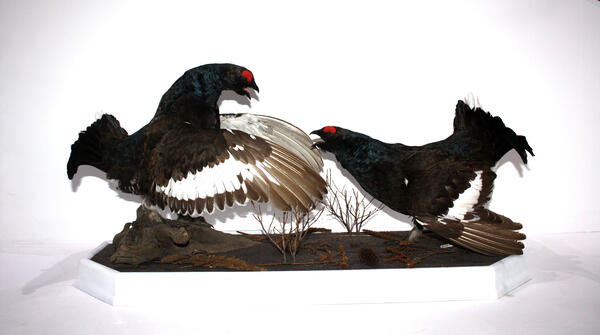
Black grouses performing courtship rituals
#11
#12
Grouses belong to the order of Galliformes of the Pheasant family and are sedentary species. The black grouse lives almost everywhere. It inhabits the territory of Europe, North Africa, Asia, and lives in the Scandinavian countries.
The male has large, bright red eyebrows and a strong beak, is colored mainly black, and shimmers with a blue or greenish hue. The wide-spread lyre-shaped tail is separated by a white feathering. Mature individuals reach 58 centimeters in length and weigh up to 1.5 kilograms. Among the forest inhabitants that pose a real danger to grouse, foxes, hawks, and martens can be distinguished.
Black grouses live mainly in birch plantations, groves, and forests. However, some species prefer mixed forests. This bird spends a significant part of its life on the ground, but in winter the grouse most often feeds on trees. In order to eat buds, birch catkins, and other twig food, the grouse willingly climbs the tree crowns.
In the warm season, the basis of its diet consists of wild berries, willow buds, aspen, clover leaves, and rose hips. Despite its massiveness, the black grouse being in search of delicious treats is able to grab a branch and hang upside down for a long time, thus reaching for a favorite berry or young kidney.
During life, along with food, adult birds swallow small stones, which contribute to active digestion and grinding of coarse food inside the stomach.
The black grouse is the only bird that uses snow chambers as a shelter during the cold season. In shallow holes dug, they hide from the cold and bad weather, and come out of them only for food.
During the spring season, there is a period of performing courtship rituals. It is a special behavior of birds at the beginning of the mating season, which contributes to attracting the female. With the beginning of spring, male grouses gather together in lekking grounds, i.e. open places in the forest where they perform such courtship rituals. They make characteristic sounds, while spreading their wings, inflating, running around the lekking ground, colliding, and grappling with each other.
#13
Полное наименование: Composition Black grouses performing courtship rituals (Lyrurus tetrix L.)
Автор: Unknown
Дата создания: 2000s
Техника: Combined method
Место создания: Russia
Размеры: Размеры 93×35×44 cm
Коллекция: Natural science
#14
National Museum of the Republic of Buryatia
read morehide
00:00
00:00
1x
Red deer, Nutcracker, Black grouses
Exhibition
0
 Point your smartphone camera to open in the app
Open in app
Share