Font
Color
Graphics
Изображение точки

To see AR mode in action:

1. Install ARTEFACT app for iOS or Android;

2. Find the exhibition «History of the region: 1589 – early 20th century»

3. Push the «Augmented reality» button and point your phone's camera at the exhibit;

Скрыть точки интересаПоказать точки интереса
Показать в высоком качестве
#4
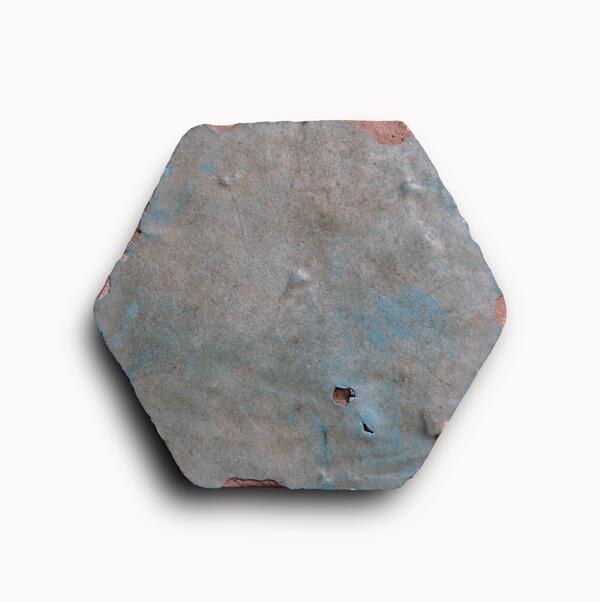
Hexagonal glazed tile
#3
The architecture of the Golden Horde borrowed traditional decorative techniques from the Central Asian urban culture. The process of penetration of Eastern traditions into the Golden Horde accelerated with the adoption of Islam in the early 1320s, during the reign of Khan Uzbek.

The main forms of exterior decoration came to the Golden Horde from Central Asia as well; and these included glazed tiles, mosaics and ganch — clay and gypsum mix, which was very durable and resistant to moisture. The design of the city buildings was notable for the opulence of the exterior decoration.

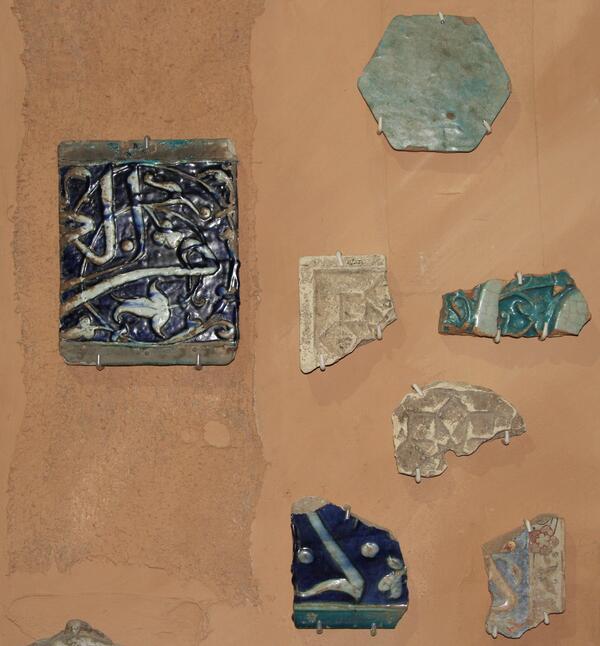
Mosaic panels were used to decorate public buildings — mosques, palaces and mausoleums. They were placed on the outer walls. A complex composition was made up of many small colored tiles, such as the one displayed at the Volgograd Regional Museum of Local History.

Passers-by perceived these large ornamental panels as whole pictures. In this sense, mosaic panels were better suited for decorating external walls than patterned glazed tiles. The elements for mosaic compositions were made in the technique of glazed ceramics. Glaze was a thin vitreous coating on a tile.

The glaze was applied to one side only, and could be white, yellow, turquoise or even ultramarine. The tiles were beveled on the sides and grooved to make them stick better to the lime mortar, which sometimes also served a decorative function.

Such hexagonal glazed tiles were made both of kashi — a special mixture of quartz sand — and a red-clay base. Kashi was considered a higher-quality and more expensive material.

Production of the kashi architectural ceramics in the Golden Horde was local; besides, domestic raw materials were used. The Golden Horde mosaics were distinctive with additional ornamentation of the elements made of gold foil on a red base. The Golden Horde architectural decor was more refined and opulent than its Central Asian prototypes.
#2
Name: Hexagonal glazed tile
Date of creation: the 13th–14th centuries
Technique: handicraft, ceramics
Dimensions: 17,5×19,7 cm
#5
Ganch decorated tile
#7
From the 1960s to the 1990s, large-scale excavations of the Golden Horde settlements took place in the Soviet Union, and later in Russia. In 1993, one of the Ulus Jochi mausoleums with a half-meter-wide fence was discovered near the settlement of Bakhtiyarovka in the Leninsky District of the Volgograd Region.

Earlier discoveries on the territory of today’s Volgograd Region include the Kolobovsky burial mound, known since 1773; the Tsarevskoe ancient settlement, a 14th century archaeological monument, which has been studied since the 19th century; and the Zubovka ancient settlement, discovered by researchers in the same historical period.

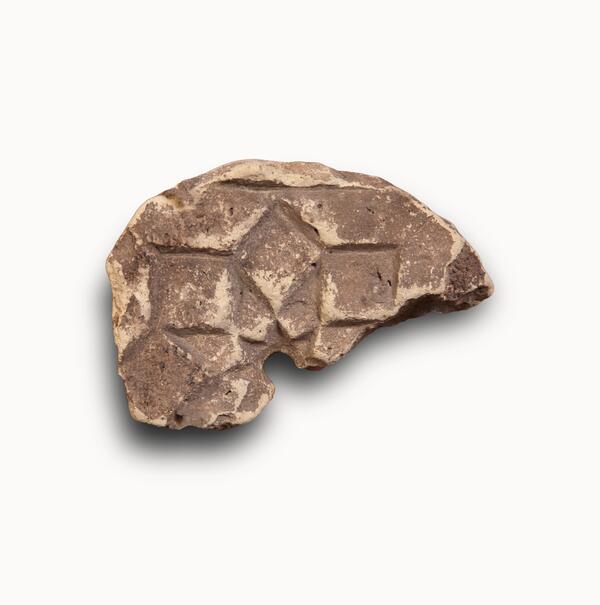
In the excavated area, researchers found a variety of architectural fragments, including those made of ganch. It was known since the first centuries AD as a material used for plastering, volumetric and plastic decorations (carvings, lattices, and sculptures). Wet ganch was easy to carve and allowed for a variety of low and high reliefs.

The surface of the carvings on ganch was white and matt. The dried layer of ganch served as a base for painting. This material was well known to builders and architects both in Central Asia and the Golden Horde. It was obtained by firing the raw material, which contained gypsum and clay. Archaeologists often find this building material during excavations in the Astrakhan and Volgograd regions.

For example, in 2014 the Volgo-Akhtubinsk archaeological expedition of Volgograd State Social and Pedagogical University carried out exploratory excavations of the Vodyanskoye settlement in the vicinity of Dubovka, Volgograd Region. Archaeologists found carved ganch tiles used to decorate external walls. 90% of the finds consisted of decorative elements — carved ganch and mosaic tiles.

This item from the collection of the Volgograd Regional Museum of Local History was created as a decoration in the 13th or 14th century. The surface clearly shows a geometric pattern that makes up a composition of several rhombuses.
#6
Name: Ganch decorated tile
Date of creation: the 13th–14th centuries
Technique: handicraft
Dimensions: 17×11,5 cm
#8
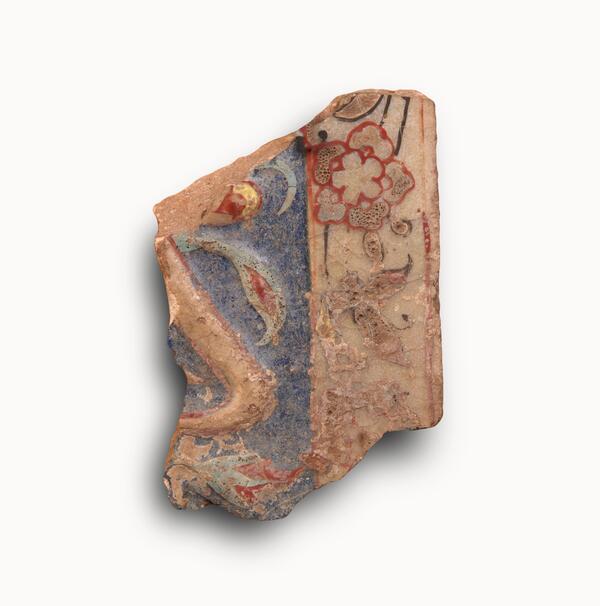
Ganch decorated tile
#10
The Golden Hord, also known as Ulus Jochi, had its own school of architectural décor. It absorbed the traditions of several countries of the Middle East and Central Asia. In the 14th century, local craftsmen mastered perfectly the art of architectural decoration. One of the forms of décor in the Golden Horde architecture was ganch carving, which decorated the walls of the buildings.

Ganch — the alabaster of special composition — was used to produce carved and stamped tiles of greyish color. It was obtained by firing the raw material, which contained gypsum and clay. Ganch tiles had carved and openwork designs and decorated mostly the interior walls of buildings, which distinguished them from glazed ceramics that were used for exterior walls.

Such forms of architectural décor as ganch carving and plaster painting were much rarer in the Golden Horde settlements compared to other decorative features. Ganch was used for friezes and partitions.

Architectural decoration was enriched by terracotta elements with stamped ornaments, carved plaster window lattices and inlays on some parts of buildings. Floral, geometric, epigraphic and zoomorphic ornamentation patterns were the most common for ganch carvings.

Ganch carved tiles featured openwork ornamentation in the form of circles and curvilinear figures. The motif of regular geometric lattices, which was widespread in the medieval Muslim world, was often used too.

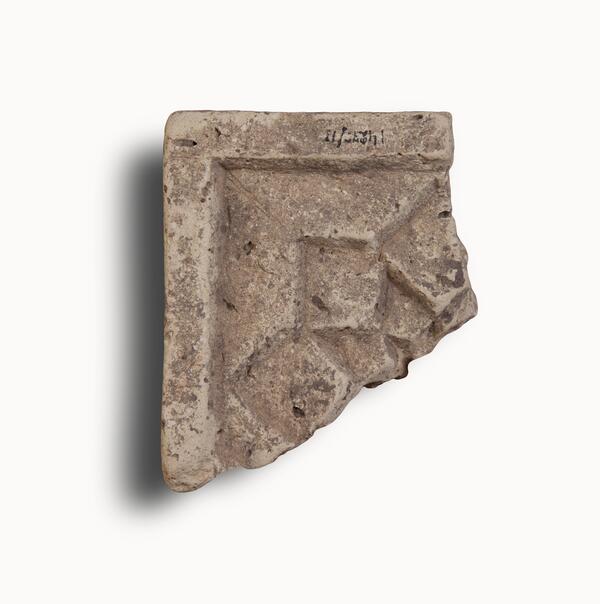
Archaeologists have also found ganch carved tiles with simple rhombic grid patterns. Ganch carving in the Golden Horde architecture was inherently more restrained compared to the multi-colored mosaics, majolica and glazed ceramics. Eventually, craftsmen in the Golden Horde started to paint ganch carvings in different colors and even to coat them with gold.

The exhibit from the collection of the Volgograd Regional Museum of Local History is a ganch tile with a geometric pattern. Experts have established that it was handmade between the 13th and 14th centuries.
#9
Name: Ganch decorated tile
Date of creation: the 13th–14th centuries
Technique: clay, handcraft
Dimensions: 14,5×11,5 cm
#11
Glazed tiles with Arabic letters
#13
At the beginning of the first millennium, potters in Turkey and Iran began to produce majolica pottery. They were ceramic products, decorated with colored compositions in the form of plant patterns and covered with glaze.

It was not long before majolica came into use in monumental architecture, in particular in the urban architecture of different Asian countries. Many of the buildings that have survived from the Middle Ages feature ceramic glazed tiles of various shapes and designs.

The various patterns were most often blue, turquoise and ultramarine. They could be made of yellow inlays, white letters of Arabic inscriptions, yellow and red flowers, rosettes and geometric shapes. Craftsmen used different paints based on minerals: blue was made from cobalt, green — from copper and yellow — from iron.

Public and religious buildings in Muslim cities were often decorated with mosaics, which were made up of individual elements. They were molded from clay as well as cut out of ceramic boards.

When designing majolica, craftsmen of the Golden Horde tended to apply underglaze and overglaze painting. Underglaze painting was more common and involved the use of transparent lead, while overglaze painting was characterized by the use of pewter.

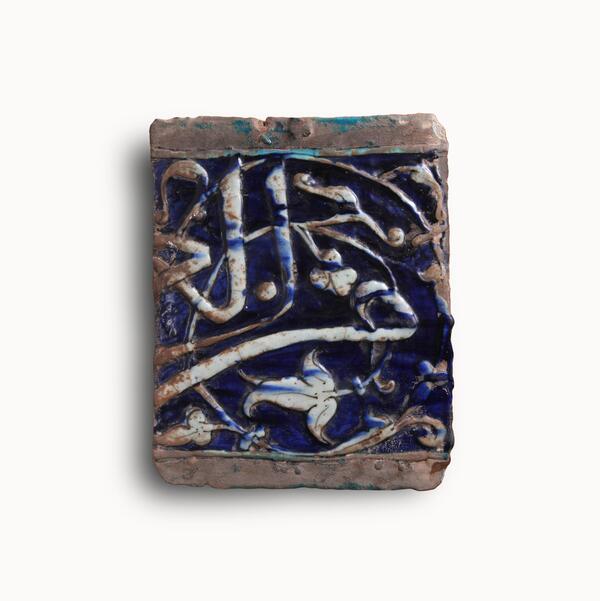
The muslim religion forbade depicting human figures in most cases, so complex weaving ornamental designs of plant or geometric elements were widespread in architectural ceramics and pottery.

It was not uncommon for such a pattern to be accompanied by epigraphic decoration, which reproduced excerpts from the Muslim holy book of Quran and Oriental poetry. Such sacred inscriptions were executed by craftsmen in calligraphic script, with the Arabic language being used on tiles since the adoption of Islam under Uzbek Khan. He belonged to the family of Chingisids, which means he was a direct descendant of Genghis Khan and lived in the period from 1283 to 1341. Uzbek became Khan of the Golden Horde in 1313.
#12
Name: Glazed tiles with Arabic letters
Date of creation: the 13th–14th centuries
Technique: handcraft, ceramics
Dimensions: 15,5×12,5 cm
#14
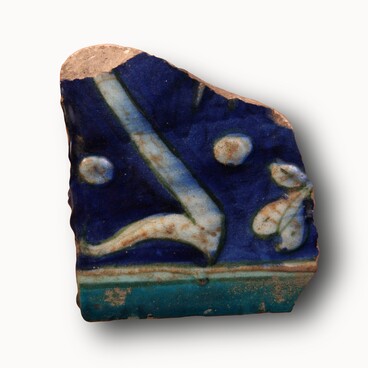
Fragment of a glazed tile with Arabic letters
#16
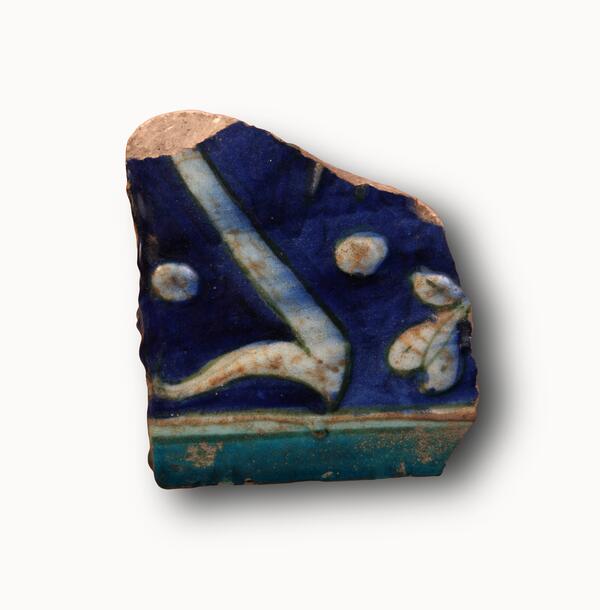
The collection of the Volgograd Regional Museum of Local History contains several dozens of tile fragments. One of the unique exhibits is a fragment of a glazed tile with Arabic letters.

The Golden Horde cities of the Volga region adopted the Central Asian traditions of town planning. Under the influence of Central Asian art, such settlements developed their own traditions of external building decoration. Ceramic tiles as elements of architectural decoration were widespread in the Golden Horde.

In those days, one of the types of ceramics produced was polychrome majolica — glazed tiles made from colored fired clay with a coarse porous ceramic body. This tile was made using precisely this technique. Glaze was a thin layer of vitreous coating that was applied to the surface of the ceramic piece.

Polychrome tiles were true works of art. Public buildings — mosques, madrasahs, mausoleums, palaces of khans and nobles — were richly decorated with them. Various shades of navy blue and blue, as well as white, were considered the most typical colors.

Glazes without lead oxide were mainly used in decorating the buildings in the Golden Horde, which gave them greater weather resistance. A translucent glaze required the use of a light base of red clay and kashi, the latter being made by combining fine quartz sand, white clay and lime, followed by firing at temperatures of 1,000–1,200°C.

The tile from the museum’s collection has a fragment of an Arabic inscription on it. It testifies to the fact that the Golden Horde was Islamized in the 14th century during the reign of Khan Uzbek (1313-1342). Historians have discovered that the item in question was made by captives.

Traditionally, inscriptions in Arabic ceramic tiles made up passages from the Quran and oriental poetry. Such sacred and solemn inscriptions were executed in calligraphic Kufic script. The plant motifs that have survived on ceramic tiles are related to Islamic symbolism.
#15
Name: Fragment of a glazed tile with Arabic letters
Date of creation: the 13th–14th centuries
Technique: handcraft, ceramics
Dimensions: 22,5×28,5 cm
#17
Glazed tile with botanical design
#19
The exhibit from the collection of the Volgograd Regional Museum of Local History is an example of a glazed tile, which was made in the 13th–14th centuries. The fragment of an azure-colored ceramic tile, discovered by the researchers, has a traditional glaze for that period.

Experts believe that this piece of ceramics was hand-painted. The artisan used the intricate botanical design, which under the influence of Central Asia became traditional for the architecture of Ulus Jochi, better known as the Golden Horde.

The wall decoration of buildings with tiles was characterized by floral linear patterns and compositions, as well as plant motifs, which looked endlessly repetitive. At the same time, the patterns of painting on the walls of the Golden Horde houses could emphasize the central figure. These could be leaves or stems. Besides, artisans could apply geometric and epigraphic ornaments on tiles. Such methods of decoration were widespread.

The former was marked by geometric shapes, mainly triangles or hexagons, as well as patterns with rhombuses. The latter, epigraphic, was used more often to frame compositions and only rarely contained the main semantic meaning.

The spread of the kashi ceramics in the Golden Horde was connected with the use of transparent glazes, which required a light base. This type of ceramic tile was made from milled siliceous rock, opoka, with the addition of an adhesive compound.

In Central Asia, kashi architectural ceramics were known from the beginning of the 12th century, and their appearance in the Golden Horde can be attributed to the influence of Khorezmian ceramics production.

The Golden Horde gradually developed its own production of the kashi architectural ceramics based on local raw materials. The tiles in the Ulus Jochi were made by captive Russian craftsmen.
#18
Name: Glazed tile with botanical design
Date of creation: the 13th–14th centuries
Technique: handcraft, ceramics
Dimensions: 9×18,5 cm
#21
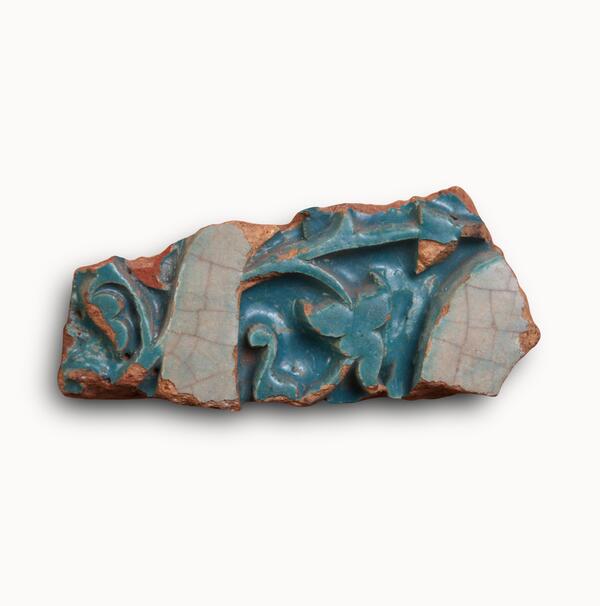
Mosaic tile
#22
The development of architecture and decorative style in the Volga region was influenced by the spread of Islam in the Golden Horde from the early 14th century. The ornamental style of Ulus Jochi was primarily influenced by the art of Central Asia, Transcaucasia and Iran.

At that time, mosaics and majolica were the main decorative features in the architecture of the Golden Horde. They were used to adorn the facades and interiors of buildings and gravestones. The mosaics were made of separate pieces of kashi tiles, which was a special mixture of quartz sand with clay. The cities of the Golden Horde had their own production of kashi glazed architectural ceramics based on local raw materials.

The elements were carefully fitted together and assembled on smooth boards face down. Then a liquid gypsum mortar was poured over the set. Finally, the board was fixed in the chosen space.

Mosaics were mainly used to cover portals, arches, side walls of pylons, inner vaults of domes and large planes of walls. The Golden Horde mosaics typically feature elements of ultramarine, turquoise, white, yellow and red colors.

The dominant color in architectural botanical decorative patterns was red. Foliage patterns in the Golden Horde mosaics were made up of sprouts, which formed picturesque compositions and did not repeat. This distinguished them from their Central Asian analogs. The mosaics used for cornices and borders had alternating botanical and geometric patterns consisting of multi-colored fragments.

Historians were able to determine that the tile, displayed at the exhibition of the Volgograd Regional Museum of Local History, was used in the construction of the walls of the khan’s palace or mosque. This piece was found during a joint expedition of the Institute of Archaeology of the USSR Academy of Sciences, Moscow State University and the Stalingrad Museum of Local History. The expedition was led by German Alexeyevich Fyodorov-Davydov, a specialist in Oriental and Russian medieval numismatics, archaeology and history of the Volga region and Central Asia.
#20
Name: Mosaic tile
Date of creation: the 14th century
Technique: handcraft
Dimensions: 55,5×40×18 cm
#23
read morehide
00:00
00:00
1x
Point your smartphone camera to open in the app
Share
VkontakteOdnoklassnikiTelegram
Share on my website
Copy linkCopied
Copy
Open in app
To see AR mode in action:
  1. Install ARTEFACT app for 
  2. iOS or Android;
  3. Find and download the «Paintings in Details» exhibition
  4. Push the «Augmented reality» button and point your phone's camera at the painting;
  5. Watch what happens on your phone screen whilst you flip through the pictures.
 
We use Cookies
Cookies on the Artefact Website. We use cookies to ensure that we give you the best experience on our website. If you continue without changing your settings, we'll assume that you are happy to receive all cookies on the Artefact website. However, if you would like to, you can change your cookie settings at any time.
Learn more about useHide
Content is available only in Russian

X

Нашли опечатку?...

%title%%type%