

#1
Izbornik of Svyatoslav, Zlatnik of Prince
#2
#3
#4
The “Izbornik of Svyatoslav” is the second oldest accurately dated Old Russian manuscript of the 11th century. It was discovered in 1817 in the library of the Resurrection Monastery near Moscow during an archaeographic expedition led by Pavel Stroyev and Konstantin Kalaydovich. Presently, it is the New Jerusalem Monastery in the city of Istra, Moscow Oblast.
The Izbornik is dated to 1073. Researchers have established that it was copied from an old Bulgarian manuscript commissioned by Yaroslav the Wise’s eldest son, Prince Izyaslav of Kiev. The original document belonged to the Bulgarian tsar Simeon and was a Slavic translation of a Greek-Byzantine anthology, which had been written at the beginning of the 11th century in Bulgaria.
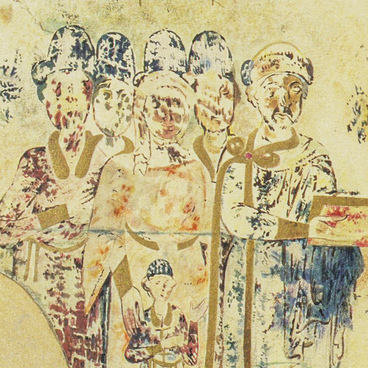
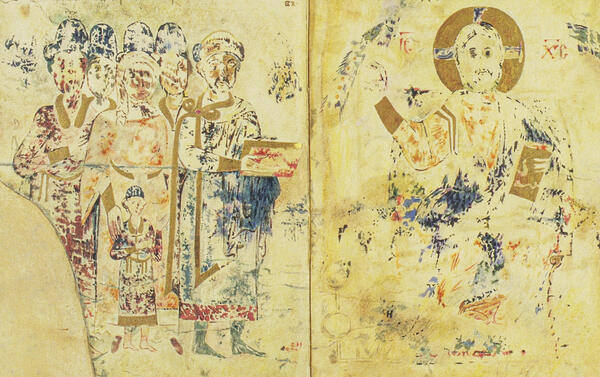
As a result of princely feuds, the “Izbornik” got into the hands of the new Kiev grand prince Svyatoslav, Izyaslav’s brother. Svyatoslav commissioned an artist to create two miniatures, one depicting his family — “The Family of Svyatoslav” and “The Savior Enthroned”. By his order, these drawings were placed at the beginning of the text. Two scribes worked on the document, but the name of only one of them, dyak Ioann (sexton Ioann), is known.
In total, the manuscript is made up of 266 sheets. The text on each of them is arranged in two columns and is written in ustav — a form of manuscript Cyrillic. The letters were written without a tilt, separately from each other, which gave them a clear outline — it seems as if each sign was inscribed into a square.
The pages of the Izbornik are decorated with colored miniatures, initials, headpieces that separate the chapters. Zodiac signs are drawn in the margins.
The document includes 363 articles. The main part is “Questions and Responses” by Anastasius Sinaita, abbot of the Saint Catherine’s Monastery on Mount Sinai, who lived in the 7th century AD. His works are reflections on faith, righteous life and morality. In addition, the Izbornik includes translations of articles on philosophy, philology and natural science. They were written by famous scientists of antiquity: Aristotle, Nemesius, Maximus the Confessor. Another part of the book consists of lists of literature banned by the church, as well as Roman, Jewish and Macedonian calendars.
The Izbornik is dated to 1073. Researchers have established that it was copied from an old Bulgarian manuscript commissioned by Yaroslav the Wise’s eldest son, Prince Izyaslav of Kiev. The original document belonged to the Bulgarian tsar Simeon and was a Slavic translation of a Greek-Byzantine anthology, which had been written at the beginning of the 11th century in Bulgaria.
As a result of princely feuds, the “Izbornik” got into the hands of the new Kiev grand prince Svyatoslav, Izyaslav’s brother. Svyatoslav commissioned an artist to create two miniatures, one depicting his family — “The Family of Svyatoslav” and “The Savior Enthroned”. By his order, these drawings were placed at the beginning of the text. Two scribes worked on the document, but the name of only one of them, dyak Ioann (sexton Ioann), is known.
In total, the manuscript is made up of 266 sheets. The text on each of them is arranged in two columns and is written in ustav — a form of manuscript Cyrillic. The letters were written without a tilt, separately from each other, which gave them a clear outline — it seems as if each sign was inscribed into a square.
The pages of the Izbornik are decorated with colored miniatures, initials, headpieces that separate the chapters. Zodiac signs are drawn in the margins.
The document includes 363 articles. The main part is “Questions and Responses” by Anastasius Sinaita, abbot of the Saint Catherine’s Monastery on Mount Sinai, who lived in the 7th century AD. His works are reflections on faith, righteous life and morality. In addition, the Izbornik includes translations of articles on philosophy, philology and natural science. They were written by famous scientists of antiquity: Aristotle, Nemesius, Maximus the Confessor. Another part of the book consists of lists of literature banned by the church, as well as Roman, Jewish and Macedonian calendars.
#5
Full name: Izbornik of Svyatoslav
Author: Dyak Ioann
Date: 1073
Technique: parchment, ink, cinnabar, boards, leather, tempera; ustav, tempera painting
Place: Kiev
Copyright: State Historical Museum
Dimensions: 33.6×24.7×11 cm
Date: 1073
Technique: parchment, ink, cinnabar, boards, leather, tempera; ustav, tempera painting
Place: Kiev
Copyright: State Historical Museum
Dimensions: 33.6×24.7×11 cm
#6
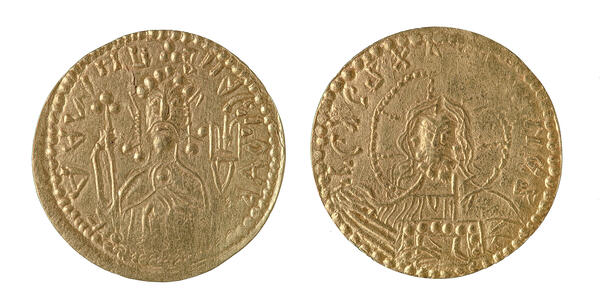
Zlatnik of Prince Vladimir Svyatoslavich
#7
#8
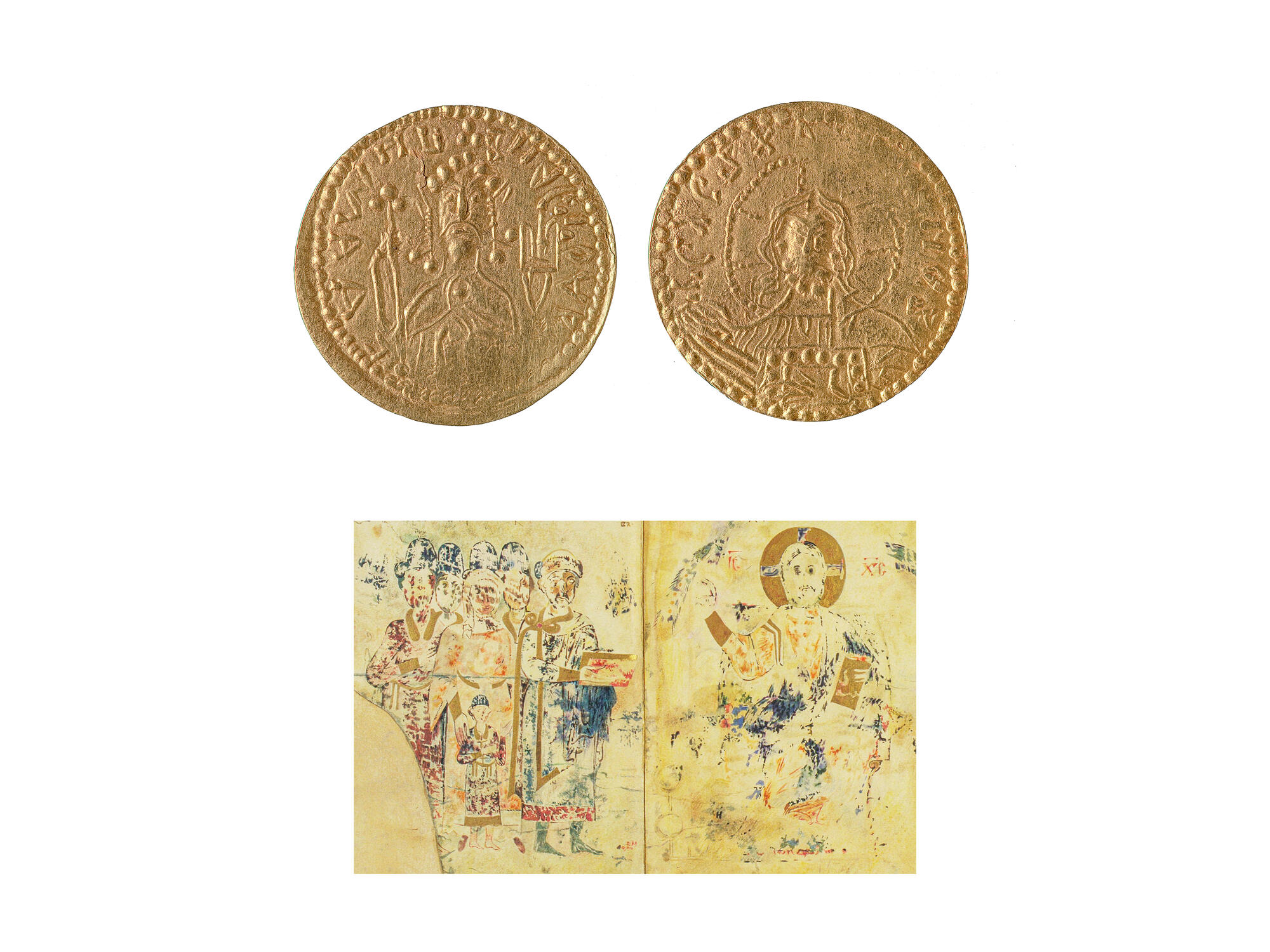
The gold coin — zlatnik — of Prince Vladimir was the first Russian coin to be minted in Kievan Rus after the adoption of Christianity as the state religion in 988. The minting of silver coins began concurrently. In terms of design and weight, the first Russian coins imitated the Byzantine ones.
The gold coin features the oldest Russian portrait, which fairly accurately reproduces the features of Prince Vladimir, as his contemporaries described him: “with bushy eyebrows… a flat nose, with a shaved beard and thick long hair hanging over the upper lip.”
Prince Vladimir Svyatoslavich was Princess Olga’s grandson, the third son of Prince Svyatoslav. After Svyatoslav’s death, his eldest son Yaropolk became the Grand Prince of Kiev. His brother Oleg took over the Drevlian territory.
Vladimir, whose mother was Svyatoslav’s servant Malusha and the key keeper of Princess Olga, was made prince of Novgorod. Five years later, a civil war began between the brothers, Yaropolk defeated Oleg’s Drevlian druzhinas (military retinues). Oleg himself died in battle. Vladimir fled “across the sea”, from where he returned two years later with a hired Varangian druzhina. Yaropolk was killed. Vladimir became the Grand Prince of Kiev.
Under Prince Vladimir, all lands of the Eastern Slavs were united as part of Kievan Rus. One of the most important tasks of that time was solved: ensuring that the Russian lands were protected from raids of the Pechenegs, nomadic tribes. In 988, Christianity was adopted as the state religion. The baptism of Vladimir and his druzhina took place in Korsun (Chersonesus) — the center of the Byzantine possessions in Crimea. First, Vladimir was baptized, then he baptized his boyars, and his whole people.
The adoption of Christianity was the starting point for the spread of literacy and development of writing system, which was of great importance for the Russian culture: it was influenced by the Byzantine culture, and through it, the cultures of Classical Greece and Rome. The adoption of Christian Orthodoxy became one of the determining factors in the further historical development of the Old Russian state. Vladimir was canonized by the church as a saint and is called equal-to-the-Apostles for his contributions to the Christianization of Russia.
The gold coin features the oldest Russian portrait, which fairly accurately reproduces the features of Prince Vladimir, as his contemporaries described him: “with bushy eyebrows… a flat nose, with a shaved beard and thick long hair hanging over the upper lip.”
Prince Vladimir Svyatoslavich was Princess Olga’s grandson, the third son of Prince Svyatoslav. After Svyatoslav’s death, his eldest son Yaropolk became the Grand Prince of Kiev. His brother Oleg took over the Drevlian territory.
Vladimir, whose mother was Svyatoslav’s servant Malusha and the key keeper of Princess Olga, was made prince of Novgorod. Five years later, a civil war began between the brothers, Yaropolk defeated Oleg’s Drevlian druzhinas (military retinues). Oleg himself died in battle. Vladimir fled “across the sea”, from where he returned two years later with a hired Varangian druzhina. Yaropolk was killed. Vladimir became the Grand Prince of Kiev.
Under Prince Vladimir, all lands of the Eastern Slavs were united as part of Kievan Rus. One of the most important tasks of that time was solved: ensuring that the Russian lands were protected from raids of the Pechenegs, nomadic tribes. In 988, Christianity was adopted as the state religion. The baptism of Vladimir and his druzhina took place in Korsun (Chersonesus) — the center of the Byzantine possessions in Crimea. First, Vladimir was baptized, then he baptized his boyars, and his whole people.
The adoption of Christianity was the starting point for the spread of literacy and development of writing system, which was of great importance for the Russian culture: it was influenced by the Byzantine culture, and through it, the cultures of Classical Greece and Rome. The adoption of Christian Orthodoxy became one of the determining factors in the further historical development of the Old Russian state. Vladimir was canonized by the church as a saint and is called equal-to-the-Apostles for his contributions to the Christianization of Russia.
#9
Full name: Zlatnik of Prince Vladimir Svyatoslavich
Date: the end of the 10th — early 11th century
Technique: gold; coining
Place: Kinburn Spit
Copyright: State Historical Museum
Dimensions: Weight — 4.14 grams, diameter — 2.2 cm
Date: the end of the 10th — early 11th century
Technique: gold; coining
Place: Kinburn Spit
Copyright: State Historical Museum
Dimensions: Weight — 4.14 grams, diameter — 2.2 cm
#10
Ministry of Culture of the Russian Federation
read morehide
Izbornik of Svyatoslav, Zlatnik of Prince
1
 Point your smartphone camera to open in the app
Open in app
Share