

The first cathedral of the Kirillo-Belozersky Monastery was built in the early 15th century. The hagiography (the story of the lives of saints) of St. Cyril of Beloozero (Kirill Beloozersky) tells the story of how when his fellow monks asked St. Cyril to build a church for regular worship, he prayed to the Virgin Mary. And although no one called them, carpenters came and began building the cathedral. In honor of this answered prayer, the cathedral was dedicated to the Virgin and Ever-Virgin Mary (more specifically to her Dormition – the event which marks her passing from this life to the next, in Catholicism, it is called the Assumption).
The first church was built of wood and stood right where the stone Dormition Cathedral (Uspensky Sobor) currently stands. As time passed, however, the first wooden Cathedral began to decay and it could no longer accommodate all the monks. In 1436 the monks erected a second and much larger wooden cathedral. The new church was built with the money of the noble family – Zechariah, ancestors of the Romanov dynasty. Unfortunately, a fire in the monastery in the second half of the 15th century destroyed this cathedral.
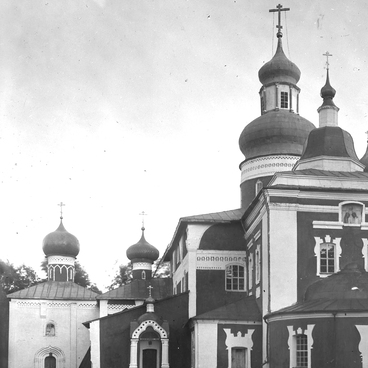
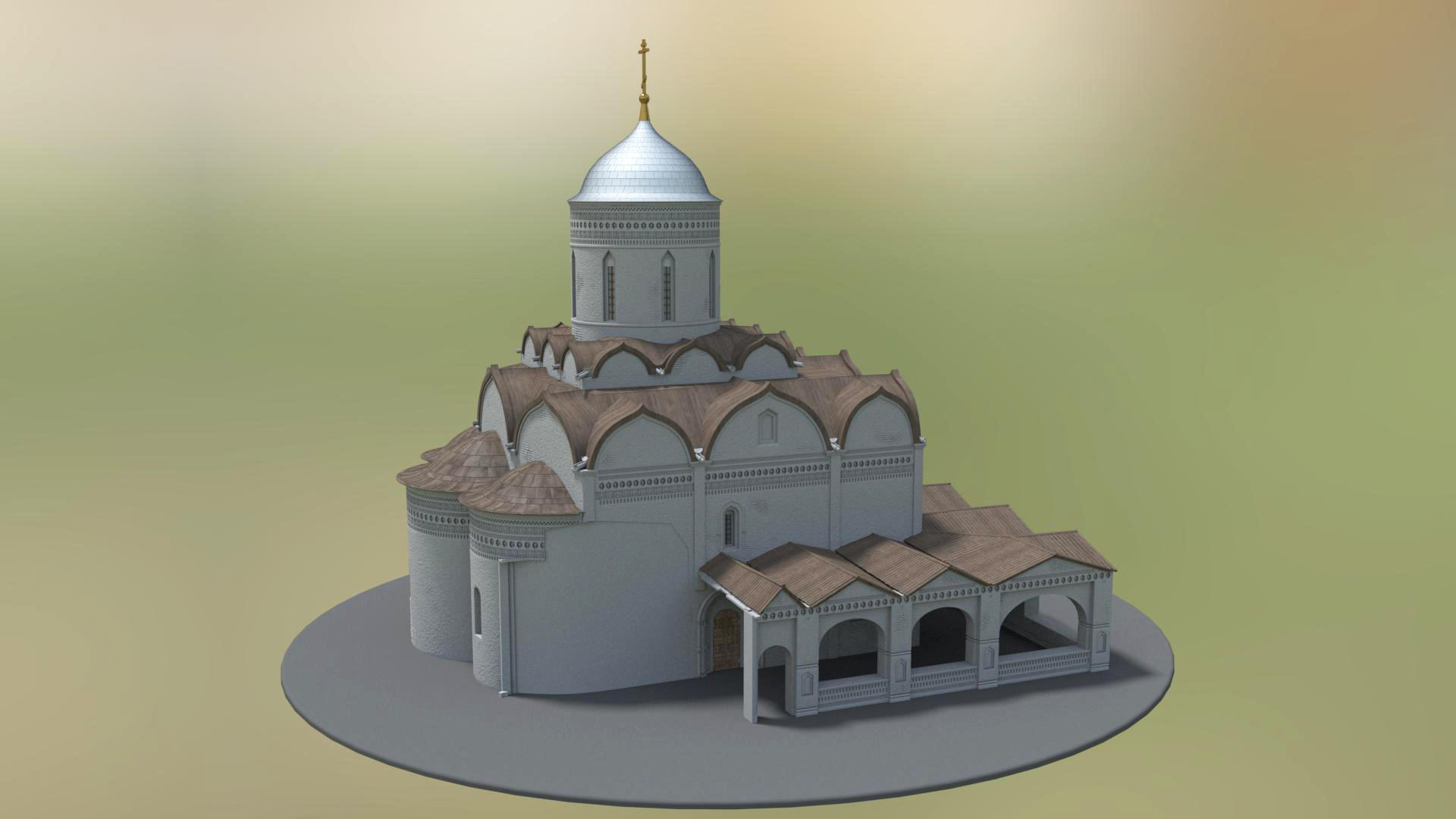
The monastery began building its first stone cathedral by 1496. Surviving documents state that the construction lasted 5 months and cost 250 rubles (at that time the cost of a good war-horse was 20 rubles and the salary of a servant of the monastery – 2-3 rubles per year). When completed the Dormition Cathedral of the Kirillo-Belozersky Monastery became one of the first stone buildings in the North of Russia. The only stone buildings dated earlier were the Cathedral of the Transfiguration (Spaso-Preobrazhensky Sobor) in the Kamenny Monastery (Spaso-Kamenny) on the Kubensky lake and the Cathedral of the Nativity of the Virgin (Rozhdestva Bogoroditsy) in the Ferapontov Convent (Ferapontov).
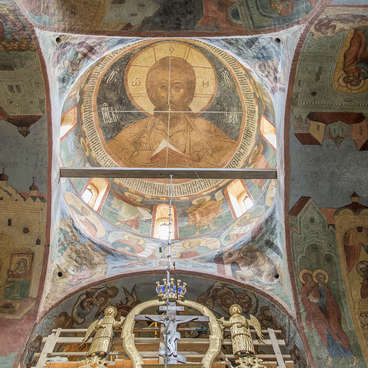
The Cathedral was well built, decorated and furnished and hardly inferior to the churches of Moscow of that time. At this same time, they erected in the Cathedral its four-tier iconostasis, at the time one of the largest in Northern Rus (as Russia was called then) and largely preserved to present day – excepting two icons. In 1641, the frescos still found on the walls today were painted. Eye-witness accounts and the monastery’s inventory documents confirm the magnificence of the Cathedral of the Kirillo-Belozersk monastery. They mention, for example, sacred images protected by jeweled coverings, and on the walls and pillars of the Cathedral icons in beautiful cases. Complementing this were works of gold embroidery, carvings, and sacred vessels, all lit by six splendid chandeliers.
Many of the items that decorated the interior of the Dormition Cathedral (Uspensky Sobor) came to the monastery as gifts from representatives of noble aristocratic families. Great Moscow princes, and later sovereigns, noble princely and boyar families were frequent guests of the monastery and generously donated money and sacred vessels to the monastery. Among these visitors are counted such guests as Tsar Ivan the terrible and his wife, Anastasia Romanovna, the representatives of the princely family Staritsa, and the boyar families: Sheremetev, Odoyev, and others. Our museum displays the royal gates (the main “door” found in any iconostasis) given to the Monastery in 1645 by the first Romanov Tsar, Mikhail Fedorovich Romanov (Michael I). Among other contributions, embroidered veils, created in the Grand Duke’s workshops and donated to the monastery by the Tsaritsas (queens), Maria Nagi and Maria Miloslavskaya. Also shown are the silver lamps and the altar cross ‒ gifts of the Royal steward Ivan Olferyev.
By the end of the 15th century, the Monastery had also become a place of exile, and thus many representatives of the Russian medieval nobility came to the monastery against their will. However, they helped to build and furnish churches. Among them are the Vorotynsky Princes, a friend, and adviser to Tsar Ivan the terrible - Silvester, Tsar Semeon Bekbulatovich, Metropolitan of Moscow - Joasaphus Skripitsyn, and many others. In addition, some notable pilgrims of the Monastery were granted their wish of being buried here.
Since the 1970s there have been periodic archaeological digs which have greatly expand our knowledge of the history of the Cathedral. The most significant digs were undertaken in 2010-2012, directly prior to the large-scale restoration of the entire Cathedral complex.
These digs uncovered the nature and history of the Cathedral’s floor. Among layers of debris, the archaeologists found fragments of floor slabs dating from the middle of the 19th century, and even earlier traces of the floor dating from the 17th to 18th centuries, as well as a brick-paved “black” floor of the 17th century. Experts also found the remains of the previously standing wall of the western portico dating from the 16th century and of the ancient portico - the original entrance to the Cathedral. They also discovered intentional change to the landscape of the shore of lake Siverskoe in the 14th to 15th centuries and subsequent changes.
The discovery of wooden fragments of both the foundations of the original wooden cathedrals and of a structure that once covered the grave of St. Cyril - the founder of the monastery. The earliest of these finds date back to the 15th century. Closer examination of the grave of St. Cyril of Beloozero showed that this wooden construction over his grave preceded the first stone Cathedral by a full century.
The hagiography of St. Cyril in a section about a miracle entitled, “Of a woman who had a blind eye” contains the following lines: “Having come to the monastery, the woman who had a blind eye, after morning prayers went to the tomb, where the tomb of St. Cyril, and began to pray with tears.” During the excavations, archaeologists discovered traces of that tomb – a wooden structure erected over the grave of the monk. In addition, the exact boundaries of the burial of the founder of the Monastery were established. Due to this work, the Monastery was able to build a gilded reliquary over the final resting place of St. Cyril.
The Dormition Cathedral (Uspensky Sobor) and its adjoining churches were considered an honorable burial place not only for Church figures but also for secular ones. In the course of the archaeological work, numerous graves of men dating from the 15th to 19th centuries were unearthed. The most ancient of them appeared before the construction of the first stone Cathedral of the Monastery. Burials are concentrated in the altar section of the Cathedral and its southern wall, not far from the burial place of St. Cyril of Beloozero. Among the oldest graves uncovered was a unique collective burial of five people. It is located in the Cathedral’s central apse near St. Cyril’s grave. This burial confirms parts of St. Cyril’s hagiography that tells about the death of a significant part of the monks from an epidemic not long after St. Cyril’s death. All the buried tombs of the 15th century were made from hollowed wooden logs and in some cases wrapped with birch bark. Some of the discovered log-tombs were so well preserved that they could be raised to the surface for preservation. Later burials were made in sarcophagi or coffins, and often placed in brick crypts, which quickened their decay.
In the Church of Saint Prince Vladimir, the tombs of the Vorotynskiy princes were uncovered during archaeological research in 2010. These burials dated from the 16th to 17th centuries. Burial directly in the earth was found side by side with brick crypts and sarcophagi. The cover of the sarcophagus of Prince Alexey Ivanovich Vorotynskiy is currently stored in the Church of Saint Prince Vladimir. The remains of the princely family were temporarily removed from the graves and sent to the Laboratory of Anthropological Reconstruction of the Institute of Ethnology and Anthropology of the Russian Academy of Sciences for facial reconstruction and DNA-analysis to clarify the exhumed bodies genealogical ties. After completing this research the bodies were returned to their original crypts.
In addition to the Vorotynskiy princes, near the northern wall of the Dormition Cathedral, many famous clergy and churchmen of the 18th century found there their final resting place.
Among those buried in a wooden coffin and then placed in a brick tomb, is the body of the Bishop of Penza Ambrosius Ornatsky. He was born in the Cherepovets district in 1778, in 1792 he graduated from the Kirillo-Belozersk theological school, then studied at the Alexander Nevsky Theological Seminary. He is famous as a historian of the Russian Orthodox Church, the author of the seven-volume work “History of the Russian hierarchy” and as one of the most enlightened people of his time. On January 11, 1825, at the age of 46, Bishop Ambrosius submitted his resignation and requested “permission to live in the Kirillo-Belozersky Monastery”, where he died three years later and was buried in the Dormition Cathedral. In the western annex of the Dormition Cathedral, to the right of the entrance, a plaque mounted to the wall tells of Father Ambrosius’s final resting place.
The first church was built of wood and stood right where the stone Dormition Cathedral (Uspensky Sobor) currently stands. As time passed, however, the first wooden Cathedral began to decay and it could no longer accommodate all the monks. In 1436 the monks erected a second and much larger wooden cathedral. The new church was built with the money of the noble family – Zechariah, ancestors of the Romanov dynasty. Unfortunately, a fire in the monastery in the second half of the 15th century destroyed this cathedral.
The monastery began building its first stone cathedral by 1496. Surviving documents state that the construction lasted 5 months and cost 250 rubles (at that time the cost of a good war-horse was 20 rubles and the salary of a servant of the monastery – 2-3 rubles per year). When completed the Dormition Cathedral of the Kirillo-Belozersky Monastery became one of the first stone buildings in the North of Russia. The only stone buildings dated earlier were the Cathedral of the Transfiguration (Spaso-Preobrazhensky Sobor) in the Kamenny Monastery (Spaso-Kamenny) on the Kubensky lake and the Cathedral of the Nativity of the Virgin (Rozhdestva Bogoroditsy) in the Ferapontov Convent (Ferapontov).
The Cathedral was well built, decorated and furnished and hardly inferior to the churches of Moscow of that time. At this same time, they erected in the Cathedral its four-tier iconostasis, at the time one of the largest in Northern Rus (as Russia was called then) and largely preserved to present day – excepting two icons. In 1641, the frescos still found on the walls today were painted. Eye-witness accounts and the monastery’s inventory documents confirm the magnificence of the Cathedral of the Kirillo-Belozersk monastery. They mention, for example, sacred images protected by jeweled coverings, and on the walls and pillars of the Cathedral icons in beautiful cases. Complementing this were works of gold embroidery, carvings, and sacred vessels, all lit by six splendid chandeliers.
Many of the items that decorated the interior of the Dormition Cathedral (Uspensky Sobor) came to the monastery as gifts from representatives of noble aristocratic families. Great Moscow princes, and later sovereigns, noble princely and boyar families were frequent guests of the monastery and generously donated money and sacred vessels to the monastery. Among these visitors are counted such guests as Tsar Ivan the terrible and his wife, Anastasia Romanovna, the representatives of the princely family Staritsa, and the boyar families: Sheremetev, Odoyev, and others. Our museum displays the royal gates (the main “door” found in any iconostasis) given to the Monastery in 1645 by the first Romanov Tsar, Mikhail Fedorovich Romanov (Michael I). Among other contributions, embroidered veils, created in the Grand Duke’s workshops and donated to the monastery by the Tsaritsas (queens), Maria Nagi and Maria Miloslavskaya. Also shown are the silver lamps and the altar cross ‒ gifts of the Royal steward Ivan Olferyev.
By the end of the 15th century, the Monastery had also become a place of exile, and thus many representatives of the Russian medieval nobility came to the monastery against their will. However, they helped to build and furnish churches. Among them are the Vorotynsky Princes, a friend, and adviser to Tsar Ivan the terrible - Silvester, Tsar Semeon Bekbulatovich, Metropolitan of Moscow - Joasaphus Skripitsyn, and many others. In addition, some notable pilgrims of the Monastery were granted their wish of being buried here.
Since the 1970s there have been periodic archaeological digs which have greatly expand our knowledge of the history of the Cathedral. The most significant digs were undertaken in 2010-2012, directly prior to the large-scale restoration of the entire Cathedral complex.
These digs uncovered the nature and history of the Cathedral’s floor. Among layers of debris, the archaeologists found fragments of floor slabs dating from the middle of the 19th century, and even earlier traces of the floor dating from the 17th to 18th centuries, as well as a brick-paved “black” floor of the 17th century. Experts also found the remains of the previously standing wall of the western portico dating from the 16th century and of the ancient portico - the original entrance to the Cathedral. They also discovered intentional change to the landscape of the shore of lake Siverskoe in the 14th to 15th centuries and subsequent changes.
The discovery of wooden fragments of both the foundations of the original wooden cathedrals and of a structure that once covered the grave of St. Cyril - the founder of the monastery. The earliest of these finds date back to the 15th century. Closer examination of the grave of St. Cyril of Beloozero showed that this wooden construction over his grave preceded the first stone Cathedral by a full century.
The hagiography of St. Cyril in a section about a miracle entitled, “Of a woman who had a blind eye” contains the following lines: “Having come to the monastery, the woman who had a blind eye, after morning prayers went to the tomb, where the tomb of St. Cyril, and began to pray with tears.” During the excavations, archaeologists discovered traces of that tomb – a wooden structure erected over the grave of the monk. In addition, the exact boundaries of the burial of the founder of the Monastery were established. Due to this work, the Monastery was able to build a gilded reliquary over the final resting place of St. Cyril.
The Dormition Cathedral (Uspensky Sobor) and its adjoining churches were considered an honorable burial place not only for Church figures but also for secular ones. In the course of the archaeological work, numerous graves of men dating from the 15th to 19th centuries were unearthed. The most ancient of them appeared before the construction of the first stone Cathedral of the Monastery. Burials are concentrated in the altar section of the Cathedral and its southern wall, not far from the burial place of St. Cyril of Beloozero. Among the oldest graves uncovered was a unique collective burial of five people. It is located in the Cathedral’s central apse near St. Cyril’s grave. This burial confirms parts of St. Cyril’s hagiography that tells about the death of a significant part of the monks from an epidemic not long after St. Cyril’s death. All the buried tombs of the 15th century were made from hollowed wooden logs and in some cases wrapped with birch bark. Some of the discovered log-tombs were so well preserved that they could be raised to the surface for preservation. Later burials were made in sarcophagi or coffins, and often placed in brick crypts, which quickened their decay.
In the Church of Saint Prince Vladimir, the tombs of the Vorotynskiy princes were uncovered during archaeological research in 2010. These burials dated from the 16th to 17th centuries. Burial directly in the earth was found side by side with brick crypts and sarcophagi. The cover of the sarcophagus of Prince Alexey Ivanovich Vorotynskiy is currently stored in the Church of Saint Prince Vladimir. The remains of the princely family were temporarily removed from the graves and sent to the Laboratory of Anthropological Reconstruction of the Institute of Ethnology and Anthropology of the Russian Academy of Sciences for facial reconstruction and DNA-analysis to clarify the exhumed bodies genealogical ties. After completing this research the bodies were returned to their original crypts.
In addition to the Vorotynskiy princes, near the northern wall of the Dormition Cathedral, many famous clergy and churchmen of the 18th century found there their final resting place.
Among those buried in a wooden coffin and then placed in a brick tomb, is the body of the Bishop of Penza Ambrosius Ornatsky. He was born in the Cherepovets district in 1778, in 1792 he graduated from the Kirillo-Belozersk theological school, then studied at the Alexander Nevsky Theological Seminary. He is famous as a historian of the Russian Orthodox Church, the author of the seven-volume work “History of the Russian hierarchy” and as one of the most enlightened people of his time. On January 11, 1825, at the age of 46, Bishop Ambrosius submitted his resignation and requested “permission to live in the Kirillo-Belozersky Monastery”, where he died three years later and was buried in the Dormition Cathedral. In the western annex of the Dormition Cathedral, to the right of the entrance, a plaque mounted to the wall tells of Father Ambrosius’s final resting place.