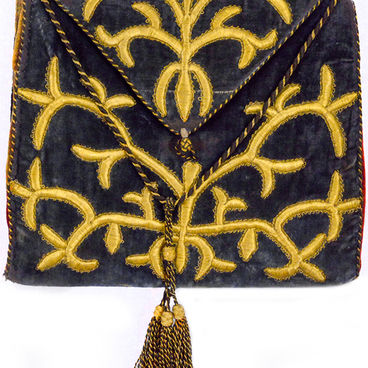
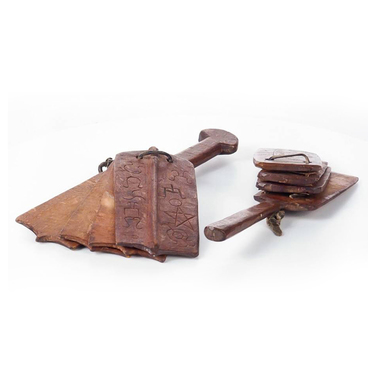
The Tamga is a family identification mark. It used to play the role of the unique family coat-of-arms, and also reflected its social and clan status. Family members were zealous and respectful towards the Tamga. It was descended in the family from generation to generation. The Adyghes carefully stored their Tamgas, trying not to discredit that significant symbol.


#1
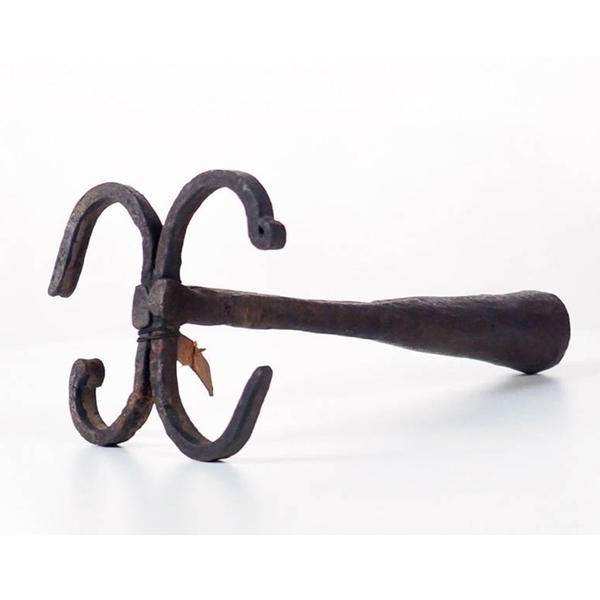
Tamga Branding Tool
#3
#4
The mark could perform most various functions. The Tamga was used to mark household items and livestock, it was embroidered on wedding flags and was carved on tombstones. Those marks helped to quickly find any missing thing, as symbols of various clans were well known not only within one village, but also far beyond.
Most often the Tamga was used to brand livestock. With this purpose, a red-hot iron Tamga was impressed to the body of an animal, mostly on the croup or gaskin. The wound then was sprinkled with salt and, after some time, poured with sour milk. When the eschar fell off, a symbol would become clearly visible.
#5
If the missing livestock were branded with the Tamga, the Adyghe who had found it knew exactly who to bring it to. And according to the tradition, the person who returned animals to the family was in all cases entitled to a reward.
#6
Tamgas were simple and laconic, nonetheless they were sufficiently expressive and individual, so that they could easily be distinguished from one another. At the same time the mark should provide some room for further additions and modifications to be introduced by the descendants of the family. Therefore, the design for the Tamga was a simple geometric figure, most often an angle, a triangle, a square or a circle. Less often, the design used letters from various national alphabets. Also, the pattern could be based on a simplified image of an animal or a bird, a sacred or household item, like a tool or a horse harness.
#7
Scientists believe that the role of the very first of such marks was played by pictograms of totem animals and other symbols that appeared way back during the period of tribal relations. Therefore, many similar figures were used in various territories at various times.
Findings by archeologists provide evidence that the first Tamgas in the North Caucasus appeared as early as in the period of the Sarmatians: an ancient nation that led a nomadic life in the steppe zone of Eurasia from the 3rd century B.C. through around the 3rd century A.D. In the 19t century Tamgas were spread among most Caucasian nations.
#8
The word ‘Tamga’ is of Turkic origin and means ‘seal’, ‘earmark’ and ‘brand iron’. At the time of the Golden Horde, the word acquired a few more meanings, like ‘tax’ and ‘a document under the Khan’s seal’. The Russian word for ‘Customs’ (‘Tamozhnya’) derives exactly form ‘Tamga’.
read morehide
00:00
00:00
1x
Tamga Branding Tool
Creation period
Late 19th century
Technique
Forging (metal)
Exhibition
6
 Point your smartphone camera to open in the app
Open in app
Share