The Resurrection of Christ is the key event of the Gospel. The theme of the resurrection is reflected in various iconographic scenes, such as the appearance of Jesus to the myrrh-bearing women, Thomas the Apostle, and other disciples. However, the composition “Descent into Hell” is perhaps the most common image.
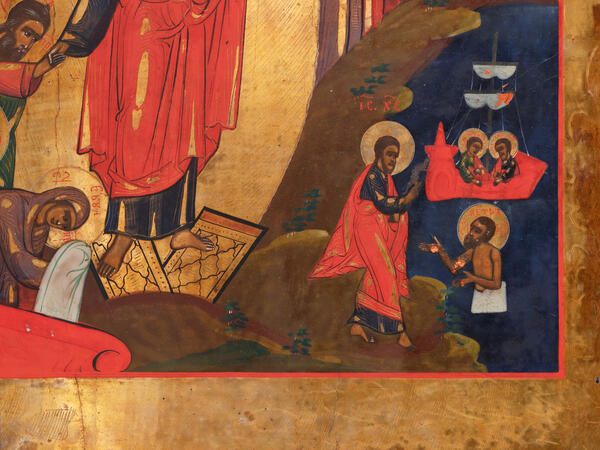
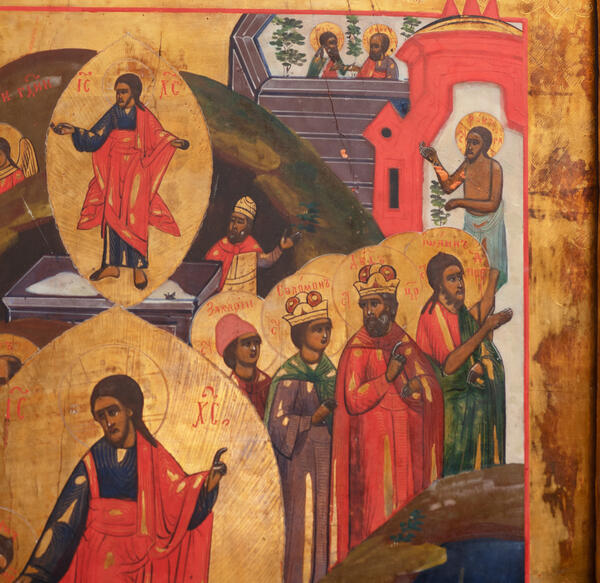
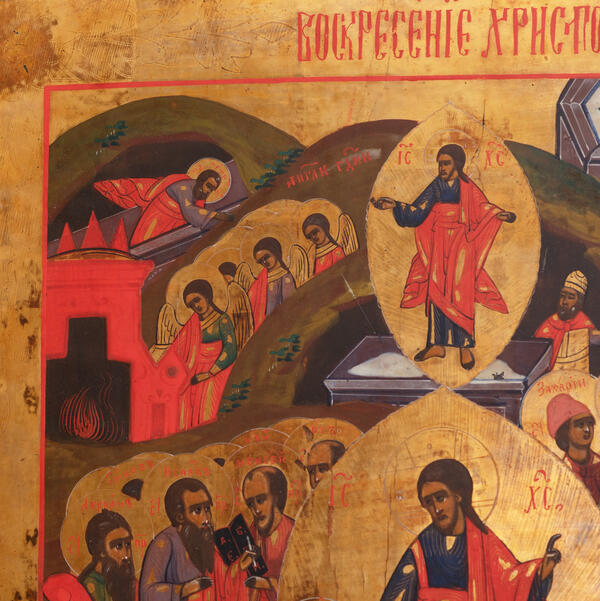
The centerpiece depicts the Resurrection with the Descent into Hell in an expanded iconographic version. It includes a detailed interpretation of the key event and additional scenes. Along the central axis of the composition, Jesus Christ is shown twice, in a golden gloriole, wearing a dark blue chiton and red himation. On top, Christ is seen making a blessing gesture as He rises from the tomb. The scene “Descent into Hell” is shown at the bottom. It occupies most of the icon board and is shown close-up. Jesus Christ stands on the gates of Hades. Raising His left hand, He leads Adam out of hell. Eve kneels before the Savior.
The “Jaws of Hades” are depicted as a great monster with his fiery red mouth open. The faces are painted brown ocher in one layer, with the facial features modeled using black and white paint. The abundant use of red, combined with green, lilac, dark blue, and light blue, gives the icon a festive character. The icon’s wooden case is covered in gold leaf.
The main literary source for the iconography of the Resurrection with the Descent into Hell is the Gospel of Nicodemus. This apocryphal work is attributed to the New Testament’s secret disciple of Jesus, Nicodemus. He was a Pharisee and a member of the Sanhedrin. In Orthodoxy, Nicodemus is venerated as a saint.
The iconography was formed under the influence of a
number of texts, including psalms, prophecies, the Epistles of Peter, and
patristic writings. According to the Gospel of Nicodemus, Jesus Christ “put to
flight all the darkness of death by the splendor of His divinity.” In Byzantine
art, the iconography of the Resurrection with the Descent into Hell developed
by the 10th century. Initially, such compositions appeared in book miniatures
and later were widely used in church painting. It can be considered one of the
most popular iconographic subjects.