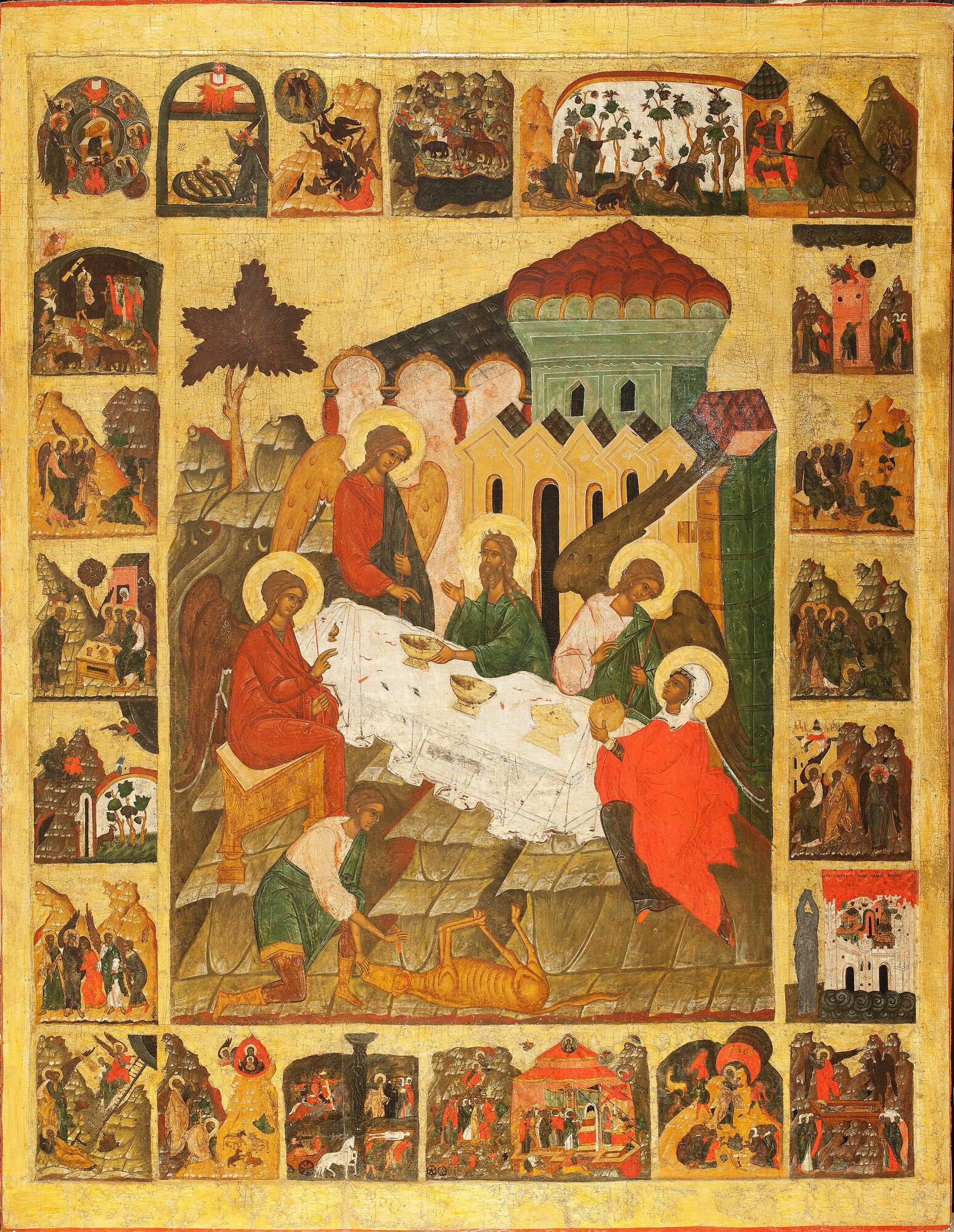


The icon “Old Testament Trinity with the Deeds and the Life of Moses in 22 Border Scenes” was painted in the 16th century. The centerpiece depicts a visit of the Holy Trinity — the Father, the Son, and the Holy Spirit — to Abraham and Sarah. It uses an extremely unusual iconographic version with a diagonal table.
The diagonal composition of the Old Testament Trinity is unparalleled in its narrative capabilities, showing the visit of the Trinity to Abraham’s house in much greater detail. The aspects of the scene, which were implied in icons with pyramidal or isocephalic placement of angels, are depicted elaborately in this icon.
The diagonal placement of the table determined a new composition for the icon. The traditional correlation between the figures of angels and their attributes was changed. Before that, according to the established rules, each of the angels corresponded to one symbol. Behind the middle angel, there was usually the Oak of Mamre interpreted as the tree of life and eternity and according to Christian symbolism as the prototype of the Resurrection; behind the left angel, there were architectural structures — not only the house of Abraham and Sarah but also the sphere of joyful and inspired knowledge; behind the right angel, there was a mountain as a symbol of the power that elevates the soul.
When the images of the angels and their symbols were displaced, all the attributes lost the meaning they had had for centuries. In this icon, the Oak of Mamre is depicted in the upper left corner, among the rock mounds which in this case are not independent symbols but merely the foundation of the oak. The rest of the background is formed by architecture.
Just like in the pyramidal composition, the figure of the central angel is placed above the others but is shifted to the left. The angel sits in an elevated position near the upper corner of the table. Abraham and Sarah were usually depicted standing still before the angels, in front of the table. In this icon, they are participants of the scene: Abraham presents a cup to the middle angel, while Sarah stands on one knee in front of the table and holds out the bread.
While in most icons of
the Old Testament Trinity, the two-fingered blessing gestures of the angels can
be interpreted as part of sacral communication among them, here they indicate
that the angels are blessing Abraham’s house and blessing Sarah to bear a
child. Apart from a new composition, this icon of the Holy Trinity described
the scene from different perspectives and added a temporal development.