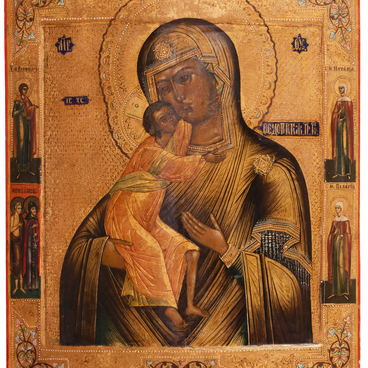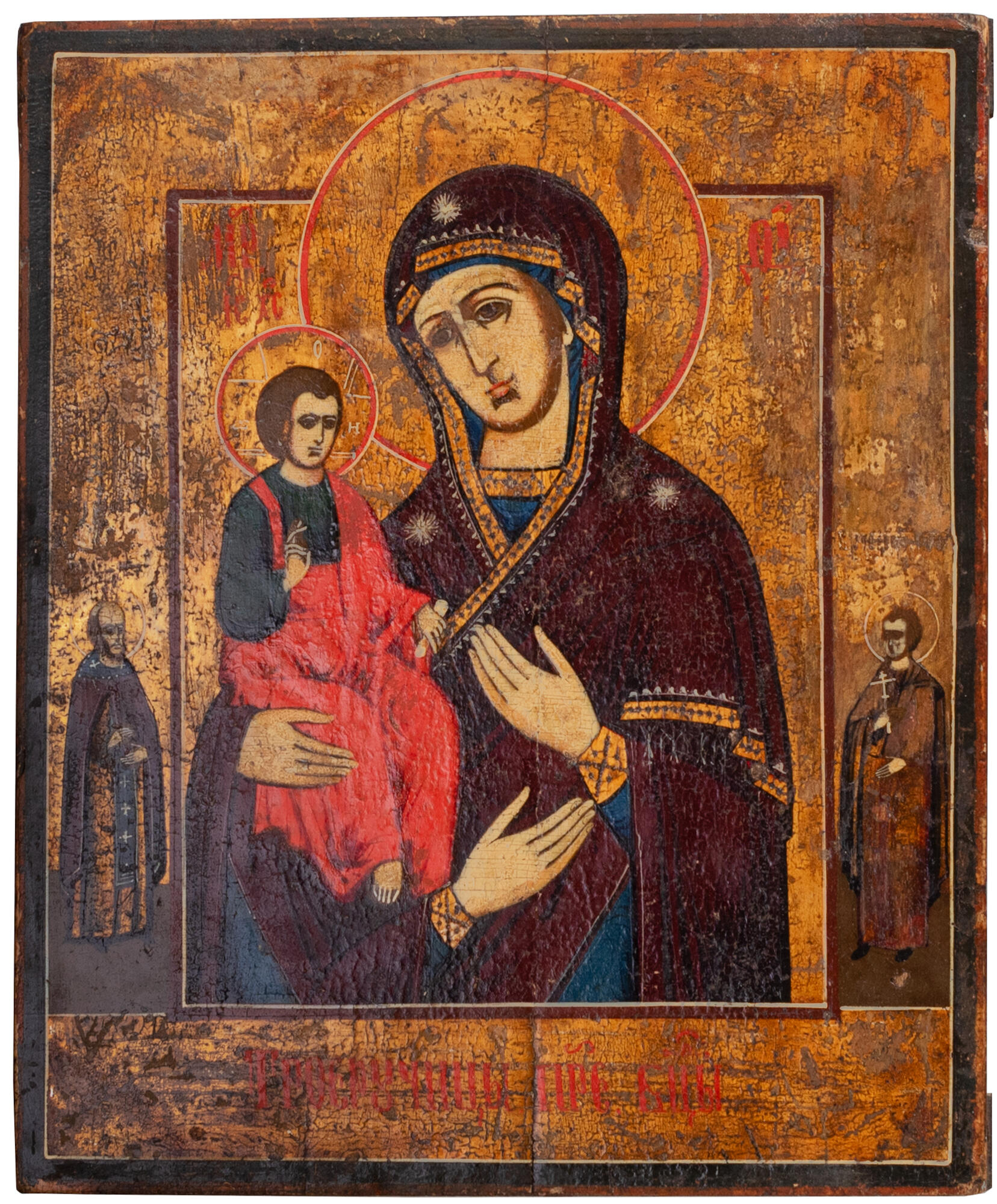


In terms of its iconographic type, Our Lady of Three Hands (known in Russian as “Troeruchitsa”) is a classic Hodegetria, that is the Guide. According to tradition, the very first Hodegetria was painted by Luke the Evangelist, a companion of Paul the Apostle.
Like all the Hodegetrias, Troeruchitsa depicts the Virgin Mary and the Child Jesus sitting on her arm as if on a throne. In its lower part, one can notice a third arm of the Virgin Mary. The Mother of God is dressed in a dark cherry-colored mantle (“maphorion”) with stars on the veil and shoulders and a chiton of dark green color. Jesus Christ is shown in a dark green chiton, with a clavus, a belt, and a red himation.
The glorification of the image of the Virgin Mary with three hands is associated with the name of John Damascene, theologian and hymnographer, creator of pious songs, who lived in the 8th century. According to an early-18th-century manuscript, the icon appeared in Damascus on December 4, 726 to the Monk Father John Damascene, who had been falsely accused of plotting against the Caliph and punished by cutting off his right hand. The severed right hand was hung in the city square for public viewing. While praying before an icon of the Virgin Mary, John fell asleep. The Mother of God appeared to the saint in a vision and “gloriously healed his hand and regenerated it as it was before”. When John Damascene awoke from his sleep, he saw his hand in its entirety at its place, praised the Queen of Heaven, and since then wore the cloth (“ubrusets”), with which his hand had been wrapped, on his head until his death.
In gratitude for the healing, the theologian attached a hand made of silver to the icon of the Virgin Mary. Copies began to be made of the miraculous image, depicting a third hand at the bottom of the icon, which is why the icon was named “Troeruchitsa”.
Another legend about the Troeruchitsa was told by the Athonite Metropolitan Leontius during his visit to Moscow at the end of the 17th century. According to his story, an Athonite icon painter was working on an image of the Virgin Mary, when a third hand miraculously appeared on it. At first, the painter thought it was a joke of the brethren and wanted to erase the third hand, but then he heard a voice that stopped him from doing so.
In Russia, the icon of Troeruchitsa enjoys great
veneration. In 1661, a copy of this icon was sent from the Hilandar Monastery
for the New Jerusalem Monastery, which was erected by order of Patriarch Nikon.